
 English
  Spanish
  Portuguese
  German
  Italian
  Japanese
  French
  Polish
  Russian
  Netherlands
  Hungarian
  Turkish
  Videos
  Thedink Pickleball

Most pickleball serve mistakes don't involve missing the court. They just give your opponent a quiet advantage every single point. Fix these three and start every rally on your terms.
The most damaging pickleball serve mistake you can make isn't hitting it out.
It's serving in a way that looks totally fine but hands your opponent an immediate edge before the rally even starts.
Most players never get feedback on their serve because it lands in. Nobody calls it wrong.But if you're stepping into the court, peeking at your target at the wrong moment, or serving without a real target, you're starting every single point behind.
These fixes come from Better Pickleball on YouTube, where coach CJ Johnson breaks down three serve mistakes that are far more common than players realize, and exactly how to correct each one.
Love pickleball? Then you'll love our free newsletter. We send the latest news, tips, and highlights for free each week.
Why Your Serve Might Be Hurting You Even When It Goes In
A serve that lands in is not automatically a good serve. It just means you avoided the most obvious error.
The real question is whether your serve is giving you a strong starting position for the third shot.
If your body is out of position, your eyes are in the wrong place, or your ball is floating into the center of the service box with no depth, you are handing the returner exactly what they want.These three mistakes are the ones that quietly show up in nearly every recreational game. Fix them and your serve and return game will improve immediately.
Mistake 1: Drifting Into the Court After the Serve
Stepping or drifting into the court after serving puts you in a terrible position for the third shot.
It happens two ways: either your forward momentum carries you in without you noticing, or you simply wander forward out of habit.Here is why it matters. A smart returner is going to hit deep, targeting a spot roughly four feet from the baseline.
If you have already drifted a foot or more inside the baseline, that deep return is now bouncing up behind you.
You have to move backward to reach it. But your third shot, whether it is a drop or a drive, needs your weight moving forward.
Backward momentum and a quality third shot do not coexist.💡
Need some new pickleball gear? Get 20% off select paddles, shoes, and more with code THEDINK at
Midwest Racquet SportsHow Do You Fix the Drift Problem?
The fix is simple and requires zero technical skill. After you serve, actively step or hop at least a foot behind the baseline.
This gives you enough cushion so that even a deep return lands in front of you.Your weight stays moving forward, and you give yourself a real shot at executing a clean third.
This also connects directly to your third shot drop placement because the quality of that shot is heavily influenced by your body position before you hit it.
- After serving, consciously move back behind the baseline
- Stay at least one full foot behind the line before the return arrives
- Do not let forward momentum carry you in, even slightly
- Think of it as a mandatory reset after every serve
Simplifying the Third Shot Drop: Fix These 5 Common Mistakes
The third shot drop becomes consistent when players stop overthinking mechanics and focus on smart positioning and progression
 The Dink PickleballThe Dink Media Team
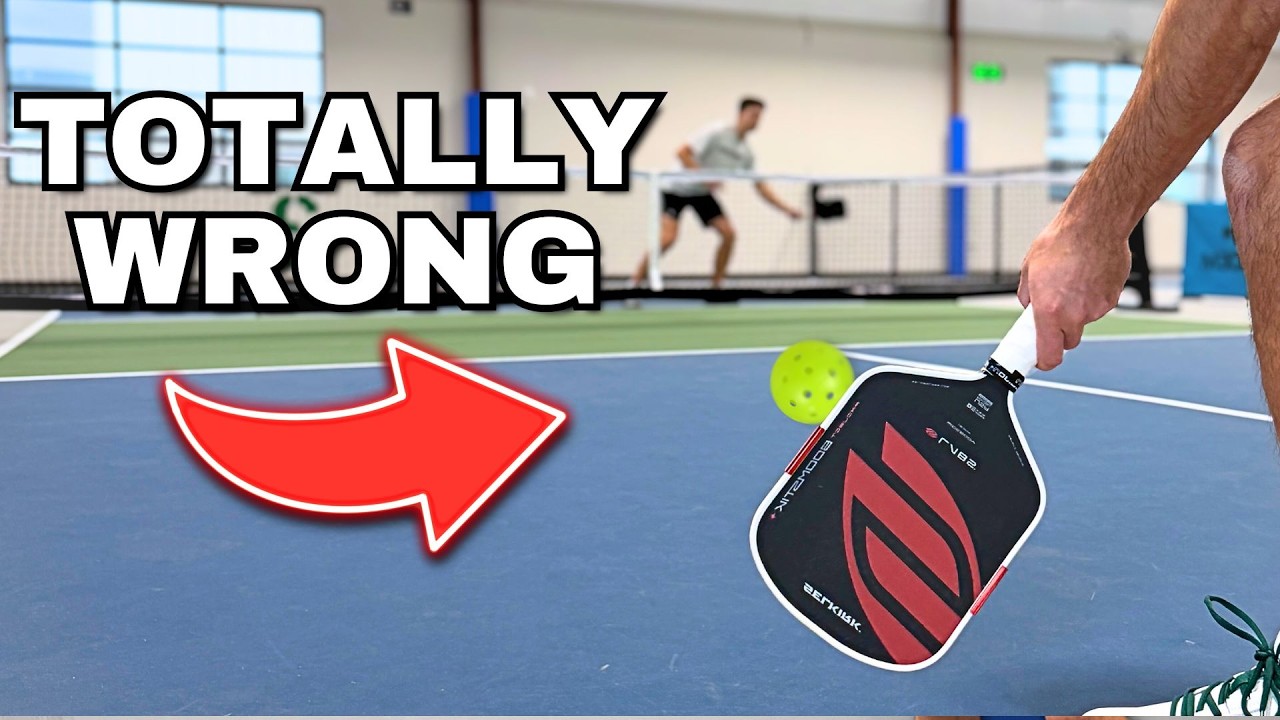
Not watching the ball make contact with the paddle is one of the most common serve errors, and most players have no idea they are doing it.
What happens is this: you look at your target on the ground, you toss the ball, and then you never bring your eyes back to the point of contact.You are guessing where your paddle is going to meet the ball instead of actually watching it happen.
The result is inconsistent contact. Sometimes it goes where you want. Sometimes it does not.
And you cannot diagnose the problem because you never saw what actually happened.
What Should You Actually Be Watching?
Look at your target on the court before the serve. Then bring your eyes back to the ball before you swing.
The more specific cue here is to watch the holes on the ball. Not the ball in general, the actual holes.
When your brain locks onto something that specific, your focus sharpens and your paddle-to-ball contact becomes far more consistent.This is the same principle behind any good contact sport. You do not just watch the ball, you watch a specific point on the ball.
That level of focus is what separates clean contact from mishits.
If you want to build on this kind of attention to detail, the habits covered in these game-level habits apply directly to the serve as well.How to Read Your Opponent’s Eyes and Poach More Balls in Doubles Pickleball
The key to winning many pickleball points isn’t just quick reflexes; it’s reading what your opponent is about to do before they do it
 The Dink PickleballThe Dink Media Team
Mistake 3: Serving Without a Real Target
Serving without a specific target is the most underrated mistake on this list. Just trying to get the ball in the box is not a plan. It is an absence of one.
Your brain needs a specific program to execute a motor skill consistently.
When your only goal is "land it in," your brain has nothing concrete to aim at and the ball ends up going all over the place.Sometimes short, sometimes wide, occasionally long.
You are essentially asking your body to do precise work with vague instructions.
Where Should You Actually Be Aiming on the Serve?
Start with a single default target: four feet from the baseline, in the center of the service box. This target does two things at once.- First, depth. A serve landing four feet from the baseline pushes the returner further back and makes it significantly harder for them to attack the kitchen line on the return. A shallow serve does the opposite.
- Second, safety margin. The center of the box gives you maximum buffer from every line. You are equally protected from going wide on the sideline, wide into the center line, or long past the baseline.
It is the highest-percentage target on the court.
Here is the concern most players raise: if you always aim at the center, won't you become predictable?The honest answer is no. You are not a machine.
Even with a fixed target, natural variation in your serve means the ball will land left, right, short, and deep within a range.
You will not be robotic. You will just be consistently deep, which is the whole point.
Check out this three-step serve system for instant depth if you want a full framework built around this exact concept.
The 4 Essential Pickleball Return Targets to Play Like a Pro
By mastering these targets, you’ll improve your return consistency, put pressure on your opponents, and ultimately win more points.
 The Dink PickleballThe Dink Media Team
The Two-Part Target System That Makes It All Work
Once you have a ground target, add a second layer: a height target over the net.
Connect three points in your mind before you serve: your paddle contact point, the height you want the ball to clear the net, and your landing target on the court.When those three points form a line in your brain, your body has a complete picture of what the shot needs to look like.
This is the same approach covered in five steps for serve power and depth, and it applies whether you are hitting a flat serve or adding spin.
- Step 1: Pick a ground target (four feet from the baseline, center of the box)
- Step 2: Pick a net height target that connects your contact point to the ground target
- Step 3: Watch the holes on the ball at contact, not the landing spot
- Step 4: After the serve, step back behind the baseline before the return arrives
These four steps work together. The target gives your brain a program. The eye focus gives you clean contact.
The footwork gives you a launchpad for the third shot.
How to Target the Weaker Player in Pickleball Doubles
Knowing how to target the weaker player in pickleball doubles is one of the fastest ways to win more matches. This guide breaks down how to identify, exploit, and maintain pressure on the weaker opponent without giving their partner easy angles.
 The Dink PickleballThe Dink Media Team
Why These Mistakes Are So Easy to Miss
None of these three mistakes cause you to fault. That is exactly why they persist.
The ball goes in, you move on, and nobody mentions that you drifted forward or glanced at your target at the wrong moment.
But each one compounds. You drift in and your third shot is harder. You lose eye contact and your serve goes anywhere.
You serve shallow to the wrong spot and the returner attacks your feet on the way to the kitchen.The rally starts at a deficit before you have even touched the ball a second time.
Understanding how your kitchen arrival percentage connects to how well you set up the third shot helps explain why serve positioning matters as much as it does.The serve also affects more than just the third shot.
A deep serve with consistent placement is the foundation of forcing weak returns that make everything after it easier.
If you want to take this further and build a more complete serving game, look at how different serve trajectories can create additional problems for specific returners.
3 Mistakes Killing Your Pickleball Serve Power
Most pickleball players are unknowingly sabotaging their pickleball serve power with three critical mistakes. Fix your shoulders, hips, and ball placement to generate explosive power on every serve.
 The Dink PickleballThe Dink Media Team
Putting It Together
Three small fixes, and every serve you hit becomes a better starting point for the rally.
Stay behind the baseline. Watch the holes on the ball. Pick a real target.None of these require athletic ability or a technical overhaul. They require awareness and repetition.
Start with one per session until it becomes automatic, then add the next.
The serve is the one shot in pickleball where you have complete control. Use it.
The serve return dynamics shift dramatically when your opponent knows your serve is going deep and consistent every time.For players who want to pair a better serve with sharper footwork recovery, the principles in fixing your split step timing apply directly to the transition after the serve.
💡
Heads up: hundreds of thousands of pickleballers read our free newsletter.
Subscribe herefor cutting edge strategy, insider news, pro analysis, the latest product innovations and more.
Frequently Asked Questions
What is the biggest pickleball serve mistake recreational players make?
The biggest pickleball serve mistake is drifting into the court after serving, which forces you to move backward when the return comes deep. This kills your momentum and makes the third shot significantly harder. Stay at least a foot behind the baseline after every serve.
Where should I aim my pickleball serve?
Aim for four feet from the baseline in the center of the service box. This target pushes the returner back and keeps them further from the kitchen line. It also gives you maximum buffer from every out-of-bounds line.
Why does watching the ball on a pickleball serve matter?
Watching the ball, specifically the holes on the ball, gives your brain a precise focal point that leads to more consistent paddle contact. When you glance at the target and never look back, you are guessing at contact rather than seeing it happen. Better contact means more control over where the serve lands.
Is aiming at the center of the service box predictable?
No. Even with a fixed target, natural variation in your swing means the ball will land at slightly different spots each time. You will be consistently deep, which is the actual goal, but not robotically in the same exact spot every serve.
How does my serve position affect my third shot?
If you are inside the baseline when the deep return arrives, you have to move backward to reach it. Your third shot, whether a drop or a drive, needs your weight moving forward to execute cleanly. Starting behind the baseline keeps your momentum going in the right direction for the shot that matters most.
Anuncie Aqui / Advertise Here
Sua marca para o mundo Pickleball! / Your brand for the Pickleball world!



 English (US) ·
  Portuguese (BR) ·