
 English
  Spanish
  Portuguese
  German
  Italian
  Japanese
  French
  Polish
  Russian
  Netherlands
  Hungarian
  Turkish
  Videos
  Thedink Pickleball

If you play against the same 30 or 40 players every week, your pickleball bubble is quietly inflating your skill level. Here are 5 traps keeping you stuck and a four-step plan to find out how good you actually are.
The pickleball bubble is one of the most common reasons players plateau and never figure out why.
You show up every Saturday, beat the same familiar faces, and feel sharp. Your confidence is high. Then you enter a tournament or drive to a new city for open play and suddenly nothing works the way it should.This breakdown is not bad luck. It is what happens when your game is calibrated entirely against one small group.
Pickleball Pick-Apart on YouTube breaks down exactly why this happens and how to get out of it before your rating becomes a complete fiction.
Love pickleball? Then you'll love our free newsletter. We send the latest news, tips, and highlights for free each week.
What Is the Pickleball Bubble?
The pickleball bubble is what forms when you play against the same small pool of players, typically 30 to 40 people, week after week until a closed ecosystem develops with its own fixed hierarchy.
Inside that ecosystem, you start beating players who used to beat you. You feel like you are improving.
In reality, you are getting better at one very specific game against one very specific group.Skill in competitive sports is entirely relative to your environment.
Your local court rank is not a global pickleball rating, and USA Pickleball's official player skill rating definitions describe a standard your Saturday rotation never has to meet.
You are a big fish in a very small pond. The bubble keeps you from ever knowing the difference.
Why Does the Bubble Fool So Many Players?
It works because the feedback loop feels real. You win more. You control rallies.
You read the game well. None of that feels false in the moment.But every single piece of that feedback is built on predictable opponents. Here are the five traps that make the bubble so effective at distorting your self-assessment.
💡
Need some new pickleball gear? Get 20% off select paddles, shoes, and more with code THEDINK at
Midwest Racquet SportsTrap 1: You Are Predicting People, Not Reacting to the Ball
When you have played someone a hundred times, you stop reading their paddle and start reading their habits.
You know your opponent drives every third shot because they cannot hit a third shot drop.
So your paddle is already up, your feet are already set, and you look like a defensive genius.
You are not. You just memorized a person.Put a stranger across the net who can mix a drive, a drop, and a drip shot and that great defense disappears immediately.
You never trained your eyes to read the ball. You trained them to read Dave.
Trap 2: Your Mistakes Are Not Getting Punished
In a bubble, bad habits survive because your opponents cannot execute the punishment.
You pop a ball up. Your friend lacks the footwork or overhead power to finish it, so you recover, win the point, and your brain files that away as a successful play.It was not. It was a gift that a stranger would convert into a ball at your feet ten times out of ten.
This is exactly why certain mistakes never go away for players who only train in closed groups.
The bubble masks your technical flaws by refusing to punish them, and your pickleball rating keeps climbing anyway.
Understanding the Pickleball Plateau and How to Break Through It
You can work hard all day, but without the right guidance to take you from where you are to where you want to be, you’ll keep spinning your wheels.
 The Dink PickleballThe Dink Media Team

Trap 3: Your Whole Group Plays the Same Pace
Closed groups unconsciously negotiate a shared rhythm over time.
If nobody in your regular rotation plays a soft game, everyone defaults to a predictable pace and tempo.
You all feel evenly matched. Then an outside player introduces a soft reset game and the entire group collapses.Nobody knows how to handle pace they have never seen before.
If you want to understand how dangerous a controlled pace can be, read more about slowing the game down without hitting harder.
That skill is invisible inside a bubble of bangers.
Trap 4: You Cannot Read Strangers Quickly
Against unfamiliar opponents, you have to identify their strengths and weaknesses within the first few points.
That is a real skill, and it atrophies when you never practice it.
Players inside a bubble are used to already knowing what is coming.
Against strangers, they spend the first game just figuring out what they are dealing with, and by the time they adjust the match is over.This is also where playing up a level gets so uncomfortable.
Everyone at the higher level already knows how to read people fast, so you are a full step behind from the opening rally.
How to Break Through a Pickleball Plateau
Stuck at 4.0 in pickleball? A pickleball plateau is frustrating, but it’s also fixable. Here are three proven strategies to level up your game and start winning again.
 The Dink PickleballThe Dink Media Team
Trap 5: Your DUPR Rating Is Floating in Its Own Universe
If everyone in your group only logs DUPR matches against each other, your pickleball rating climbs in a closed system with no connection to the broader player population.
That population is not standing still, either.
Participation data from the SFIA shows pickleball still adding millions of players a year, which means the field you are being measured against keeps getting deeper.Here is what that looks like in practice.
A team Pickleball Pick-Apart watched at a tournament went 0 and 6 in six games, having come from a smaller community where they considered themselves legitimate 3.5 players.In a large city tournament, they got picked apart.
The team that beat Pickleball Pick-Apart and his partner, both rated just below 4.0 in DUPR, then turned around and pickled that same 3.5 team 11 to nothing.
The pickleball rating gap looked small on paper. On the court, it was a completely different story.
DUPR and AI: Your Rating Just Entered the Intelligence Era
For the entire history of amateur pickleball, the only record of your match was the score and your memory, and memory is a generous narrator. Thanks to AI integration, it’s a whole new dawn.
 The Dink PickleballBen Borton
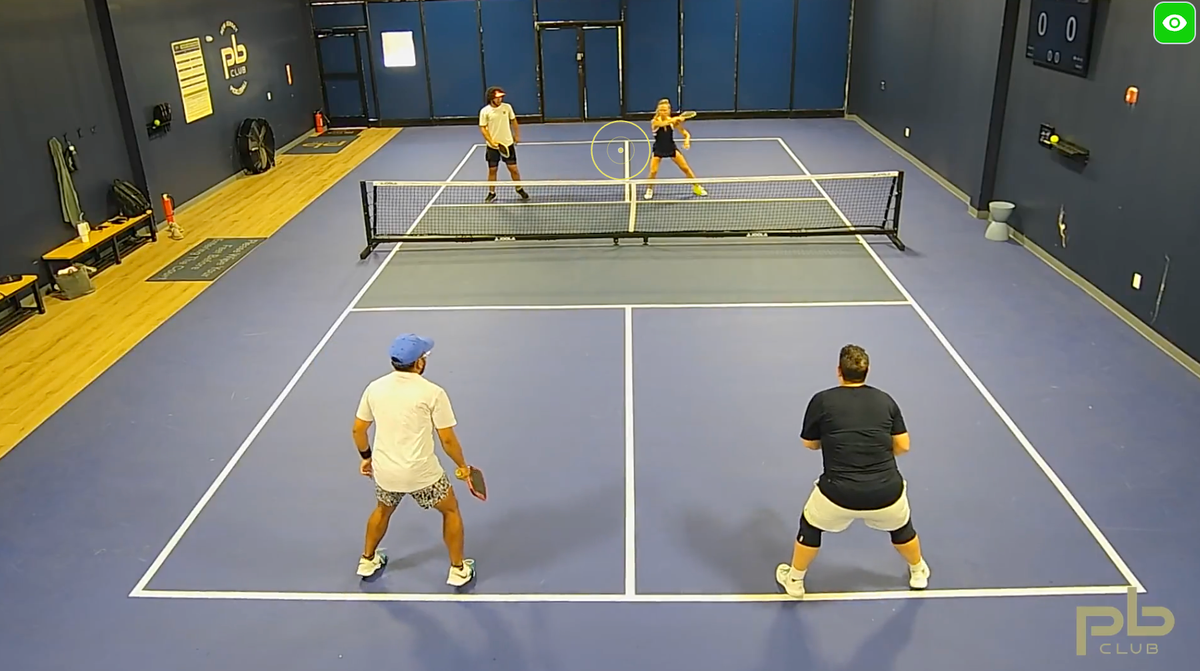
What Happens When a Bubble Player Steps Outside?
It hits in three phases, and they arrive fast.
- Phase one is pace and depth shock. Outside players hit with purpose, their drives carry topspin you are not used to, and their kitchen game is relentless rather than polite. That high popup you get away with at home gets smashed into your shoes before you can reset your feet.
- Phase two is target isolation. Competitive opponents find your weak backhand reset or your poor footwork within two rallies, and they do not stop attacking it. This happens even faster in mixed doubles, where opponents assume the female player is the weaker target and send 80 percent of balls her way. It is not personal. It is strategy. For a deeper look at that dynamic, the breakdown on mixed doubles strategy fixes is worth your time before you ever enter an event.
- Phase three is mental collapse. When your go-to patterns stop working against strangers, frustration sets in fast, and the lob your bubble partners could never track down gets smashed into your face. You realize the shots that made you look like a hero at home make you a liability everywhere else.
If you have already hit that wall, the work on rebuilding pickleball confidence after a loss is a good starting point for getting your head right again.
7 Fixes for the Most Common 3.5 Pickleball Mistakes
Most 3.5 pickleball players make the same seven mistakes without even knowing it. Fix these and your game will look completely different within weeks.
 The Dink PickleballThe Dink Media Team
How Do You Break Out and Fix Your Pickleball Rating?
You do not need to abandon your home court. You need to be deliberate about expanding beyond it.
Here is a four-step plan that works.
- Apply the 80/20 rule. Keep 80 percent of your court time at your local community, and dedicate at least 20 percent, roughly once every two weeks, to a completely new facility where nobody knows your name or your tendencies.
- Seek uncomfortable matchups. Stop queuing up for rotations where you win 11-3 every game and put yourself in games where you are clearly the worst player on the court. Getting exposed is the fastest path to real growth.
- Train your eyes on the ball, not the person. Force yourself to read paddle angle, contact point, and court positioning rather than relying on what you already know about a specific player's habits. This is a trainable skill.
- Test yourself under real pressure. Enter a ladder league, a local tournament, or open play in another city. Nothing strips false assumptions away faster than an official score sheet against strangers, and nothing else gives you a real pickleball rating.
5 Mental Game Habits That Beat Pickleball Pressure
Kate Fahey of the St. Louis Shock breaks down the mental game habits that keep top pros loose when the pressure peaks. Here is how to copy them and stop plateauing.
 The Dink PickleballThe Dink Media Team
Which Technical Gaps Is Your Pickleball Rating Hiding?
Two show up almost every time: a third shot drop that fails under pressure and a reset game that falls apart when pace increases.Both get exposed immediately outside your bubble.
You should also be honest about whether your unforced errors are actually low or just going unpunished, because the bubble makes it nearly impossible to tell which one is true.
If you want a clear picture of what skill looks like at every pickleball skill level from 3.0 to pro, that gap between what you think you are and what you actually need to do gets obvious quickly.Your local court is a great place for community. It is a terrible mirror for your actual game.
The only way to find out how good you really are is to step outside the bubble and let strangers tell you the truth.
💡
Heads up: hundreds of thousands of pickleballers read our free newsletter.
Subscribe herefor cutting edge strategy, insider news, pro analysis, the latest product innovations and more.
Frequently Asked Questions
What is the pickleball bubble and how does it affect your rating?
The pickleball bubble is what forms when you play exclusively against the same small group of players until a closed competitive ecosystem develops. Your DUPR or self-assessed rating floats higher than it should because it is calibrated against that limited pool, not the broader player population. When you step outside that group, the rating gap becomes obvious fast.
How do I know if my DUPR rating is inflated by a bubble?
The clearest sign is that you consistently beat players at your local courts but struggle immediately when you play at open play in a new city or enter a regional tournament. If you have never tested your game against complete strangers in a competitive setting, your rating is likely not accurate. A honest look at how to find your actual level for open play can help you calibrate.
Can playing in a bubble make bad habits worse over time?
Yes, and this is one of the most damaging effects. When your opponents cannot punish your mistakes, your brain registers those mistakes as acceptable plays. The bad habit gets reinforced instead of corrected and it compounds the longer you stay inside the bubble.
What is the fastest way to break out of the pickleball bubble?
Play at a new facility at least once every two weeks against people who have never seen your game before. Enter one competitive event, whether a ladder league or a local tournament, every one to two months. The discomfort of that exposure is the entire point.
Is playing in a bubble okay if I just want to have fun?
Absolutely, the social side of pickleball is one of the best things about the sport. The problem only starts when you confuse that comfortable local ranking with a true measure of your skill level. Enjoy your home court community, but stay honest with yourself about what it does and does not tell you about your game.
Anuncie Aqui / Advertise Here
Sua marca para o mundo Pickleball! / Your brand for the Pickleball world!



 English (US) ·
  Portuguese (BR) ·