
 English
  Spanish
  Portuguese
  German
  Italian
  Japanese
  French
  Polish
  Russian
  Netherlands
  Hungarian
  Turkish
  Videos
  Thedink Pickleball

Competitive doubles strategy 4.0 pickleball is less about hitting harder and more about controlling patterns, court positioning, and forcing opponents into losing situations.
At the 4.0 level, competitive doubles strategy in pickleball shifts from "hit good shots" to "build better patterns."
The players who plateau here have solid mechanics.
What they're missing is a system, a repeatable framework for creating pressure, controlling the court, and forcing errors without relying on pace alone.
This is where doubles gets interesting.
Love pickleball? Then you'll love our free newsletter. We send the latest news, tips, and highlights for free each week.
Why Competitive Doubles Strategy Separates 4.0 from 5.0 Play
The jump from 3.5 to 4.0 is mostly technical. The jump from 4.0 to 4.5+ is almost entirely strategic.
At 4.0, you've got your third shot drop. You can dink cross-court and keep it low. You reset under pressure most of the time.So why aren't you winning more? Because pickleball is full of patterns, and recognizing, building, and disrupting those patterns is the actual game at this level.
The 4.0 ceiling is a pattern recognition problem. Players who break through it aren't suddenly hitting cleaner drops.
They're thinking two shots ahead. They're creating situations, not just responding to them.
Here's the framework that matters: every point in competitive doubles has a sequence, serve, return, transition, NVZ battle.
At 4.0+, you need a deliberate plan for each phase. Improvising the whole point is a 3.5 approach.
Understanding how to change the way you think about doubles is where elite recreational players begin their upgrade.
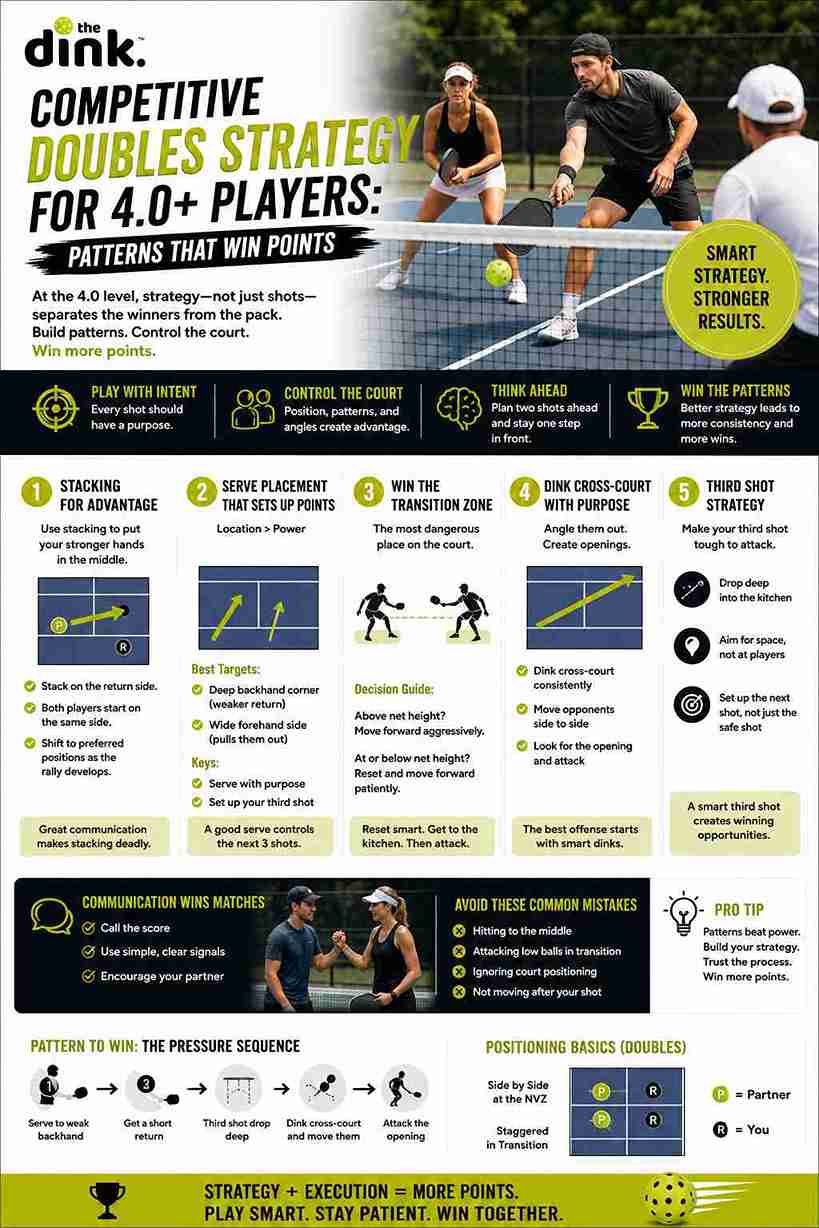
What Is Stacking in Pickleball (and When Should 4.0 Players Use It)?
Stacking is a court positioning system where both players line up on the same side of the court after the serve or return, then shift to their preferred sides as the rally develops.
It's not magic, it's mathematics. You're engineering the court so your stronger hands face the crosscourt angles you need.
Most 4.0 players know what stacking is. Most don't use it consistently because they're afraid to miscommunicate mid-point. That fear is costing them matches.
💡
Need some new pickleball gear? Get 20% off select paddles, shoes, and more with code THEDINK at
Midwest Racquet SportsThe payoff is significant. When a right-handed team stacks so both forehands cover the middle, they eliminate the single biggest exploitable gap in recreational doubles.
The "X" rule for covering the middle becomes manageable with a clear system instead of a guessing game.
Full stacking after every serve is advanced. Start smaller: use a half-stack on the return side only.The returner runs to the preferred side after the return; their partner shifts. Practice it in low-stakes games first.
Staggering your positioning strategically is the stepping stone before a full stacking system.
Doubles Stacking 101: The Fool-Proof Positioning Strategy That Wins Points
Stacking might be the single most underrated positional tool in doubles pickleball – and it’s way simpler than you think
 The Dink PickleballThe Dink Media Team
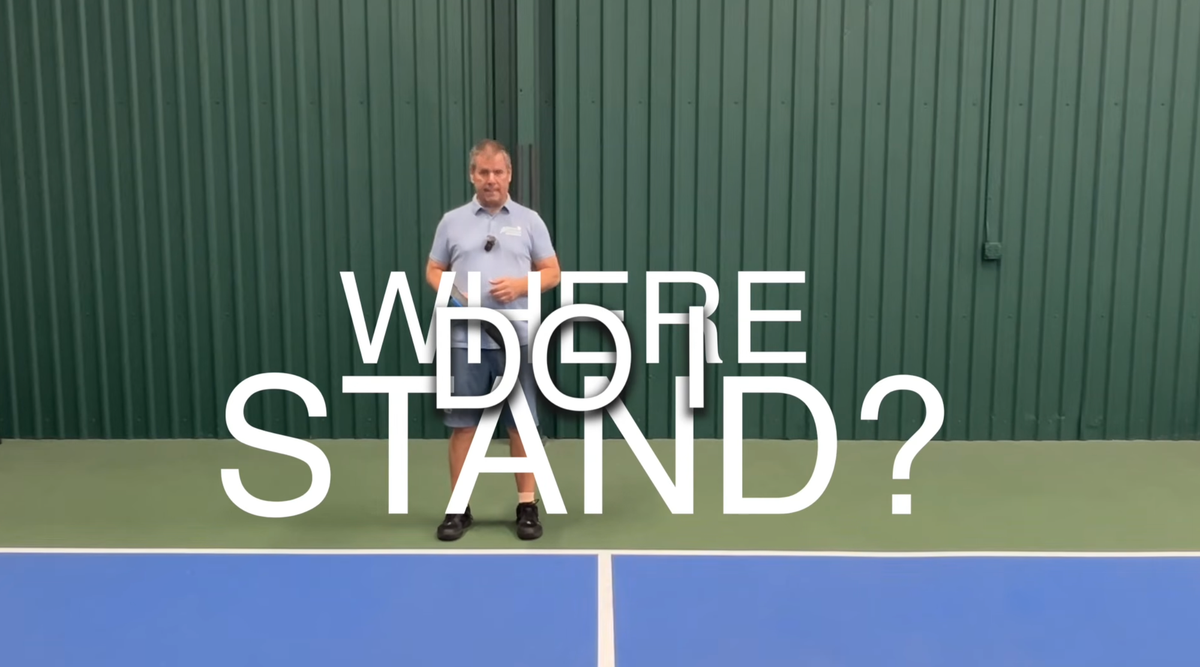
How Does Serve Placement Change Competitive Doubles Strategy at 4.0?
Serve placement drives everything that follows.
A well-placed serve limits return angles, sets up your third shot, and forces your opponent into a defensive return.
Most 4.0 players serve to start the point. Smart 4.0 players serve to build the point.
Weaponizing your serve at 4.0+ isn't about power. It's about location and spin. Two placements win disproportionate points:
- Deep to the backhand corner. Most recreational players have a weaker backhand return. A deep ball to that corner produces a short, floaty return, exactly what you want for a put-away third shot or a poach.
- Wide to the forehand side. This pulls the returner off the court and creates a diagonal return angle your partner can poach.
Neither serve is complicated. Both require intention.
Where your partner returns to matters equally, the serve and return phase is a connected system, not two independent shots.
The drill: pick one placement for an entire practice session. Backhand corner only. Watch what it does to return quality over 30 minutes.
The feedback will be immediate and permanent.
Senior Pickleball Doubles Strategy After 60
Senior pickleball doubles strategy is less about speed and more about positioning, shot selection, and court IQ. Here’s how players over 60 can outthink, and outplay, opponents half their age.
The Dink PickleballThe Dink Media Team
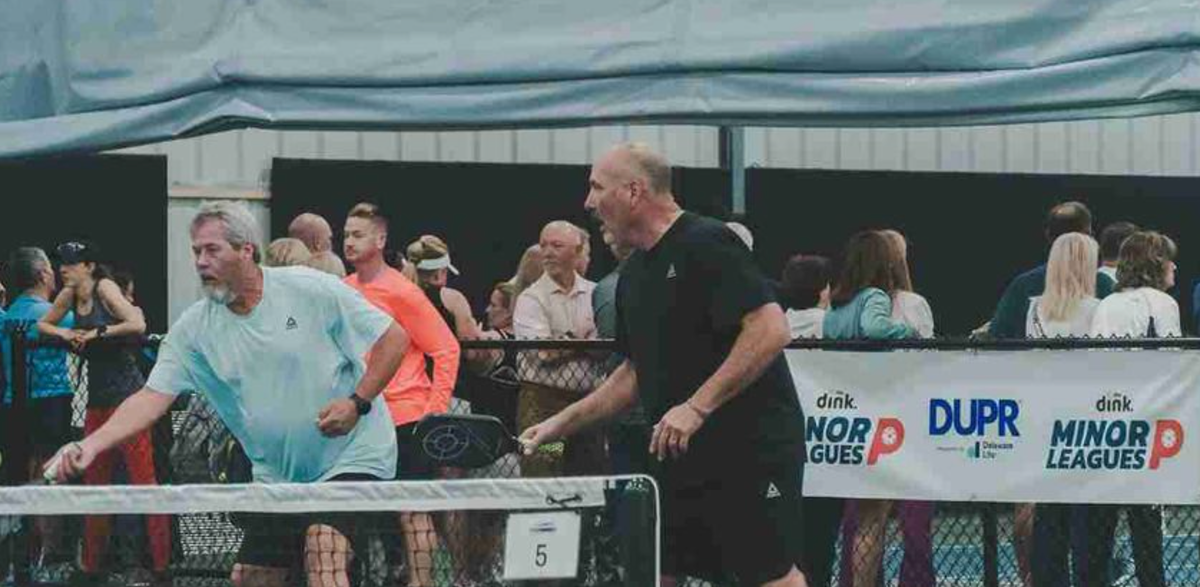
The Transition Zone Problem: Why 4.0 Players Lose Points in the Middle of the Court
This is the phase that separates competitive doubles strategy at 4.0 pickleball from everything below it.
The transition zone is the stretch of court between the baseline and the non-volley zone. It is the most dangerous real estate on the court.
More points are lost in transition than anywhere else, and the mistake is almost always the same: attacking when you should be resetting.
At 4.0+, the mid-court transition phase requires a simple decision framework:
- Ball above the net? Move forward aggressively.
- Ball at or below the net? Reset and move forward patiently.
That's it. The problem is players feel pressure in transition and swing for heroes. A ball that's knee-high with pace on it is not an attacking ball, it's a reset ball.
Learning to reset better is the single highest-ROI skill investment for players stuck at 4.0.
Pair your reset discipline with understanding the back third of the court for those moments when you genuinely can't get to the kitchen safely.
Sometimes the correct play is retreating, resetting from deep, and rebuilding. Forcing the advance when you're out of position is how you give away free points.
Master the Pickleball Transition Zone: Attack or Reset
The best players in the world aren’t just comfortable in the transition zone – they actively use it to their advantage
The Dink PickleballThe Dink Media Team
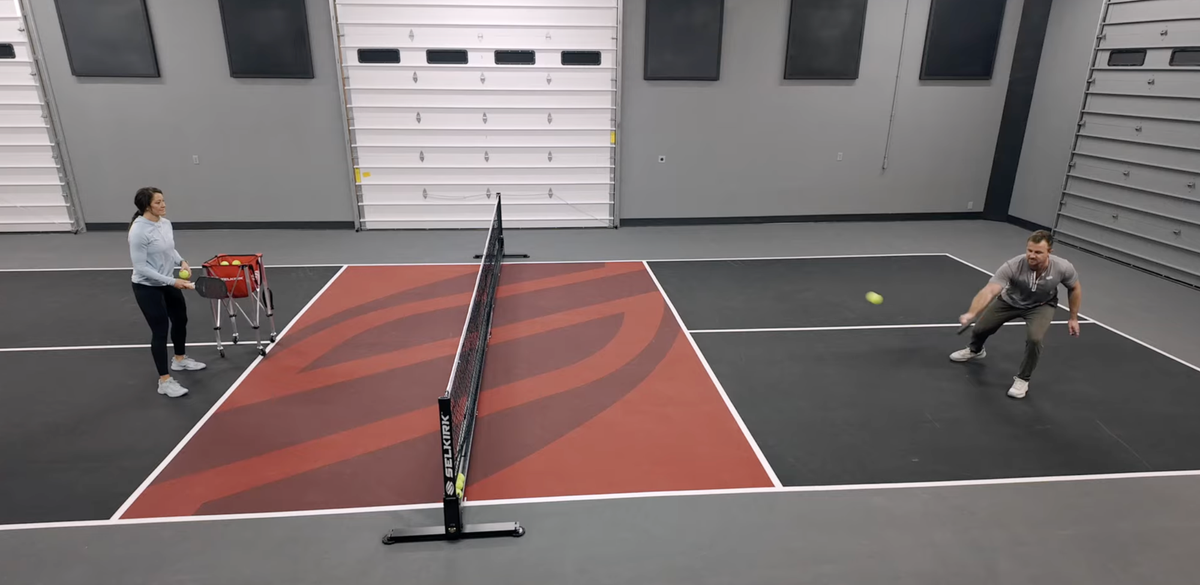
Is Dinking Cross-Court a Passive Strategy or a Weapon?
Short answer: it's a weapon. A slow one, but a weapon.
Cross-court dinking in competitive doubles isn't about keeping the ball in play, it's about angling your opponent out of position.
The geometry is in your favor. A cross-court dink travels over the lowest part of the net, lands in a wider portion of the kitchen, and pulls your opponent sideways.
That sideways movement creates a gap. That gap is your attack opportunity.
Turning mediocre dinks into winners means building a dinking pattern with intent. The slice dink is particularly effective here.
It stays low, skids through the kitchen, and generates a pop-up, the exact response you want before speeding up.
The go-to slice dink deserves a permanent spot in every 4.0+ player's toolkit.
Here's the sequence pros use, adapted for 4.0+ players:
- Dink cross-court 3-5 times, building toward the sideline
- When the opponent moves wide, redirect down the line or to the middle
- When they lift the ball above net height, attack with a speed-up to the hip or shoulder
Understanding the pressure zone inside the dinking exchange tells you exactly when this sequence has created a hittable ball.
Attacking too early gives up the pattern; attacking too late lets your opponent recover.
Timing the speed-up off a positional dink pattern is genuinely competitive doubles strategy.
How to Hit a Crosscourt Dink in Pickleball
The crosscourt dink is one of pickleball’s most versatile shots, and mastering it requires understanding paddle positioning and footwork fundamentals. Learn the exact technique used by top players to control the net and dominate rallies.
The Dink PickleballThe Dink Media Team

How to Use the Poach in 4.0+ Competitive Doubles
A poach is when one partner crosses to intercept a ball intended for the other.
At 4.0+, a well-timed poach is one of the most point-efficient moves in doubles.
It disrupts your opponents' rhythm, creates confusion in their communication, and puts pace on a ball they weren't expecting to be attacked.
The poach works best on predictable cross-court dinks.
When you see your opponent locked into a cross-court pattern, telegraph your poach with eye contact to your partner (not a verbal call, that tips your hand).
Then commit fully. A half-hearted poach is worse than no poach at all because it leaves your partner stranded and creates an open court.
Building simple tips for doubles teamwork with your partner includes defining your poach signals before you play.
A fist behind the back, a foot tap, whatever works consistently. The best doubles teams have two or three set communication cues.
They play chess while everyone else is playing checkers.Your partner's job after a poach is to immediately shift to cover the vacated side.
This is the part that breaks down for most 4.0 teams, the poacher goes, but the partner freezes.
Drill the poach-and-shift sequence specifically. Advanced shot selection in practice drills will build the pattern into muscle memory faster than match play alone.
How to Poach Effectively in Pickleball
Learning how to poach effectively in pickleball is one of the fastest ways to put pressure on your opponents in doubles. This guide breaks down the exact timing, footwork, and signals that turn a hesitant net player into a match-winning weapon.
The Dink PickleballThe Dink Media Team
Competitive Doubles Patterns That Actually Win Points at 4.0+
Theory is useful. Actual patterns are better. Here are three that translate directly to wins at the 4.0 level:
- Pattern 1: Serve Wide, Poach the Return Serve wide to the forehand. Your partner (at the NVZ) watches the return lane. A wide serve produces a crosscourt return, your partner poaches the middle. This works especially well when opponents haven't played together long and their "X" communication breaks down.
- Pattern 2: Third Shot Drop, Crash on the Soft Ball Hit a quality third shot drop. Move forward. If the fourth shot is soft and below net level, reset it, don't flick. If the fourth shot is driveable (ball floats up), rip it at the non-dominant player's hip. Choosing drive versus drop on the fifth shot depends on how well that fourth-shot floated, let contact height make the decision for you.
- Pattern 3: Dink to Backhand, Speed-Up Middle Dink persistently to the weaker player's backhand. Stack enough dinks that they start reaching. On a slightly pop-up dink, drive middle, not at a body, but through the seam between the two players. Making opponents hit difficult shots means exploiting the seam ball at the 4.0 level, where communication about who takes the middle breaks down under pressure.
Playing the percentages in pickleball means using these patterns because they generate errors from opponents, not because they feel flashy.
Winning doubles is about manufacturing situations, not winning individual exchanges on athleticism.
10 Pickleball Doubles Strategy Mistakes Beginners Make
Most pickleball doubles players lose points not because of bad shots, but because of poor positioning, weak communication, and lack of structure. Here are the 10 pickleball doubles strategy mistakes that separate casual players from consistent winners.
The Dink PickleballThe Dink Media Team

Positioning at the Kitchen: Are You and Your Partner Actually Aligned?
Two players at the NVZ need to function as one unit. Most 4.0 pairs drift.
One player gets pulled wide chasing a dink; their partner doesn't adjust; suddenly there's a gap down the middle big enough to drive a truck through.
Positioning yourself correctly at the kitchen isn't just about your feet, it's about maintaining a connected front relative to your partner.
Think of a string attached between your hips. When one player moves left, the other shifts left. The gap between you should stay roughly paddle-length, no wider.
The T and sideline placement strategy is a direct extension of this.
Your goal is to keep balls in front of you, never let them get behind you, and become unattackable in your kitchen positioning by refusing to reach.
If you have to reach, you're already out of position. Adjust your stance before the ball arrives, not after.
Off-Ball Positioning in Pickleball: Stop Ball Watching
Most pickleball players think the point is decided by whoever hits the ball, but at higher levels, off-ball positioning is what actually controls the court. Master this skill and you’ll transform how you play at the net.
The Dink PickleballThe Dink Media Team

Key Takeaways
- Stacking unlocks preferred-hand matchups. Start with a half-stack on the return side.
- Serve wide or deep-backhand with intention, the serve sets up everything that follows.
- Transition zone discipline means reset-first when the ball is low. Attacking low balls in transition is the most common 4.0 unforced error.
- Cross-court dinking is a pattern builder, not a survival tool. Angle your opponents out of position before you attack.
- Poach with commitment and communication. Your partner must shift to cover.
- Three winning patterns: serve-and-poach, drop-and-crash, dink-to-backhand-speed-up-middle.
- NVZ alignment requires constant micro-adjustments between partners. The gap kills you.
💡
Heads up: hundreds of thousands of pickleballers read our free newsletter.
Subscribe herefor cutting edge strategy, insider news, pro analysis, the latest product innovations and more.
Frequently Asked Questions
What makes competitive doubles strategy different at 4.0 pickleball vs. lower levels?
At 4.0 pickleball, competitive doubles strategy focuses on pattern construction, court positioning systems, and deliberate shot sequencing rather than individual shot quality. Players at this level already have working mechanics, the differentiator is understanding how to create pressure through 2-3 shot combinations, exploit positional gaps, and use tools like stacking and the poach to control point structure. Lower levels rely more heavily on winning individual shots; 4.0+ players win through manufactured situations.
How do you cover the middle in competitive doubles pickleball?
The general rule is that the player with the forehand in the middle takes middle balls, but this breaks down without communication. The most effective 4.0+ teams use a pre-agreed system, such as the "X" rule (each player covers their side of the court based on which side the ball came from) combined with a verbal or non-verbal call for ambiguous middle balls. Stacking can simplify this by engineering both forehands toward the middle at the same time.
When should you poach in competitive doubles at 4.0+?
Poach when your opponent is locked into a predictable cross-court dink pattern, when the returning player is out of position, or when you can read the trajectory of a floating return off a wide serve. Always communicate with your partner before the poach, a fist-behind-back or foot tap signal is cleaner than a verbal call that tips your intention. Commit fully once you decide; a half-poach creates more problems than it solves.
What is the best third shot strategy for 4.0 doubles players?
The third shot drop remains the safest high-percentage option, but making your third shot more effective at 4.0+ means varying placement and pace rather than hitting the same drop every time. Aim for the backhand side of the weaker returner or the sideline closest to the player who just returned. A third shot drive is viable when the return is short and sitting up, otherwise, the drop-and-transition approach gives you more time to reach the NVZ.
How do you stop opponents from attacking the middle in doubles pickleball?
Closing the middle gap requires synchronized positioning at the NVZ. Both partners should stay within roughly paddle-length of each other, adjust laterally together as the ball moves, and never let one player reach across the other's side. Pre-agreeing on who takes the middle (forehand rule or verbal call) removes hesitation. You can also use serve and return placement to reduce crosscourt return angles that naturally funnel balls toward the seam.
Anuncie Aqui / Advertise Here
Sua marca para o mundo Pickleball! / Your brand for the Pickleball world!




 English (US) ·
  Portuguese (BR) ·