
 English
  Spanish
  Portuguese
  German
  Italian
  Japanese
  French
  Polish
  Russian
  Netherlands
  Hungarian
  Turkish
  Videos
  Thedink Pickleball

New DUPR data reveals how pickleball ratings are distributed, including what percentile a 3.5, 4.0, 4.5 and 5.0 rating puts you in
For the first time, we have a clear picture of how DUPR ratings are actually distributed. DUPR provided The Dink with previously unpublished data on its doubles ratings, covering global users who recorded a result in the previous 12 months, as of September 2026.
The headline stats speak for themselves:
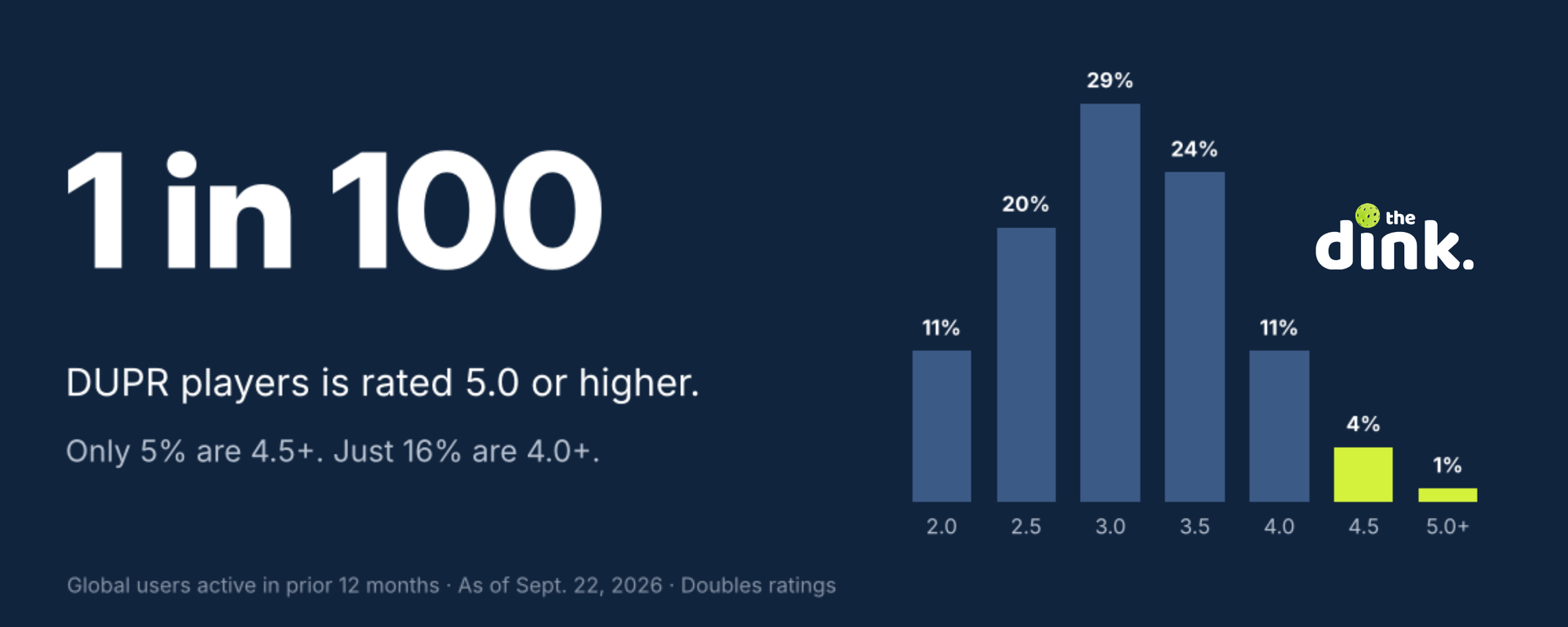
- Only about 1% of those players are rated 5.0 or higher
- Just 5% are 4.5+
- About 16% are 4.0+
And the single most common rating range isn't any of those. It's 3.000 to 3.499, home to 29% of the rated population.
For a sport that spends an extraordinary amount of time arguing about who's really a 4.0, that's useful context. If you're still wondering how DUPR actually works, read this.
The full DUPR doubles distribution
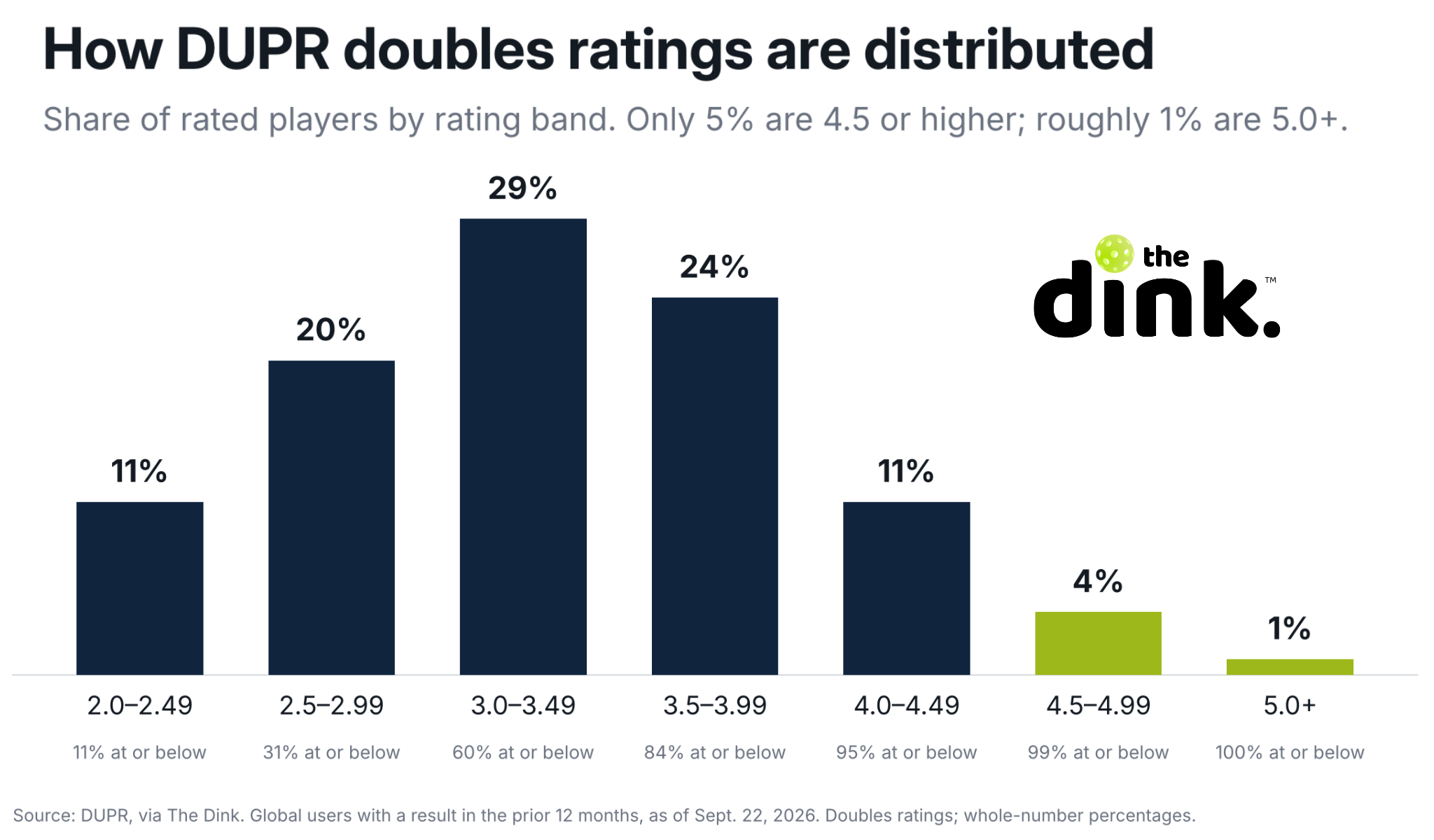
Source: DUPR. Snapshot as of September 22, 2026. Includes global DUPR users with a result in the previous 12 months; doubles ratings only. Percentages were provided by DUPR as whole numbers, so cumulative figures, percentiles and ratios calculated by The Dink are approximate.
DUPR rating percentiles at a glance
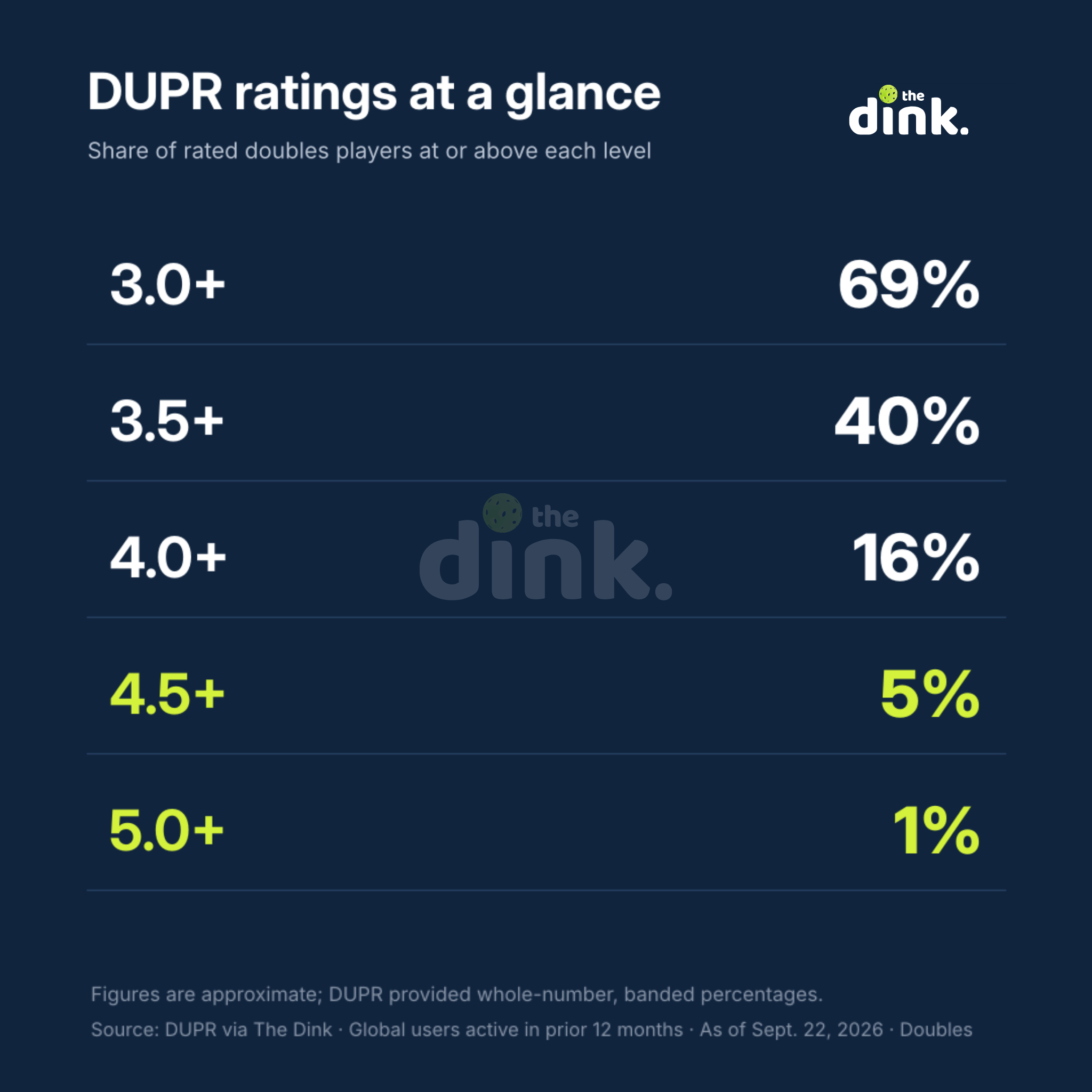
Based on global DUPR users with a result in the previous 12 months, as of September 22, 2026. Doubles ratings. Figures are approximate.
What percentile is your DUPR?
The same data, flipped into the question most players actually care about:
Approximately what share of rated doubles players are below you?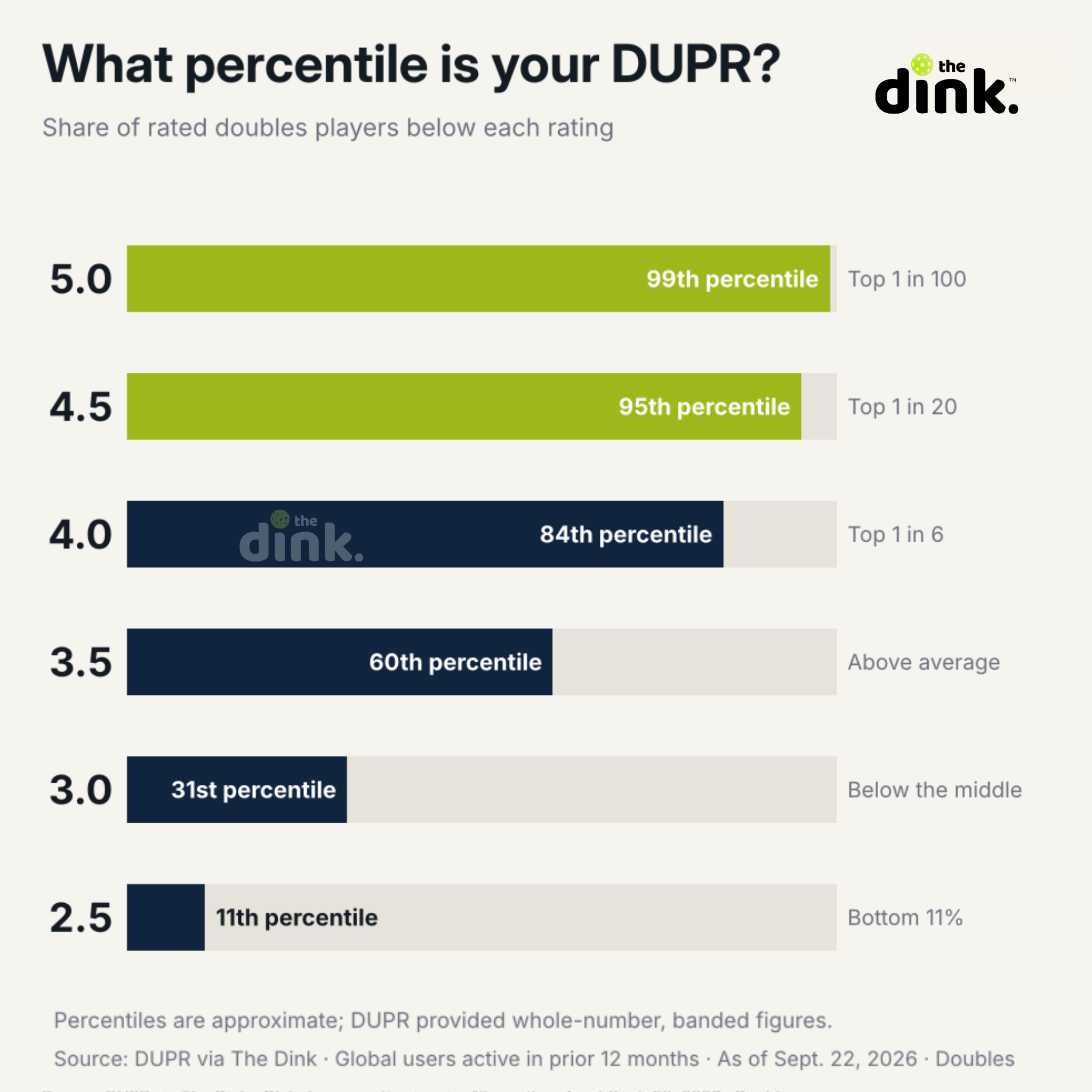
Percentiles are approximate.
What is the average DUPR rating?
The data doesn't give us an exact average, because DUPR provided the distribution in half-point bands rather than individual ratings. What we can identify confidently is the median range.
Thirty-one percent of rated players are below 3.0, and 60% are below 3.5.
That means the 50th-percentile player falls somewhere between 3.000 and 3.499. If players were spread evenly within that band, the median would land around 3.3. We don't have the granular data to know whether they are, so treat 3.3 as a useful estimate, not an official average.
What we know without estimating is arguably more useful: the most common rating band is 3.000–3.499, containing 29% of rated players, and 53% of all rated players fall somewhere in the 3s.
A 4.0 is already well above the middle of the pack
This may be the number that most conflicts with how pickleball feels online. A 4.0 is often discussed as the dividing line between ordinary recreational play and "good" pickleball.
But 84% of rated doubles players haven't reached 4.0.
A player in the mid-3s is far closer to the center of the distribution than a 4.0 is. The next time a conversation makes it sound like everyone at open play is a 4.0, remember: only about one in six actually is.
Curious What Your Pickleball Skill Level Is? The Dink Can Help You Evaluate Your Game
Whether you’re a pickleball newcomer or a seasoned player, understanding the nuances of pickleball ratings is crucial for rec players and tournament junkies alike.
 The Dink PickleballLuke Burton

Ratings thin out fast above 4.0
If you're above 4.0, it's OK to flex a bit.
- 11% of rated players fall between 4.0 and 4.49
- Only 4% fall between 4.5 and 4.99
- Everyone rated 5.0 or higher fits inside roughly 1%
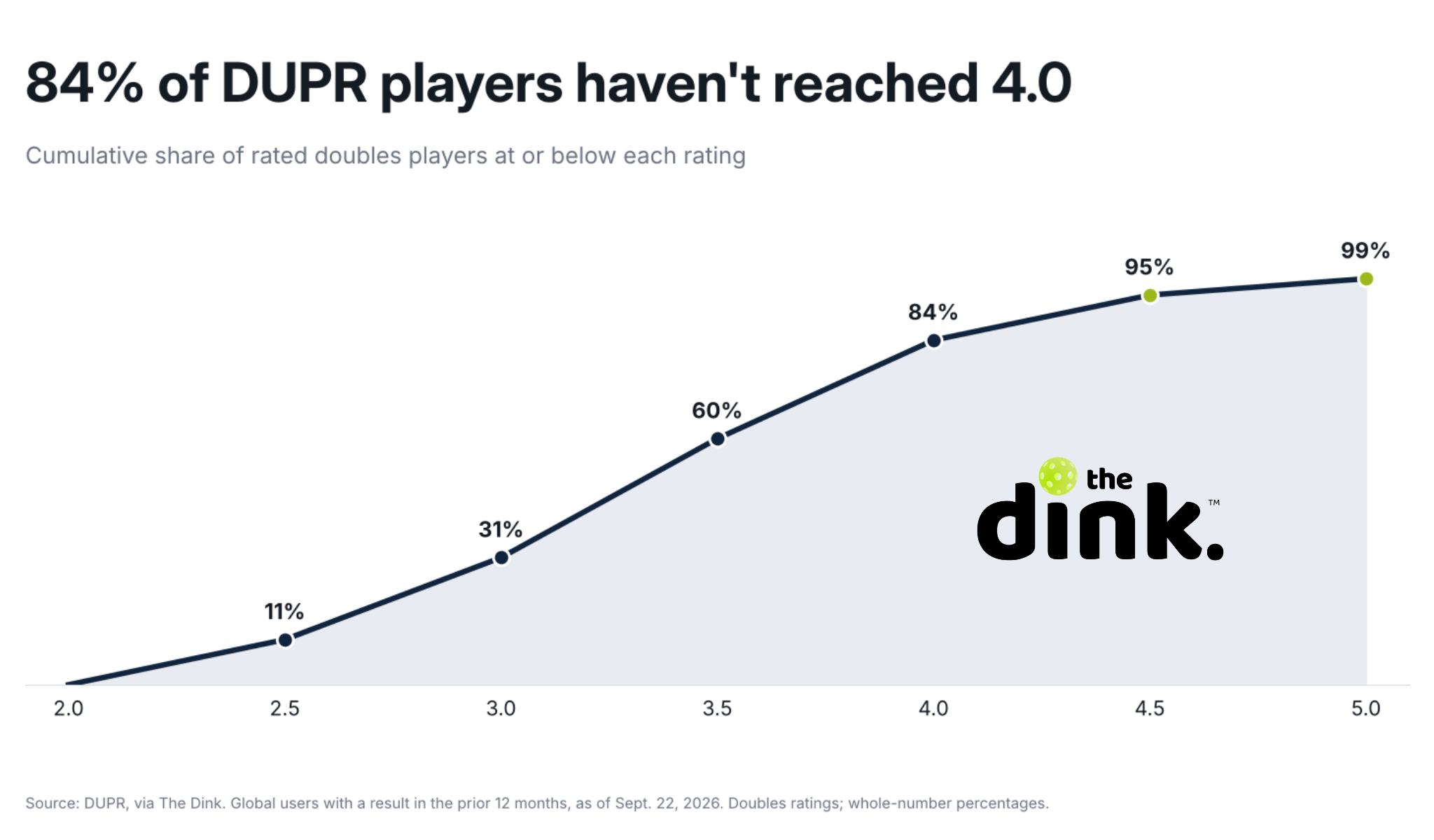
That means the step from 4.0 to 4.5 isn't just another half-point. In population terms, you're moving from a group containing the top 16% of rated players to one containing the top 5%. Then the field narrows again at 5.0, where a rating puts you in approximately the top 1%.
A 5.0 can feel relatively common in certain corners of the sport. Spend enough time at high-level tournaments, advanced open play or facilities frequented by serious players and you may know several. But that's not representative of the broader DUPR population.
Across the global population represented here, roughly 99 out of every 100 players are below 5.0.
Love pickleball? Then you'll love our free newsletter. We send the latest news, tips, and highlights for free each week.
What happens above 5.0? This data doesn't say
DUPR grouped every player rated 5.000 or higher into a single bucket, so this distribution can't tell us what share of players are 5.5+, 6.0+ or beyond.
That distinction matters: the DUPR scale runs from 2.000 to 8.000, and the sport's top professionals occupy the upper reaches of it, so there is substantial territory above 5.0 that this dataset simply doesn't resolve.
It would be tempting to slice that final 1% into estimates for each level above it. We're not going to, because the data doesn't support it. What we can say definitively is that the entire 5.0-and-above population fits inside approximately 1% of rated doubles players.
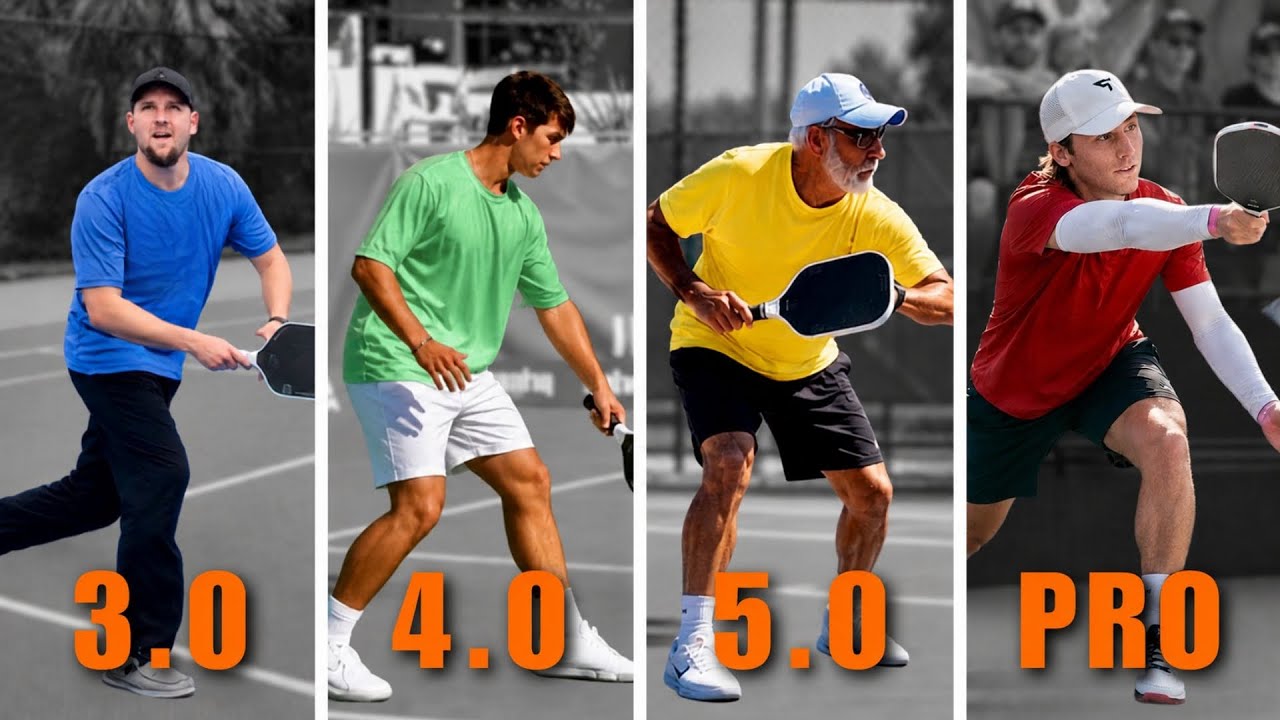
Every Pickleball Skill Level Explained From 3.0 to Pro
Every pickleball skill level from 3.0 to pro has specific markers that separate it from the next. Here is exactly what each DUPR rating means and what it takes to move up.
 The Dink PickleballThe Dink Media Team
What this data does, and doesn't, tell us
This is the distribution of doubles ratings among global DUPR users who recorded a result within the previous 12 months, as of September 22, 2026.
That's a meaningful population: it excludes dormant accounts, so someone who logged two matches three years ago and never opened the app again isn't skewing the numbers. But it is not the skill distribution of everyone who plays pickleball, and it should not be quoted that way.
Specifically:
- Doubles only. DUPR maintains separate singles and doubles ratings; singles are not included here.
- Active, rated players only. Plenty of recreational players don't use DUPR at all, and players who do log matches are likely a more competitive slice of the sport than the whole.
- Ratings vary in reliability. Players differ in how much match data sits behind their rating. DUPR uses a separate Reliability Score to indicate how strongly a player's match history supports their number.
- Whole-number figures. DUPR provided percentages as whole numbers, so ratios like "1 in 100" are approximations, not exact counts.
So the accurate statement is not "1% of all pickleball players are 5.0+." It's that approximately 1% of DUPR-rated doubles players are rated 5.0 or higher. Less sensational, but it's the one that will hold up.
A rating is earned, not declared
One more reason to take the chart seriously: a DUPR rating isn't a self-assigned skill level. Under DUPR's current system, a player's rating moves based on how they perform relative to the result the algorithm expected given everyone on the court. Outperform expectations and your rating can rise; underperform and it can fall. Since DUPR's 2025 algorithm update, that can even mean a rating goes up after a loss or down after a win. Match type, recency and volume factor in as well.
These aren't the levels players say they play at. They're the ratings produced from recorded match results. Which is exactly why the distribution is worth paying attention to.
DUPR Reset Results: How to Find Your New DUPR Rating
After more than two months and 400,000 match results recorded, DUPR Reset ratings can now be found in the DUPR app.
 The Dink PickleballAlex E. Weaver
The numbers worth remembering
If you only keep four figures from this article, keep these:
- 60% of rated doubles players are below 3.5
- 84% are below 4.0
- 95% are below 4.5
- 99% are below 5.0
A 3-something isn't an amateurish outlier; it's where the majority of rated players live.
A 4.0 is meaningfully above the center of the distribution. A 4.5 puts you in a small group. And a 5.0 puts you, by DUPR's own numbers, in roughly the top 1%.
💡
Need some new pickleball gear? Get 20% off select paddles, shoes, and more with code THEDINK at
Midwest Racquet SportsAbout the data
The rating-distribution data in this article was provided to The Dink by DUPR in October 2026 and had not previously been published. It is a snapshot as of September 22, 2026, covering global DUPR users who recorded a result in the previous 12 months, with doubles ratings grouped into the half-point bands shown above. Percentages are displayed as provided by DUPR, as whole numbers; cumulative percentages, percentiles and the estimated median are derived by The Dink from those figures and are approximate.
Heads up: hundreds of thousands of pickleballers read our free newsletter. Subscribe here for cutting edge strategy, insider news, pro analysis, the latest product innovations and more.
Anuncie Aqui / Advertise Here
Sua marca para o mundo Pickleball! / Your brand for the Pickleball world!








 English (US) ·
  Portuguese (BR) ·