
 English
  Spanish
  Portuguese
  German
  Italian
  Japanese
  French
  Polish
  Russian
  Netherlands
  Hungarian
  Turkish
  Videos
  Thedink Pickleball

Knowing when to speed up from the kitchen in pickleball is the difference between earning a point and handing one away. This guide breaks down the exact timing triggers, target zones, and attack patterns 3.5–4.0 players need to start winning more exchanges at the net.
Most players who try to speed up from the kitchen in pickleball do it wrong, not because they lack the arm speed, but because they pull the trigger at the wrong moment and aim at the wrong spot.
The result is a predictable ball right back at them, faster than they sent it.
That's not a power problem. It's a decision problem.
This guide fixes that.
You'll learn the exact contact height that makes a speed-up worth attempting, the two primary target zones that create the most errors, and how to recover when things don't go as planned.
All of it is calibrated for the 3.5–4.0 range, skill levels defined by USA Pickleball's official rating criteria as players who have mastered the basics and are building consistent point-construction at the net.
Love pickleball? Then you'll love our free newsletter. We send the latest news, tips, and highlights for free each week.
What Does "Speed Up From the Kitchen" Actually Mean?
A speed-up from the kitchen is an offensive drive struck from near the non-volley zone (NVZ) line, typically out of the air as a volley, intended to catch your opponent mid-transition or off-balance during a dinking exchange.
It's not a slam. It's not a reset. It's a controlled acceleration designed to disrupt rhythm and force a weak reply.
The NVZ itself is the 7-foot zone on each side of the net where volleying is prohibited, a rule codified in USA Pickleball's official rulebook.
Here's the distinction that matters: a speed-up is not the same as just hitting the ball hard.
A hard ball at the wrong contact point or aimed at the wrong place gives your opponent a gift, a ball they can re-speed or roll back at your feet.
A well-timed speed-up at the right height into the right space is genuinely difficult to handle.
Think of it as the difference between chaos and intention.
Understanding shot selection at the NVZ starts with recognizing that speed-up opportunities aren't created equally.
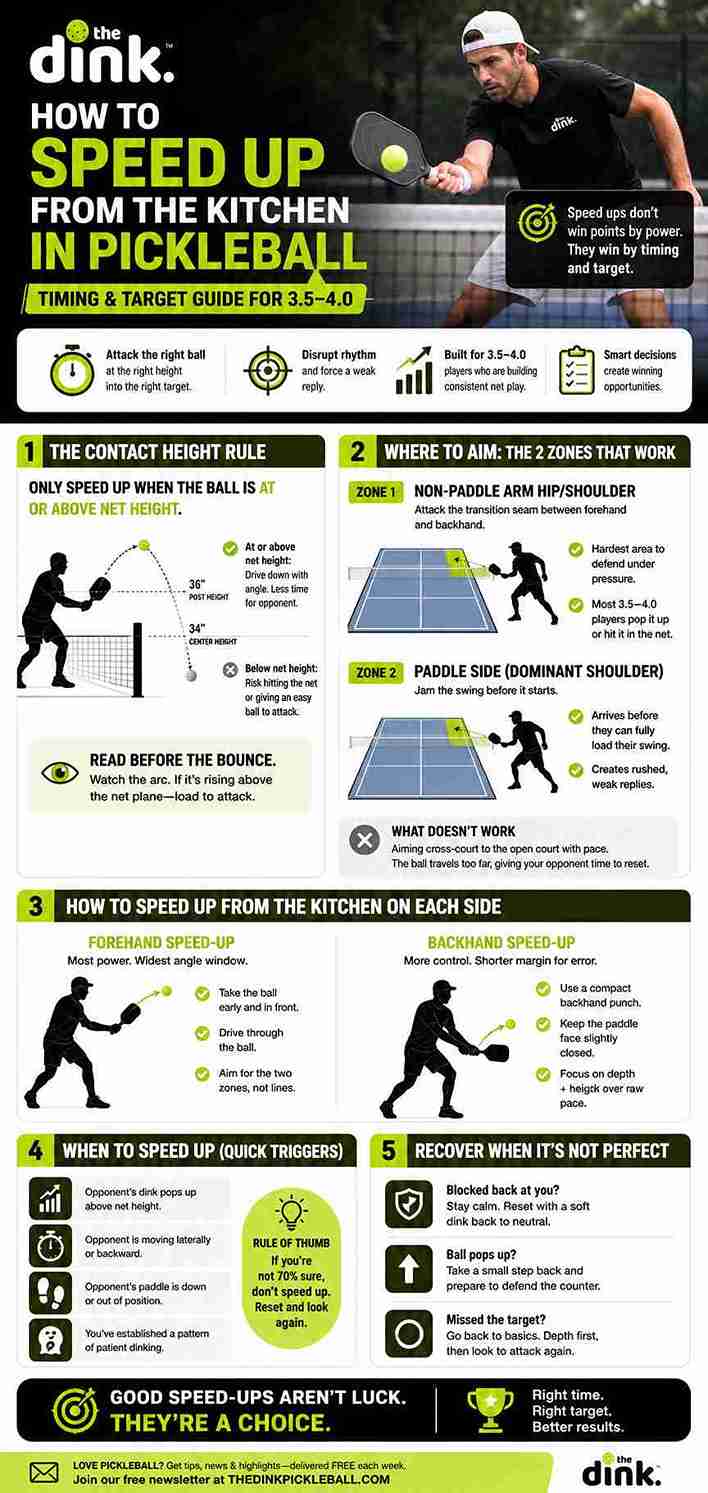
The cleanest rule in pickleball: only speed up when the ball is at or above net height at contact. That's the threshold.
Below the tape, the odds shift hard against you.
For reference, the net sits at 34 inches at the center and 36 inches at the posts, that's a small window, and it matters.
When a dink pops up, floats even slightly above net level, you have a genuine opportunity.
The ball is in your strike zone, you can drive it downward with angle, and your opponent has dramatically less time to react.
Research on visual reaction time in racquet sports shows that athletes typically need 150–250 milliseconds to initiate a response to a fast incoming ball, a window that shrinks fast the closer contact is to the net.
That's the window. Shoulder height at contact is the premium zone: the ball is high, you have full swing leverage, and the angle into the opposing court opens up significantly.
When a dink stays low and skims the net, don't speed up. You'll either clip the tape or pop it up soft enough that your opponent re-attacks off your attack.
That's a rally you lose in two shots.
Here's the practical cue most 3.5–4.0 players miss: read the ball before it bounces, not after.
By the time the ball lands and rises, you've already lost reaction time. Watch the arc off your opponent's paddle.
If it's climbing above the net plane, your body should already be loading to accelerate.
Positioning at the kitchen line directly affects how often you see attackable balls. Stay too far back and you'll contact everything on the way down.
Crowd the line correctly and you intercept balls before they drop.
💡
Need some new pickleball gear? Get 20% off select paddles, shoes, and more with code THEDINK at
Midwest Racquet SportsWhere to Aim: The Two Zones That Actually Work
Knowing when to speed up is half the answer. Where you aim decides whether the shot works.
There are two primary target zones worth knowing:
- Zone 1: The hip/shoulder of the non-paddle arm side. On a right-handed player, that's the left hip. This is the body attack. The ball jams into the transition seam between forehand and backhand, a zone that USA Pickleball certified coaching programs consistently identify as the hardest area for players to defend under time pressure. At the 3.5–4.0 level, most players haven't grooved a reliable body-ball answer. They either block it into the net or pop it up.
- Zone 2: The opponent's dominant shoulder (paddle side). This one surprises people. Hitting into the forehand shoulder seems counterintuitive, but the ball arrives before the player can fully load their swing. You're not giving them an open forehand, you're jamming their swing before it starts.
What doesn't work: aiming cross-court to the open court with pace. That's a driving temptation at 3.5 level.
The ball travels too far, giving your opponent time to reset.
Doubles court placement strategy reinforces this, attacking the body is statistically more effective than trying to win with pure placement at this pace.
Master the Pickleball Transition Zone: Attack or Reset
The best players in the world aren’t just comfortable in the transition zone – they actively use it to their advantage
 The Dink PickleballThe Dink Media Team
How to Speed Up From the Kitchen on Each Side
Does the Backhand Speed-Up Work Differently Than the Forehand?
Yes. And understanding that difference will save you a lot of unforced errors.
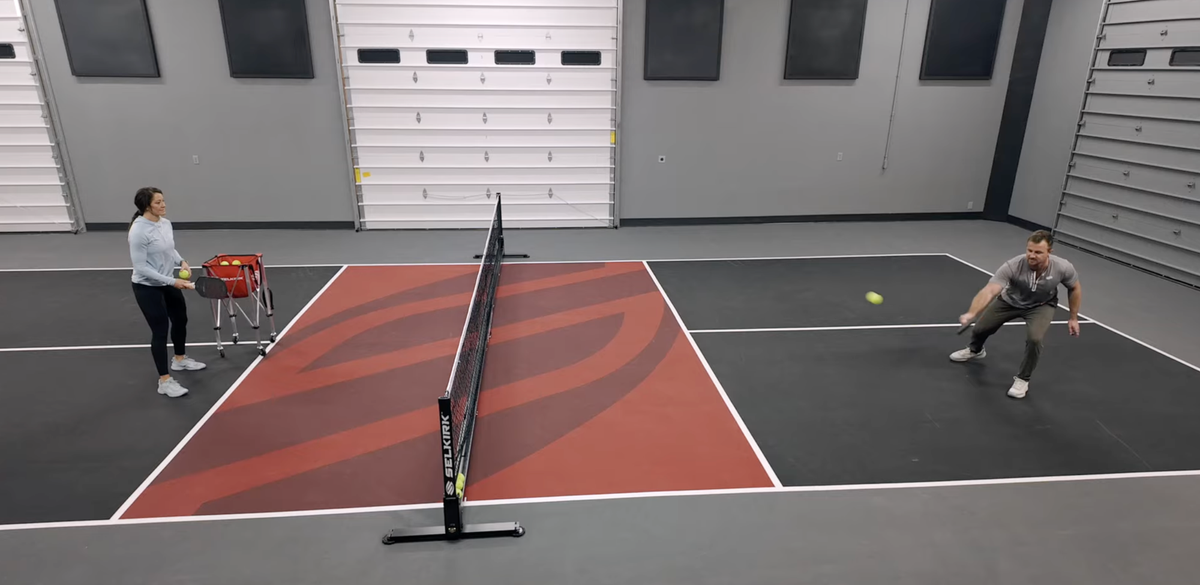
The forehand speed-up from the kitchen gives you the most power and the widest angle window.
Load your shoulder, keep your elbow in front of your body, and drive through the ball with a firm wrist, not a snap.
The error most 3.5 players make is flipping the wrist at contact, which kills direction control.
The backhand speed-up requires a completely different setup. This is a compact punch, not a full swing.
Biomechanical research on racquet sport volleys published in the Journal of Sports Sciences consistently shows that a shorter, more controlled contact arc produces better directional accuracy than a full swing from a compact stance, exactly the mechanic that makes the backhand speed-up effective at the kitchen line.
Your backhand volley mechanics should be tight: elbow slightly bent, paddle face slightly closed, contact in front of your body.
Drive it at the hip, Zone 1, because the cross-court angle on a backhand speed-up is harder to control and gives your opponent more time.
One more thing about the backhand: it's the setup that catches most opponents off guard. They expect a reset or a soft redirect.
A compact, accurate backhand speed-up at hip height is one of the five shots that separates 3.5 from 4.0 players.
Kitchen Line Aggression: When to Attack in Pickleball
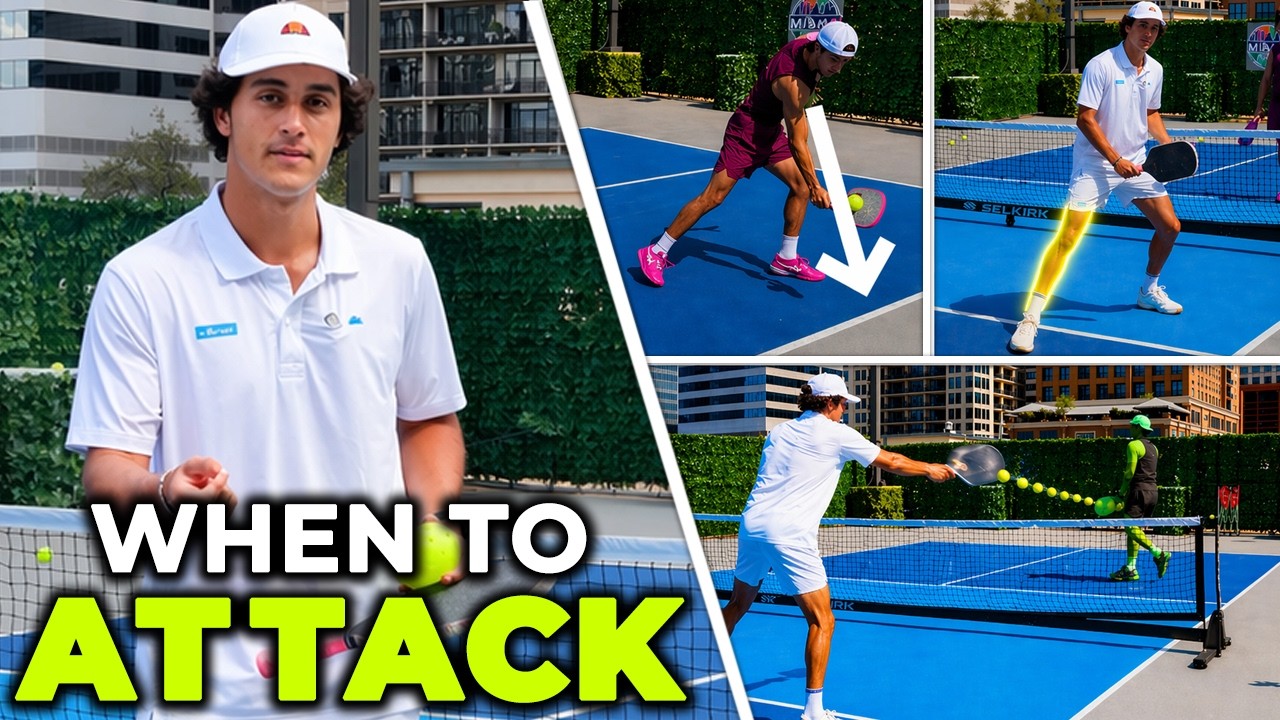
Jack Munro, the #1 player on the APP tour in mixed and men’s doubles, breaks down the exact signals that tell you when your opponent is vulnerable and ready to be attacked.
 The Dink PickleballThe Dink Media Team
What Happens When the Speed-Up Goes Wrong?
It will. Know the answer before it happens.
When you speed up and your opponent handles it, blocks it, rolls it, or re-speeds it, your first job is reset, not counter-attack.
The temptation is to panic-speed again. That's how you lose a five-ball exchange in two shots.
Reset mechanics after a speed-up exchange come down to one thing: soft hands.
Your paddle face absorbs pace, the ball drops into the kitchen, and the rally resets to neutral.
You're not losing the point, you're recycling the situation and waiting for a better opportunity.
This is the mental shift that defines 4.0 play. Pros don't abandon the dinking game after a failed speed-up.
They go back to building pressure through the dink and wait for the next window to open. Patience, then acceleration.
Not acceleration every time the ball comes back.
Understanding pressure zones in pickleball helps here too.
The speed-up is a pressure tool, but the dink cross-court, the body dink, the deep angle dink, those create the conditions that produce the attackable ball in the first place.
Pro Speed-Up Strategy: Master the Kitchen Line Attack Like a 5.0+ Player
Connor Garnett shows that winning kitchen battles isn’t about raw power, but about positioning, psychology, and reading opponents in real time
 The Dink PickleballThe Dink Media Team
Two Drills to Build a Reliable Speed-Up From the Kitchen
Drill 1: The Feed-and-Fire Drill
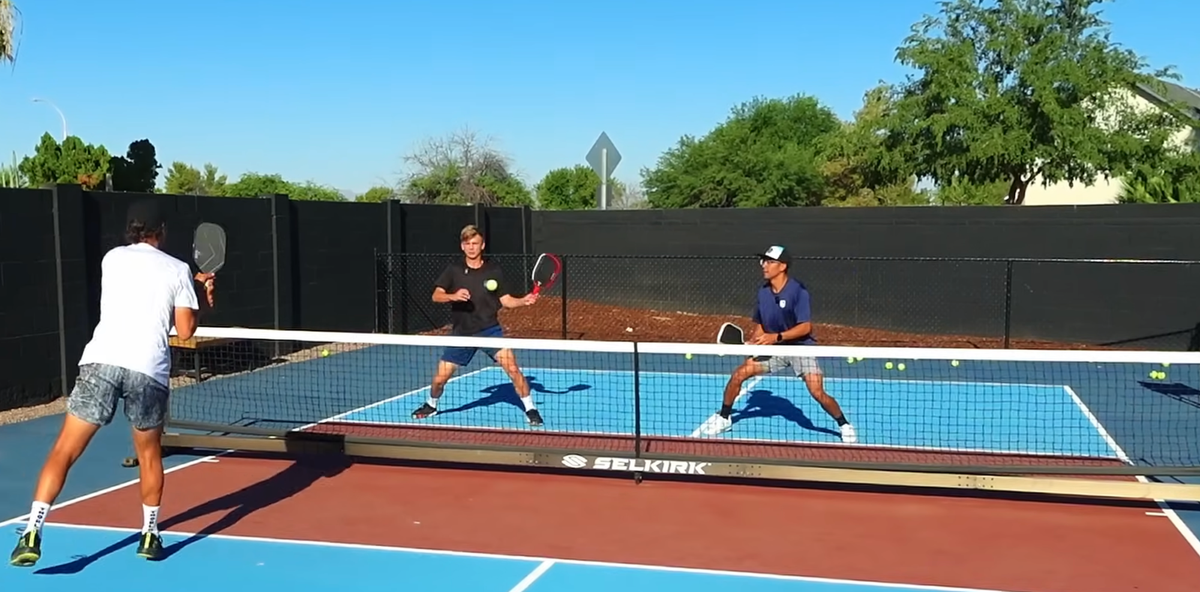
One player feeds soft, waist-to-shoulder-height balls from across the net. The other player speed-ups only when the ball reaches the target contact window, above net height. Anything lower gets a neutral reset. This trains selective aggression instead of habitual swinging. Run it three minutes and track makes vs. errors. Your benchmark: 70%+ in before taking it into match play.
Drill 2: Live Dink Rally with Speed-Up Permission
Full cross-court dink rally. Either player can speed up at any moment, but must call "attack" before swinging, making the decision conscious. After any exchange, both players reset and continue dinking. The figure-8 dink drill pairs well here, building the hand-and-feet coordination that makes recovery automatic. Layer in pickleball deception once the mechanics are solid.
The 12 Pickleball Drills You Need for Your Best Game in 2026
You can’t just show up and hit balls – you need a plan, and that plan should build progressively from simple to complex
 The Dink PickleballThe Dink Media Team
Common Mistakes at the 3.5–4.0 Level
Speeding up too early in the rally. The first few balls of a dink exchange rarely produce an attackable ball. Patience is the setup.
The secrets advanced players use start with knowing when not to attack.
Aiming cross-court to the open court. The ball travels the maximum distance, giving your opponent time to track and reset.
Attack the body first. Always.
Speeding up on the move. Contact from a planted stance wins. Contact while shuffling sideways bleeds direction control fast.
Good shot or bad positioning? Most of the time, it's both.
Counter-attacking a handled ball. If your opponent managed your speed-up cleanly, reset. Don't re-attack.
The second swing at a handled ball is where most 3.5 rallies fall apart.
How to Get From 3.5 to 4.5 in Pickleball
Cliff Pickleball reveals that the jump from 3.5 to 4.5 is driven by discipline, consistency, and better decision-making
 The Dink PickleballThe Dink Media Team
Key Takeaways
- Speed up from the kitchen in pickleball only when contact is at or above net height. Below the tape, reset.
- The two best target zones are the non-paddle-arm hip and the dominant shoulder, both create body-jam problems your opponent has to solve quickly.
- The forehand speed-up uses shoulder loading and a firm wrist; the backhand speed-up uses a compact punch drive with a closed paddle face.
- After a failed speed-up, reset immediately, don't counter-attack on a handled ball.
- Use the Feed-and-Fire drill to build selectivity. Use the Live Rally drill to apply it under pressure.
- Patience in the dink rally creates the speed-up opportunity. You can't manufacture it by swinging at every soft ball.
💡
Heads up: hundreds of thousands of pickleballers read our free newsletter.
Subscribe herefor cutting edge strategy, insider news, pro analysis, the latest product innovations and more.
Frequently Asked Questions
When should I speed up from the kitchen in pickleball?
Speed up from the kitchen in pickleball when the ball is at or above net height at contact. That's the hard rule. If the ball is skimming the net or dropping below it, you don't have enough angle or leverage to attack effectively. Wait for the dink that floats, even slightly, and that's your window. Reading the ball's arc off your opponent's paddle (before it even lands) trains you to recognize attackable balls a beat earlier.
Where should I aim when I speed up from the NVZ?
Target the body, not the open court. The most effective zones are the non-paddle-arm hip (right hip for lefties, left hip for righties) and the dominant shoulder. Both create a decision problem for your opponent at a moment when reaction time is minimal. Aiming cross-court to the open side gives your opponent too much time to track the ball and reply with control.
Is a backhand speed-up from the kitchen effective?
Yes, and it's underused at the 3.5–4.0 level. The backhand speed-up works best as a compact punch volley directed at the opponent's hip. It's not a full swing, it's a short, firm drive with a slightly closed paddle face and the contact point in front of your body. The surprise factor alone makes it worth developing. Most opponents expect a soft reset from your backhand side, not an attack.
What should I do after a speed-up that my opponent handles?
Reset immediately. The instinct is to counter-speed, but if your opponent handled the ball well, you no longer have the advantage, and swinging again at a ball you're not set up for creates unforced errors. Absorb the pace with a soft-hands reset into the kitchen and rebuild the dinking rally. Your next attack opportunity will come if you're patient.
How is a speed-up from the kitchen different from a drive?
A drive is typically hit from the baseline or transition zone after a bounce, with full swing mechanics. A speed-up from the kitchen is struck out of the air as a volley from near the NVZ line, it's compact, faster to execute, and relies on surprise and contact height rather than raw power. The intent is the same (force a weak reply), but the mechanics and timing cues are entirely different.
Anuncie Aqui / Advertise Here
Sua marca para o mundo Pickleball! / Your brand for the Pickleball world!




 English (US) ·
  Portuguese (BR) ·