
 English
  Spanish
  Portuguese
  German
  Italian
  Japanese
  French
  Polish
  Russian
  Netherlands
  Hungarian
  Turkish
  Videos
  Thedink Pickleball

Your forehand speed-up doesn't have to sail long or crash into the net. A forehand speed-up requires precise mechanics, body positioning, and timing to become a reliable weapon in your game.
The forehand speed-up is one of the most deceptive shots in pickleball, but it's also one of the most frustrating to master.
You set up what looks like a dink, then accelerate through the ball to catch your opponent off guard. When it works, it's beautiful.
When it doesn't, the ball either buries itself in the net or flies three feet past the baseline.
If your forehand speed-ups feel inconsistent or wristy, you're not alone.
Most players struggle with this shot because they're making the same mechanical mistakes over and over. The good news? These mistakes are fixable.
In a recent coaching breakdown, Cori Elliott from the Dink Pickleball channel worked with a player named Malik to diagnose and correct the exact issues holding back his forehand speed-up game.
The session reveals the core problems that plague intermediate players and the step-by-step fixes that actually work.
Love pickleball? Then you'll love our free newsletter. We send the latest news, tips, and highlights for free each week.
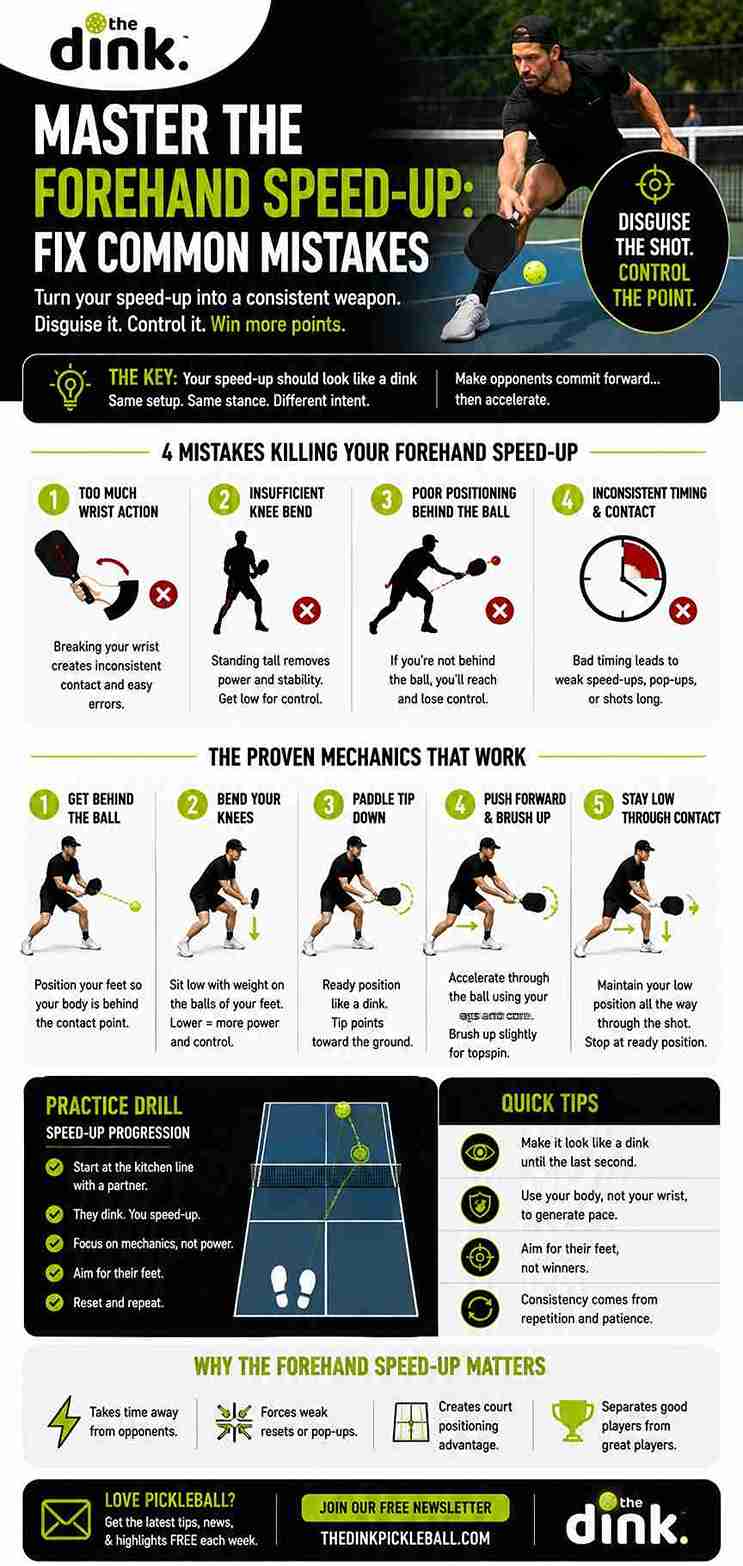
The Four Mistakes Killing Your Forehand Speed-Up
When Malik first demonstrated his forehand speed-up, Elliott immediately spotted the culprits.
His biggest issues weren't complicated or obscure. They were the same four mistakes that show up in players at every level.
- 1. Too much wrist action. This is the number one killer of a consistent forehand speed-up. Players instinctively try to generate pace by breaking their wrist, which creates an unpredictable contact point and makes the shot nearly impossible to repeat. The wrist should twist slightly, like a windshield wiper, but it should never bend or snap.
- 2. Insufficient knee bend. A forehand speed-up requires you to get low and stay low through contact. Most players stand too upright, which forces them to rely entirely on their arm and wrist to generate power. Without proper knee bend, you lose stability and control.
- 3. Poor positioning behind the ball. You can't speed up a ball effectively if you're not behind it. This positioning issue forces players to reach or extend their arm, which leads to inconsistent contact and weak shots that opponents can easily counter.
- 4. Inconsistent timing and contact. Because of the three mistakes above, players never develop a repeatable motion. They hit one good speed-up and then three bad ones, never understanding why.
Why Your Forehand Speed-Up Needs to Look Like a Dink
Here's the thing about a great forehand speed-up: it should be disguised.
Your opponent shouldn't see it coming until the ball is already past them.Elliott emphasizes this point repeatedly during the coaching session. The setup for a forehand speed-up should be identical to your dinking motion.
You hold the paddle the same way, position your feet the same way, and bend your knees the same way.
The only difference is that at the last second, you accelerate through the ball instead of softly blocking it back.
This disguise is what makes the shot so effective.
Your opponent reads a dink and starts moving forward, expecting a soft ball. Instead, they get a hard, flat attack that they can't react to in time.
But here's where most players go wrong: they try to disguise the shot by using their wrist. They think a subtle wrist flick will hide the acceleration. It won't.
In fact, it does the opposite. A wristy forehand speed-up looks exactly like what it is: a desperate attempt to add pace. It's telegraphed, inconsistent, and easy to read.
The real disguise comes from your body position and your paddle path.If you're in a proper dinking stance with bent knees and the paddle tip down, your opponent can't tell what you're about to do.
The acceleration happens through your core and your forward momentum, not through your wrist.
💡
Need some new pickleball gear? Get 20% off select paddles, shoes, and more with code THEDINK at
Midwest Racquet SportsThe Mechanics That Actually Work
Elliott breaks down the forehand speed-up mechanics into a simple, repeatable sequence.
This is the foundation that Malik practiced throughout the session.
- Step one: Get behind the ball. Position your feet so that your body is behind the contact point. This gives you stability and options. If you're beside the ball or in front of it, you're already in trouble.
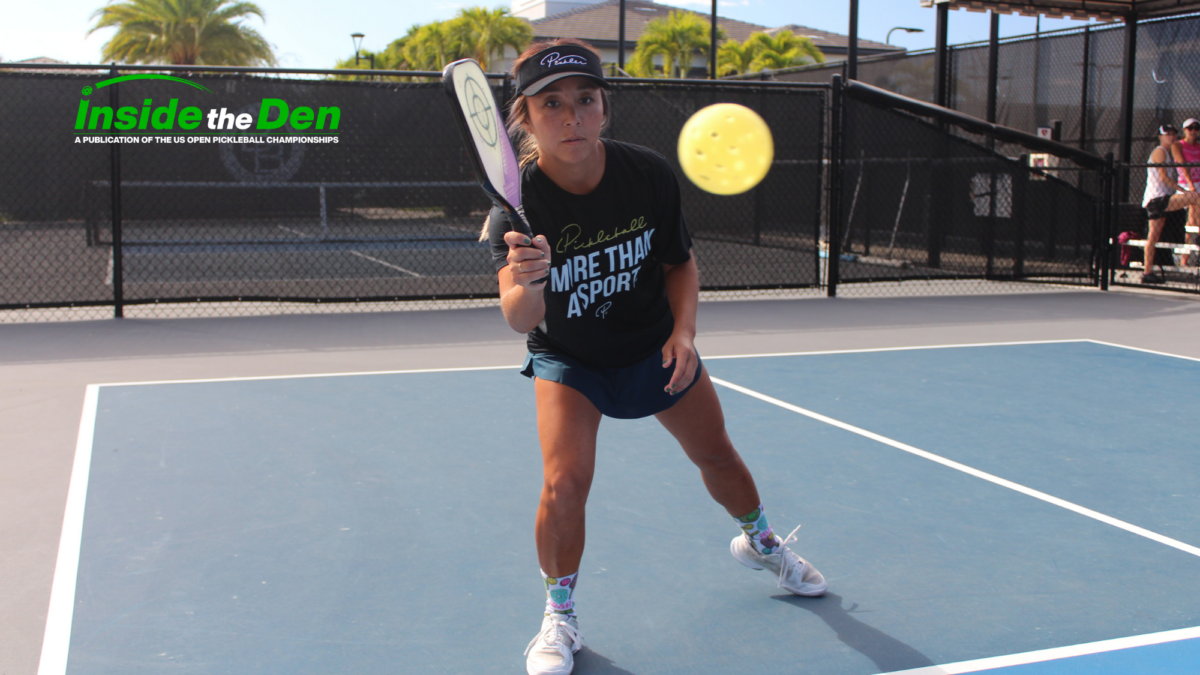
- Step two: Bend your knees. Think of it like doing a squat. Your knees should be noticeably bent, and your weight should be on the balls of your feet. This low position is where all your power comes from.
- Step three: Hold the paddle tip down. Your paddle should be in a ready position with the tip pointing toward the ground. This is the same position you'd use for a dink.
- Step four: Push forward and brush up. As you accelerate through the ball, you're pushing forward with your core and legs, not pulling with your arm. At the last second, you brush up slightly to add topspin and control. Your paddle should stop at your ready position again, not follow through across your body.
- Step five: Stay low through contact. This is critical. Many players stand up as they swing, which kills consistency. You need to maintain that low position all the way through the contact point.
The result is a shot that looks like a dink but travels with pace and precision. It's flat, it's controlled, and it's repeatable.
Off the Bounce vs. Out of the Air
A forehand speed-up can come in two forms: off the bounce and out of the air. The mechanics are nearly identical, but there are subtle differences that matter.
Off the bounce, you have more time to set up. The ball bounces, you get into position, and you wait for it to slightly descend before you hit it.
This timing is crucial. You're not hitting the ball on the way up; you're hitting it as it's coming down. This gives you a better contact point and more control.
Out of the air, you're hitting the ball before it bounces. This requires faster reactions and slightly different positioning.
Elliott recommends holding the paddle lower and staying even lower through contact.
The motion is the same windshield wiper action, but you're executing it from a more compact position.
One adjustment Elliott made with Malik was moving his grip higher up on the paddle for out-of-the-air speed-ups.
This is a small detail, but it made a huge difference in control.
By choking up on the grip, Malik gained better command of the paddle and could execute the kitchen line attack with more precision.
The Grip Adjustment That Changes Everything
Most players grip their paddle the same way for every shot. Elliott challenges this assumption, especially for the forehand speed-up.
For out-of-the-air speed-ups, moving your grip higher up on the paddle gives you significantly better control.
You're closer to the paddle head, which means you have more leverage and a smaller margin for error.
This is why professional players are increasingly choking up on their grips for net play.
Malik had been gripping his paddle at the very bottom of the handle his entire pickleball career.
When Elliott suggested moving up, Malik was skeptical. But after just a few attempts, he felt the difference immediately.
The shot became more controlled, more repeatable, and more deceptive.
This is a small adjustment that can have an outsized impact on your game.
If you're struggling with your forehand speed-up, try experimenting with your grip position. You might be surprised at how much it helps.
Timing Is Everything
The biggest revelation in Elliott's coaching session is how much timing matters for a forehand speed-up. You can't speed up every ball. In fact, you shouldn't.
The ideal ball to speed up is what Elliott calls a "dead dink." This is a ball that bounces high and floats softly over the net.
It's sitting up, waiting to be attacked. When you get a ball like this, you have options. You can speed it up, you can angle it, or you can hit it down the line.
But if the ball is low, if it's coming at you fast, or if it's not set up perfectly, you should probably dink it again.
Trying to speed up a bad ball is how you end up hitting it into the net or sailing it long.
Malik struggled with this initially. He was trying to speed up every ball, regardless of the setup.
Elliott had to remind him repeatedly: wait for the right ball. When you get that dead dink, that's when you accelerate.
This patience is what separates good players from great ones.A forehand speed-up is a weapon, but like any weapon, you have to know when to use it.
The Deception Factor
One of the most satisfying moments in the coaching session comes when Malik executes a perfect forehand speed-up that looks exactly like a dink until the moment of contact.
Elliott immediately recognizes it and praises the deception.
"That looks like a dink," Elliott says. "That's what I'm talking about."
This is the goal. Your forehand speed-up should be so well disguised that your opponent commits to moving forward before they realize what's happening.
By the time they see the pace, it's too late to react.
The deception comes from three things: your body position, your paddle path, and your timing.
If all three are aligned with your normal dinking motion, your opponent won't see the speed-up coming.
They'll read a soft shot and start moving in, only to have the ball blow past them.
This is why the wrist action is so damaging. A wristy forehand speed-up looks different from a dink. Your opponent can see it coming.
The shot loses its most valuable asset: surprise.
If you want to learn how to make your attacks completely unreadable, studying 3 deceptive pickleball shots is the natural next step.
Practice the Motion First
Elliott doesn't jump straight into live rallies with Malik. Instead, they spend time practicing the motion in isolation. This is a crucial step that many players skip.
Before you try to speed up balls in a rally, you need to groove the mechanics.
You need to feel what a proper forehand speed-up motion looks like. You need to understand the difference between a wristy swing and a body-driven swing.
Elliott has Malik practice the motion without a ball, just to get the feel of it.
Then they practice with Elliott tossing balls, so Malik can focus entirely on mechanics without worrying about the rally.
Only after the motion feels natural do they move into live practice. This progression is what allows Malik to make real improvements.
He's not just hitting balls; he's building muscle memory.
If you're working on your forehand speed-up, take this approach. Spend time on the mechanics before you worry about the results. The consistency will follow.
💡
Heads up: hundreds of thousands of pickleballers read our free newsletter.
Subscribe herefor cutting edge strategy, insider news, pro analysis, the latest product innovations and more.
Frequently Asked Questions
What is a forehand speed-up in pickleball?
A forehand speed-up is a disguised attack shot hit from the kitchen area that accelerates a soft exchange into a hard, flat drive. It's designed to catch your opponent off guard by mimicking the setup of a standard dink.
What's the difference between a forehand speed-up and a drive in pickleball?
A forehand speed-up is a controlled attack from the kitchen or midcourt that accelerates a soft dink into a harder shot. A drive is a full-power shot from the baseline. The speed-up is designed to be deceptive and set up the next shot, while a drive is meant to end the point immediately.
Why does my forehand speed-up go into the net?
The most common reason is that you're hitting the ball too low or too early in its bounce. Wait for the ball to slightly descend before you make contact. Also check your knee bend and make sure you're staying low through the shot. A low contact point combined with upward brush will help you clear the net.
Should I use the same grip for forehand speed-ups as I do for dinks?
For off-the-bounce speed-ups, yes. For out-of-the-air speed-ups, consider choking up on the grip slightly. This gives you better control and a smaller margin for error when you're hitting the ball before it bounces.
How much pace should I put on a forehand speed-up?
Start at about 60 percent pace. This allows you to focus on mechanics and consistency rather than trying to hit a winner. As you get more comfortable with the shot, you can gradually increase the pace. The goal is a controlled attack, not a full-power blast.
Can I forehand speed-up a ball that's below the net?
Technically yes, but it's risky. The lower the ball, the harder it is to clear the net with pace. Generally, you want to speed up balls that are at or above net height. If the ball is low, it's usually better to dink it again and wait for a better opportunity.
Anuncie Aqui / Advertise Here
Sua marca para o mundo Pickleball! / Your brand for the Pickleball world!





 English (US) ·
  Portuguese (BR) ·