
 English
  Spanish
  Portuguese
  German
  Italian
  Japanese
  French
  Polish
  Russian
  Netherlands
  Hungarian
  Turkish
  Videos
  Thedink Pickleball

Counters are point-winners. They're aggressive shots that put your opponent on their heels. But they only work if you're positioned correctly and thinking ahead.
Ryan Fu breaks down the mental and physical mechanics of hitting counters at the kitchen line. Honestly, it's a game-changer for anyone serious about winning hands battles.
Love pickleball? Then you'll love our free newsletter. We send the latest news, tips, and highlights for free each week.
The Anticipation Game Changes Everything
Here's what most players get wrong about counters: they think it's all about reaction time. It's not. According to Fu's latest video, hand speed is really about anticipation. That's the secret sauce separating pros from everyone else grinding at your local courts.
When you're dinking out wide and your opponent has the ball, you need to be thinking three moves ahead. If you're hitting to the outside of the court, you should already have two hands on your paddle, preparing for that speed-up down the line. That's not luck. That's preparation meeting opportunity.
Fu demonstrates this concept throughout his video by showing how positioning your paddle before the ball even comes to you makes all the difference. You're not reacting to what's happening; you're predicting it. And that prediction comes from understanding the geometry of the kitchen and where your opponent is most likely to attack.
The Three Zones: Your Defensive Blueprint
Fu breaks down counter coverage into three distinct zones, each requiring a different technique. Think of your body as divided into three sections, and each section has its own counter strategy.
Zone One: Left of Your Left Shoulder
Anything coming at you on the left side of your body calls for a two-handed backhand counter. Why? A one-handed backhand in this area gets floppy and weak. You lose power and control. With two hands on the paddle, you can generate a full swing and actually compete in the hands battle. This is where you're taking aggressive swings, not just blocking the ball back.
Zone Two: Between Your Shoulders
This is your neutral zone, and it's where a one-handed backhand counter shines. You can meet the ball out in front easily and cover your body without getting jammed. Here's the thing: if you try a forehand in this zone, you're asking to get jammed. The ball's coming at you too centrally. The one-handed backhand gives you the reach and angle you need.
Zone Three: Right of Your Right Shoulder
Your forehand counter lives here. You transition from that one-handed backhand in zone two and flip into a forehand counter on the right side. It's all about meeting the ball out in front and swatting it with authority. This is where you finish points.
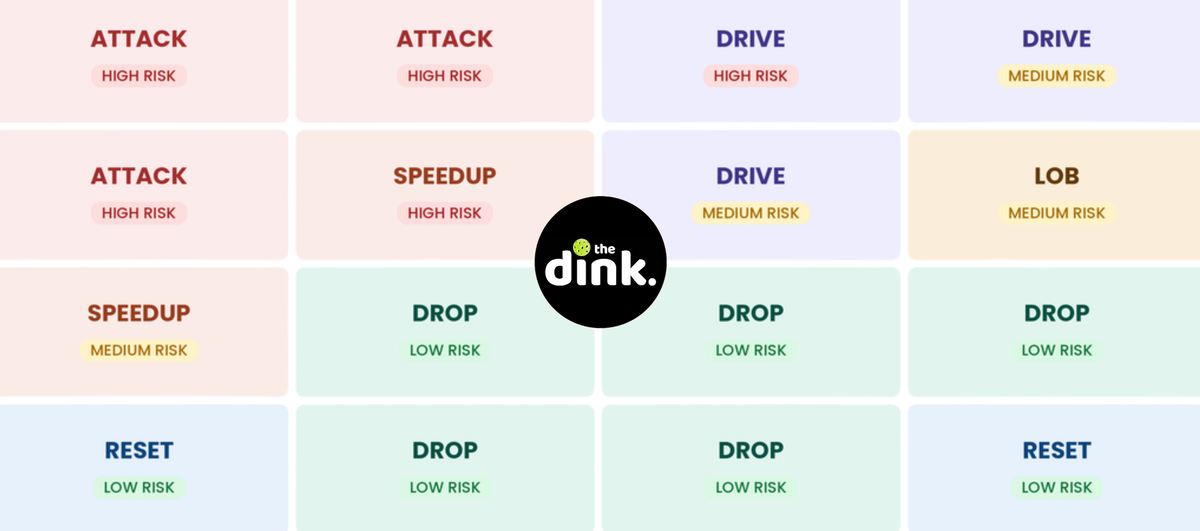
Decision Matrix: When to Attack or Reset in Pickleball
Pickleball is really all about two key factors: your court positioning and the height of the ball. This matrix decodes the game for you.
 The Dink PickleballThe Dink Media Team
Paddle Position: The Overlooked Detail
Here's where most players leak points without even realizing it. After you hit a ball, where your paddle ends up matters enormously. Fu sees a lot of players cheating backhand, meaning they're positioning their paddle as if they're expecting another backhand. The problem? If your opponent speeds it up to your right shoulder, you're hitting a chicken wing. That's a weak, defensive shot that pops up and gets destroyed.
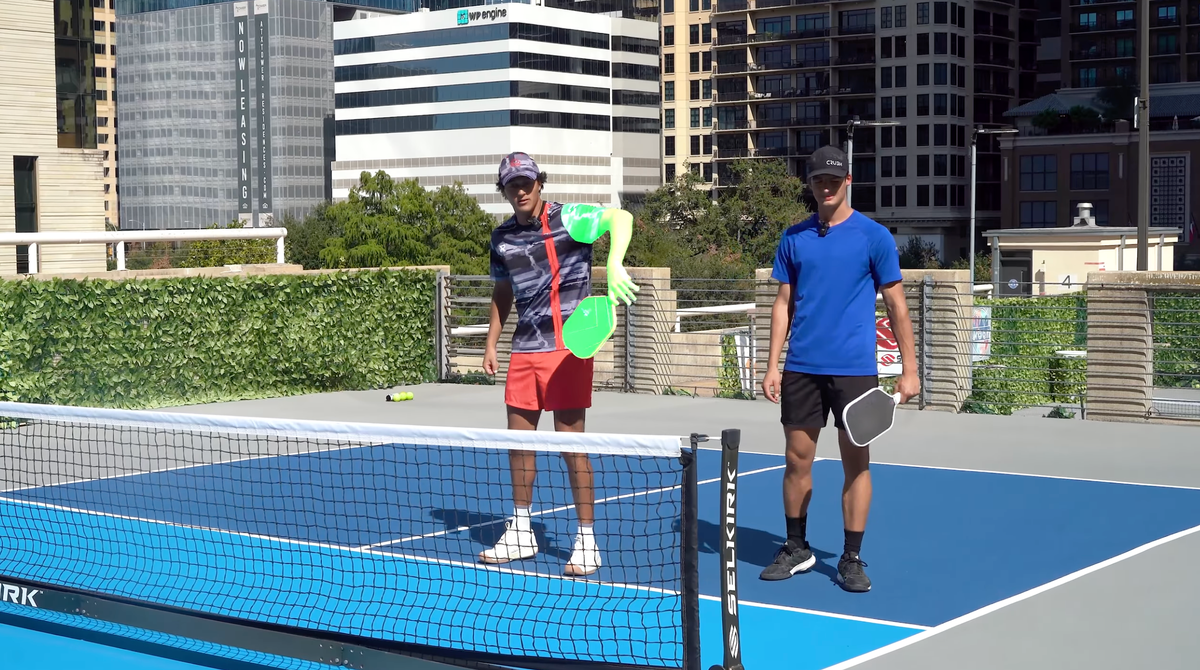
Instead, keep your elbow tucked and maintain a neutral grip with a neutral paddle position.Your paddle should be tight into your chest, not extended or favoring one side. From there, you can flip to either a forehand or backhand counter depending on where the ball actually goes.
The paddle position changes based on where the ball lands on the other side of the net. If your opponent hits across court, your paddle tip should face where that ball is landing. If they hit in front of you, your tip points forward. But here's the critical part: you're never breaking your wrist or cheating with your positioning. Everything stays out in front of your body.
How Sitting Neutral Can Transform Your Counters and Chop the Chicken Wing for Good
Instead of committing to one side, tuck your elbow and stay balanced in the middle. This way you can react to where the ball actually goes.
 The Dink PickleballAlex E. Weaver
Tracking the Ball with Your Paddle
When the ball is cross-court from you, your paddle should already be facing that direction. Why? Because if your opponent speeds it up to your forehand, your paddle is already positioned to handle it. You're not scrambling to move your paddle from the center to the side. That extra movement usually causes your elbow to come back, which kills your counter.
Fu demonstrates this by dinking out wide with his paddle already facing the cross-court direction. When his opponent speeds it up, he's ready. His paddle is already there. No wasted motion. No chicken wings. Just a clean forehand counter that puts the ball away.
This is the difference between reacting and anticipating. Your paddle position is your prediction made physical.
💡
Need some new pickleball gear? Get 20% off select paddles, shoes, and more with code THEDINK at Midwest Racquet Sports
The Backhand Counter at the Chest
When demonstrating the backhand counter at chest height, Fu emphasizes staying straight on with your paddle. You're never starting in a cheating position. From neutral, you go straight up and then execute the counter. The paddle stays out in front. Your elbow never comes behind your body. Everything is extension and reach, not rotation and twist.
If your opponent comes to your right shoulder, you can flip that forehand counter without ever moving your feet. Your upper body stays compact. Your paddle stays out front. You're meeting the ball early and controlling the point.
Heads up: hundreds of thousands of pickleballers read our free newsletter. Subscribe here for cutting edge strategy, insider news, pro analysis, the latest product innovations and more.
Why This Matters for Your Game
Counters are point-winners. They're aggressive shots that put your opponent on their heels. But they only work if you're positioned correctly and thinking ahead. Fu's breakdown of the three zones gives you a framework for understanding where each counter lives and why it works.
The mental side is just as important as the physical side. You need to be reading your opponent's position and anticipating where they're going to hit. Are they dinking out wide? Get two hands on the paddle. Is the ball coming at your chest? One-handed backhand. Right shoulder? Forehand counter.
This isn't complicated, but it requires practice and awareness. You need to train these positions until they become automatic. Then, when you're in a match and the pressure's on, your body knows what to do before your brain even processes it.
That's when you're playing like a pro.
Anuncie Aqui / Advertise Here
Sua marca para o mundo Pickleball! / Your brand for the Pickleball world!



 English (US) ·
  Portuguese (BR) ·