
 English
  Spanish
  Portuguese
  German
  Italian
  Japanese
  French
  Polish
  Russian
  Netherlands
  Hungarian
  Turkish
  Videos
  Thedink Pickleball

The Dink Minor League Pickleball exists to answer a simple question: what if regular players got to compete in the same electric team format the pros play in Major League Pickleball?
Dreambreakers. DUPR divisions. Tickets to Championships decided four rallies at a time.
The Dink Minor League Pickleball (MiLP) exists to answer a simple question: what if regular players got to compete in the same electric team format the pros play in Major League Pickleball?
The result is a worldwide amateur circuit where you build a squad, get sorted into a division by rating, rip through a full day of guaranteed games, and, if you're good enough and steady enough, earn your way to The Dink MiLP Championships.
It's fast, it's social, and it's built for pressure. Before you sign up (or the next time you're watching a match point unfold), here's everything that's happening on court.
The Building Block: A Traditional MiLP Match Is Four Games, Not One
This is the piece that trips up newcomers. In a standard tournament, you play one game (or a best-of-three) and move on. The Dink MiLP throws that out.
In the original mixed format, a match is made up of four separate 21-point games, played back to back on the same court, in this order:
- Women's doubles
- Men's doubles
- Mixed doubles
- Mixed doubles (a second, different pairing)
Every team carries four players, two women and two men, and the lineup rules keep it interesting.
Each player suits up for two of the four games, and no pairing can play together twice in the same match. That means captains are constantly weighing matchups, and there's nowhere to hide a weak spot.
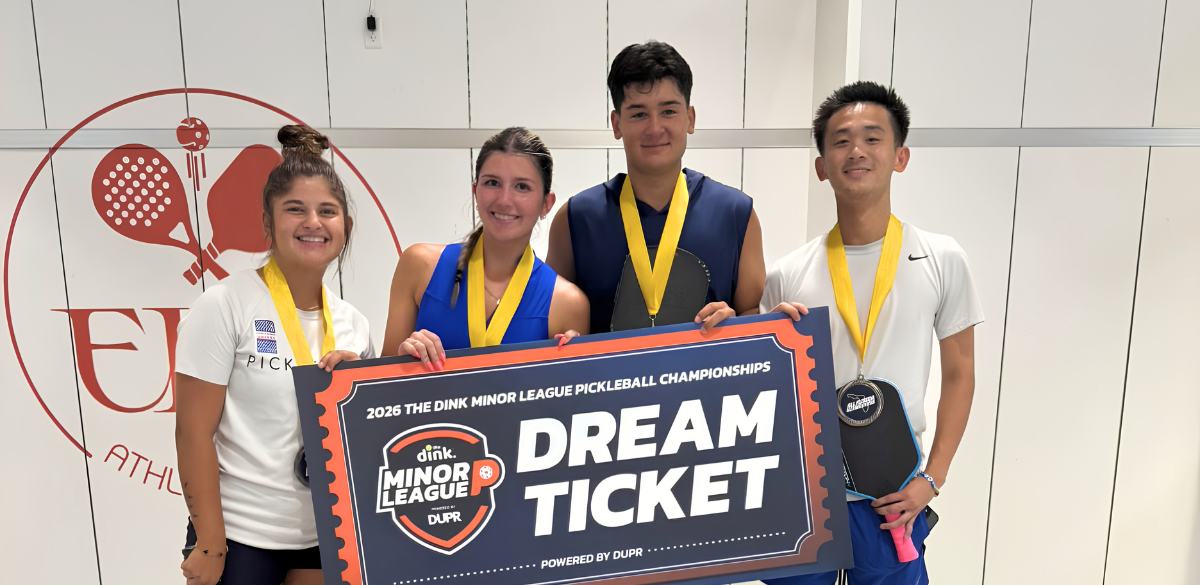
The Dink MiLP Florida State Championship: Dink Floyd, Kitchen Nightmares, and Hold My Pickle Punch Their Tickets
South Florida already has a claim on some of the best professional pickleball players in the country. After this weekend, you could make the case for the amateurs, too.
 The Dink PickleballMary Margaret Stewart
Rally scoring, with a twist
Games are played to 21 with rally scoring, so a point goes up on every rally no matter who served.
The twist? To win, you have to be the serving team, and you still have to win by two.
So if the receiving team wins the rally that would clinch it, the game doesn't end. They have to win the serve back and close it out on their own serve.
It's a small rule, but it's the reason so many games come down to the wire.
Minor League Pickleball at MLP New York: Dream Tickets Punched at Randall’s Island
The Dink MiLP came to Randall’s Island. The Brooklyn Ballers dominated. Here’s a recap of the weekend.
 The Dink PickleballMary Margaret Stewart

Keeping the day moving
The Dink MiLP is famous for how much you play without the endless waiting of a normal bracket.
Once a match starts, there are only two minutes between games, so no extra warmups. Teams take their water and rest while they're off the court, not on it.
It's part of why a MiLP day feels like an event, not a waiting room.
The Dreambreaker: Where Pickleball Legends (And Tickets) Are Made
Win three of the four games and the match is yours. But if the teams split 2-2, you get the moment MiLP is built around: the Dreambreaker.
The Dreambreaker is a single game of singles, but your entire team plays it. It's a game to 21 (win by two, rally scoring), and all four players rotate through in a set order, each playing four rallies before the next teammate steps in.
Player 1 plays four, then Player 2, then Player 3, then Player 4, then back around, until someone crosses 21.
Captains set their rotation right before it starts, home and away teams reveal lineups in sequence, and then it's off to the races: every four rallies a new matchup, momentum swinging, and an entire team's day riding on who's on court at 20-20.
Divisions: How MiLP Keeps It Fair
You'll never get steamrolled by a team three levels above you.
Every team is placed into a division based on its combined (aggregate) DUPR rating. Add up your players' ratings, and that total has to fit under the division's cap.
The mixed format runs divisions from DUPR 12 through DUPR 22, with 50+ age divisions available in select markets.
Division | Max team aggregate DUPR |
DUPR 22 | 22.999 (select markets/special events) |
DUPR 20 | 20.300 / 20.999 |
DUPR 18 | 18.300 |
DUPR 16 | 16.300 |
DUPR 14 | 14.300 |
DUPR 12 | 12.300 |
A couple of things worth knowing:
- Some divisions also cap any single player's individual rating (so you can't stack one ringer with three beginners).
- Once you register, your team's ratings are locked for that event (your DUPR going up or down before match day won't change your division).
One League, Three Ways To Play
MiLP has grown past its original format. There are now three, and all of them run the same divisions-to-Championships structure. They just change who's on your team and how a match is shaped.
1. Original (Mixed)
The format everything above describes: four players, two women and two men, four games, and a DreamBreaker when it's tied. It's the classic MiLP experience and the source of most of the highlight reel.
2. V3
Introduced to streamline match play and spotlight tight, coordinated teams, v3 swaps mixed play for single-gender trios: three women vs. three women, or three men vs. three men.
A match is three games, each player plays two of them, no pairing repeats, and there's no DreamBreaker. Just three-on-three straight to the point.
v3 runs its own division ladder at DUPR 9, 11, 13, and 15, and it's a full pathway to Championships in its own right. Because we've already gone deep on V3, we'll keep it short here.
The complete v3 breakdown lives here.
3. V4
The newest addition, rolled out in 2025. v4 keeps the full four-game rhythm and the DreamBreaker stakes of the original, but with single-gender squads of four: all men or all women.
For veteran teams it's a fresh challenge. For captains it's a new way to build a roster around a specific set of strengths.
It follows the same match structure and division logic as the mixed format.
The Whole Point: Earning Your Spot At Championships
None of this is just for a day's medal. MiLP events feed a season-long chase.
Win your division and you're earning your place at The Dink MiLP Championships, the biggest amateur stage in pickleball.
That's where players who spend most weekends on rec courts suddenly find themselves going for gold on a grandstand court, with a real crowd and the lights on.
So, How Do You Actually Get In?
That's the whole loop: assemble a team, find your division, survive the Dreambreaker, and go chase gold.
Anuncie Aqui / Advertise Here
Sua marca para o mundo Pickleball! / Your brand for the Pickleball world!





 English (US) ·
  Portuguese (BR) ·