
 English
  Spanish
  Portuguese
  German
  Italian
  Japanese
  French
  Polish
  Russian
  Netherlands
  Hungarian
  Turkish
  Videos
  Thedink Pickleball

Most players hit the two-handed backhand wrong because they focus on form over footwork and forget which hand actually controls the shot. Jack Munro breaks down the exact technique that makes his two-handed backhand one of the most consistent and deceptive in the world.
Your two-handed backhand is not broken because of your grip or your paddle. It is broken because you are using the wrong hand to do the work, taking too big a backswing, and sitting still after you hit it.
Those three mistakes turn a weapon into a liability. And once you see exactly what is going wrong, fixing it is much simpler than you think.This breakdown comes from a deep-dive session with Jack Munro, one of the most consistent two-handed backhand players in the game.Richard Pickleball sat down with Munro to pull apart every detail of the shot, from hand pressure to post-contact footwork, and what Munro shared challenges almost everything most recreational players believe about the stroke.
Love pickleball? Then you'll love our free newsletter. We send the latest news, tips, and highlights for free each week.
The Off Hand Is Doing Most of the Work
This is the single biggest misunderstanding about the shot. Most players think the dominant hand leads. It does not.
Munro, who is a lefty, uses his right hand for roughly 70 to 80 percent of the shot.His right hand sits behind the paddle and drives the ball forward, while his left hand provides stability, not power.
Think of it this way: the off hand is hitting a forehand. The dominant hand is just keeping the paddle steady through contact.Flip that relationship and you get inconsistency, mishits, and shanks. It is the same principle that shows up when you defend with two hands against speed-ups.
You can run one finger or two along the edge guard.
Munro prefers two, because he plays with a shorter handle and the two-finger position gives him more stability on the back face of the paddle.Fewer shanks. More solid contact.
Try both in your next session and pay attention to which one cuts your off-center hits.
Small grip experiments like this are exactly the kind of thing worth logging inside a structured drill block.
Why Does Your Backswing Keep Hurting You?
A big backswing on the two-handed backhand is one of the most common errors at every level.
Munro has one rule that applies to almost all of his shots: see the ball and see the paddle at the same time.When you loop into a big backswing, you lose sight of your paddle. You cannot track the ball and your paddle simultaneously.
That split-second gap in awareness creates unforced errors, especially on dinks where precision matters more than power.
Munro sets his paddle immediately when the ball is coming toward him. No loop, no wind-up.
He is down and ready before he needs to swing, and then he simply pushes through the ball.
Here is why that matters for consistency. If your goal at the kitchen line is to make balls, a smaller setup gives you a far higher rate of clean contact.The players you see with big looping two-handed backhands are exceptional athletes with elite timing.
For most players, the compact setup is the smarter path.
If you keep popping up your dinks, this breakdown on two common pop-up fixes connects directly to the same setup problem Munro is describing here.
💡
Need some new pickleball gear? Get 20% off select paddles, shoes, and more with code THEDINK at
Midwest Racquet SportsGetting Around the Ball Is Not Optional
Munro does not try to hit direct topspin on his two-handed backhand.
He gets around the outside of the ball, which creates side topspin that kicks off the court in a way that is difficult to handle.
This is a small detail that makes a massive difference. Direct contact pushes the ball forward.Getting around the outside of the ball adds a lateral kick that pulls opponents out of position or forces awkward contact angles.
Even when Munro is hitting the ball directly in front of him, he is still swinging slightly around the outside.This is not a full sidespin flick. It is a subtle adjustment to his contact point that adds movement to the ball without changing the visible shape of his swing.
For a deeper look at why your spin attempts fall short, this article on topspin failures covers the mechanics in detail.
The same contact logic separates a slice backhand dink from a two-handed roll.
Master the Two-Handed Backhand Dink Like a Pro
Topspin is taking over pickleball. If you’re still relying solely on slice dinks, you’re playing too much defense. And nobody wins tournaments by playing defense.
 The Dink PickleballThe Dink Media Team
Placement: Stop Hitting Every Two to the Same Spot
One of the biggest gaps between recreational and elite two-handed backhand play is placement variety.
Most recreational players find a comfortable target and repeat it. Munro almost never hits the same spot twice in a row.His two primary targets are:
- Wide crosscourt: Pulling the opponent off the court and opening up the middle. Munro notes that if you go very wide, you need to also go a bit deeper so you are not feeding your opponent an around-the-post opportunity.
- Inside foot: Jamming the ball into the opponent's inside hip, which makes it extremely difficult for them to redirect the ball behind you on the next shot. This also lets Munro crowd the middle and take away their best angles.
The inside foot target is underused at almost every level below 5.0.
Most players never practice hitting there with their two-handed backhand because it feels counterintuitive.But that target creates offense more reliably than the wide ball because it limits your opponent's response options.
Knowing how to win a crosscourt dink battle starts with understanding exactly where to put the ball, and Munro's placement logic applies directly to that situation.
Pickleball Two-Handed Backhand Volley: 6 Keys From a Pro
The two-handed backhand volley looks effortless when a pro hits it, then falls apart the moment you try. Here are six keys that fix the shot, starting with where the power actually comes from.
 The Dink PickleballThe Dink Media Team
What Are You Doing After the Two?
This is the question most players never ask. You hit a good two-handed backhand and then you stand there waiting for the next one. That is a mistake.
Munro is looking for two things immediately after contact:
- Short hops: If his two-handed backhand forces a weak, low return, he wants to be moving forward to take that ball out of the air before it bounces. Waiting for the bounce gives the opponent time to recover.
- Pop-ups: Any ball that rises above the net is an opportunity. But you can only attack it if you are already leaning in and reading your opponent's response.
The key phrase Munro uses is "follow the ball to the target." After you swing, your body should be moving toward where you hit it.
You are not stuck watching.
You are already transitioning into your next position, which is where understanding the transition zone becomes the next step once the shot itself is dialed in.Munro says you can spot an amateur instantly by watching what they do after the two-handed backhand.
Two-Handed Backhand Dink: Fix It With These Pro Tips
The two-handed backhand dink is one of the most deceptive shots in pickleball when done right. Here is exactly how to stop hitting it long and start generating topspin that moves your opponents around.
 The Dink PickleballThe Dink Media Team
How to Make Your Speed Up Look Identical to Your Dink
Disguise is Munro's biggest weapon. His two-handed backhand speed-up and his dink look the same until the moment of contact.
That is not an accident. It is the direct result of eliminating his backswing on both shots.
Here is how he separates them mechanically:
- The dink: Set paddle down early, push forward with moderate arm speed, minimal wrist involvement.
- The speed-up: Same set, same early positioning, but with faster arm acceleration and a wrist snap at contact to brush over the top of the ball and create topspin.
Munro aims to make more than 80 percent of his speed-ups. He would rather hit a lob than miss one into the net.
That mindset stops him from chasing pace he cannot control.It also forces him to attack only the balls he can finish with authority, a principle that shows up across every essential shot worth mastering this season.
The arm drives first and the wrist follows.
The wrist is not leading the motion; the arm accelerates forward and the wrist snaps through at the end, adding RPM rather than directing the ball.
Without the wrist, you get a faster dink. With it, you get a genuine speed-up that sits on top of the ball and dips.If you want the same sequencing on the forehand side, this two-step forehand speed-up breakdown covers the identical arm-then-wrist order.
And if you tend to overswing, this overswing fix drill builds the compact motion Munro is describing.
3 Pickleball Speed Up Patterns Every 5.0 Player Uses
Most players speed the ball up hoping to end the point right there. Here are three pickleball speed up patterns that force a predictable response so you can finish on the very next shot.
 The Dink PickleballThe Dink Media Team
Direction Control on the Speed-Up
Munro targets three zones: the body, the line, and the middle.What decides where the ball goes is the direction his arms push through contact, not a late wrist adjustment.
Crosscourt, his arms drive crosscourt.
Down the line, his arms drive down the line. The swing shape looks identical from the outside, which is exactly why the disguise works.The read only becomes available at the moment of paddle contact, leaving almost no reaction time.
Munro calls the line speed-up his most deceptive shot because his arm drive stays hidden longest on it.
That is a trainable skill, not something that shows up on its own.
Learning how to disguise pickleball shots is the logical next step once your mechanics are clean, and it pairs well with the broader kitchen-line attack strategy pros use.
Master Dink Placement: The Secret to Controlling the Kitchen Line
When you’re at the kitchen line, your goal is simple: make your opponents uncomfortable
 The Dink PickleballThe Dink Media Team
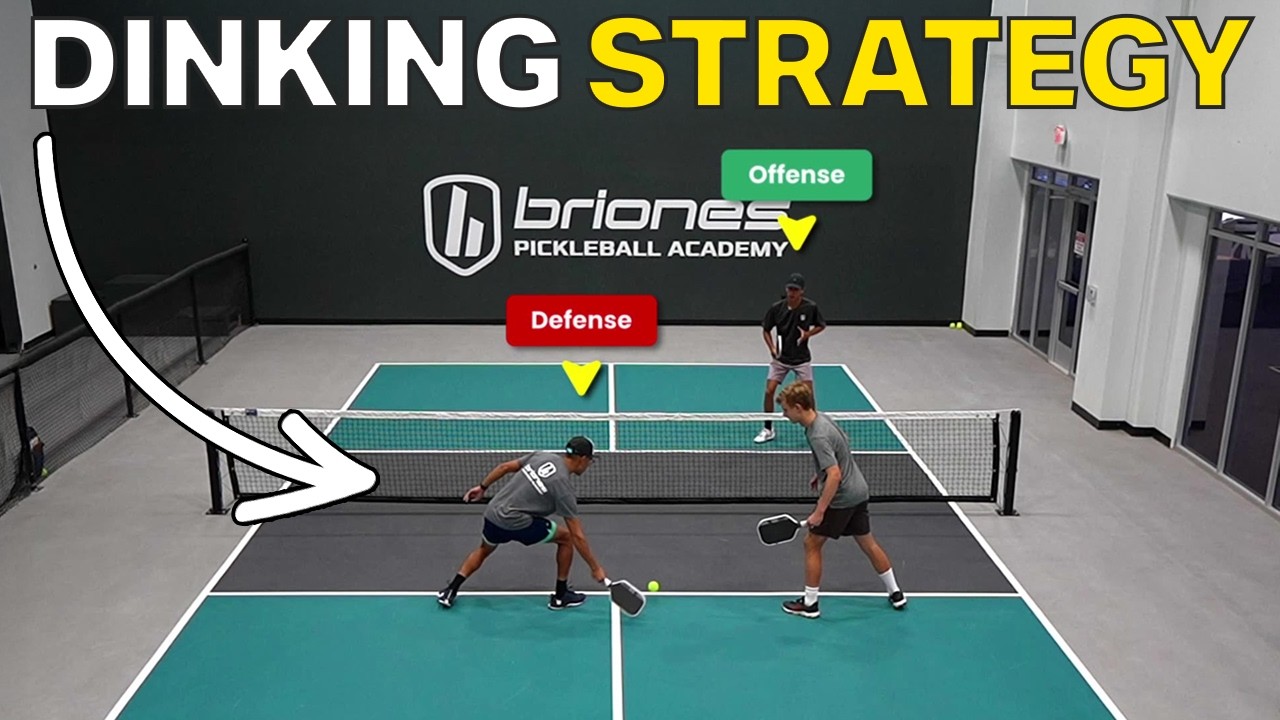
Everything Munro teaches about the two-handed backhand comes back to footwork. The form matters, but footwork is what makes the form usable in a live rally.
A good two-handed backhand with bad footwork buys you one good shot. Good footwork after that shot buys you the next two or three.Munro is always moving toward his target after contact, reading the short hop, leaning into the advantage he just created.
Stay flat-footed and you are leaving points on the court.
These three footwork drills build the movement habits that make his approach work in real matches, and they slot neatly into a simple four-step system for winning more games.The grip, the off hand, the compact setup, the contact point: all of it serves one goal. Getting you into a better position for the next ball.
Cleaner dinking technique plus active post-shot movement is what separates players who use the two-handed backhand as a weapon from players who use it to keep the ball in play.
If you want the full ladder, start with the five shots you need before you break 5.0.
💡
Heads up: hundreds of thousands of pickleballers read our free newsletter.
Subscribe herefor cutting edge strategy, insider news, pro analysis, the latest product innovations and more.
Frequently Asked Questions
What hand does most of the work on a two-handed backhand in pickleball?
The off hand does 70 to 80 percent of the work on the two-handed backhand. It pushes the paddle forward like a forehand while the dominant hand provides stability through contact. Most players have this reversed, which causes inconsistency and shanks.
Should I use one finger or two fingers on the edge of the paddle for a two-handed backhand?
Both are valid, and it comes down to personal preference and handle length. Jack Munro uses two fingers along the edge guard because it gives him more stability on the back face of the paddle, which reduces mishits. Players with longer handles may find one finger sufficient.
How do I make my two-handed backhand speed-up look like a dink?
Eliminate your backswing on both shots so the setup looks identical. The only difference is arm speed and wrist involvement at contact: the dink is a push, the speed-up is an accelerated push with a wrist snap that brushes over the top of the ball. If you have a bigger backswing on speed-ups, opponents can read it early.
Where should I aim my two-handed backhand dink?
The two best targets are wide crosscourt to pull opponents off the court, and the inside foot to jam them and limit their return angles. Hitting the inside foot is especially effective because it prevents your opponent from redirecting the ball behind you on the next shot.
What should I do after I hit my two-handed backhand?
Follow the ball toward your target and immediately look for short hops or pop-ups to attack out of the air. Standing still after contact wastes the advantage your two-handed backhand creates. Moving forward after the shot is what turns a good dink into a point-ending sequence.
Anuncie Aqui / Advertise Here
Sua marca para o mundo Pickleball! / Your brand for the Pickleball world!



 English (US) ·
  Portuguese (BR) ·