
 English
  Spanish
  Portuguese
  German
  Italian
  Japanese
  French
  Polish
  Russian
  Netherlands
  Hungarian
  Turkish
  Videos
  Thedink Pickleball

Most players never practice their pickleball serve technique with intention, and it shows. Here is the step-by-step system that turns your serve into a genuine weapon.
Your pickleball serve technique is probably costing you points before the rally even starts.
Most players just walk up to the baseline, knock the ball over the net, and hope for the best. They never experiment with spin, placement, or trajectory.
Two hours of rec play go by and the serve stays exactly the same.
This breakdown comes from Cliff Pickleball on YouTube, where Cliff worked through a serve progression with a coach on court, building from drop serve fundamentals all the way to targeted placement and speed training.
Here is everything they covered, organized so you can apply it right away.
Love pickleball? Then you'll love our free newsletter. We send the latest news, tips, and highlights for free each week.
Why Most Serves Are Easy to Return
A fast, flat, low serve sounds dangerous. It is not.
When the ball comes in low and hard, the returner just has to place the paddle in the path of the ball.
There is no decision to make. The ball does the work for them and it comes back just as easily as it arrived.
The serve that actually creates problems is one that combines spin, height, and placement.
That combination forces the returner to adjust their swing path, their footwork, and their positioning all at the same time. That is where weak returns come from.
Step 1: Start With the Drop Serve
The drop serve is not a beginner gimmick. It is a training tool that builds the exact mechanics your serve needs.
When you drop the ball and let it bounce before you swing, two things happen automatically.
You get low, and you are forced to swing upward. Those two things are the foundation of every good serve in pickleball.
If you skip the drop serve and go straight to an aerial serve, you tend to stay upright and swing forward instead of up.
That is what produces flat, returnable serves.
Fixing an inconsistent serve almost always starts with fixing the upward swing path, and drop serves train that faster than anything else.
Spend real time here. Hit 20 to 30 drop serves per session before you ever touch your full motion serve.
💡
Need some new pickleball gear? Get 20% off select paddles, shoes, and more with code THEDINK at
Midwest Racquet SportsDoes Power Really Come From the Legs?
You have probably heard that power comes from your legs. That is only partly right, and if you take it too literally, you will stay weaker than you should be.
The legs create a spark. They initiate the chain. But the hip rotation is where the real power lives.
Here is a simple test you can do right now. Stand at the baseline with your feet planted, no leg bend, no explosion.
Rotate your hips hard and swing through the serve.
You will be surprised how much velocity you can generate with zero leg involvement.
Now add the leg explosion back in.
That combination, legs sparking the movement and hips delivering the power, is what produces a serve that opponents genuinely struggle with.
Think of it as a sequence, not a single motion.
The three parts of the kinetic chain for a strong serve are:
- Knee bend and leg drive to load and initiate
- Hip rotation as the primary power source
- Arm angle at roughly 45 degrees to create both spin and pace
Train each one in isolation before combining them. That is exactly how Cliff built the consistency you see in the video.
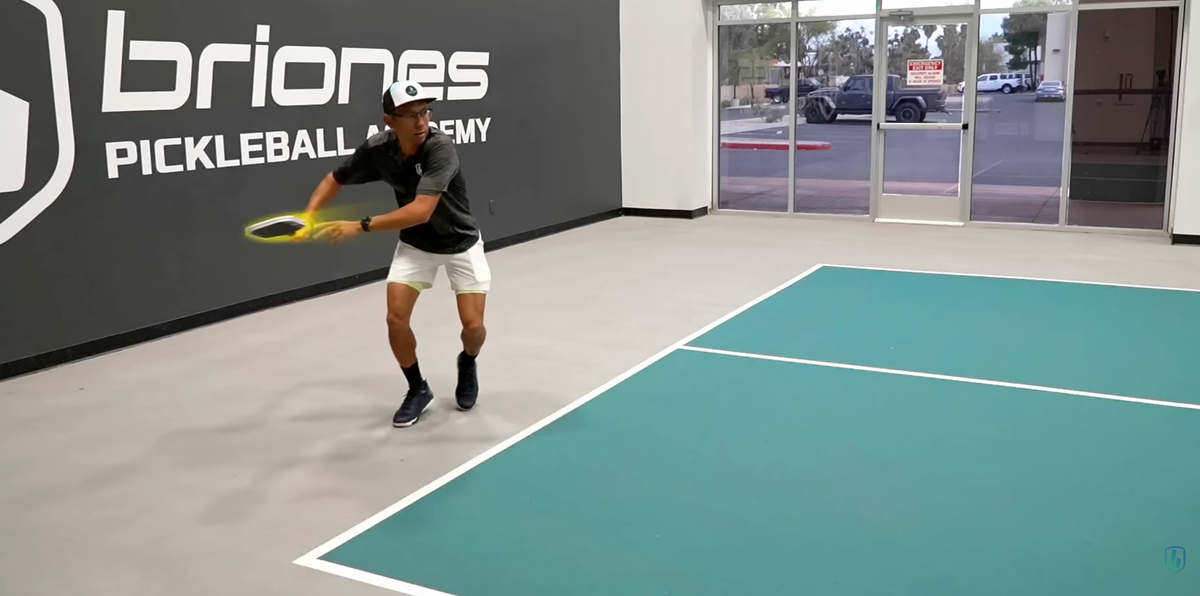
The Pickleball Drive Crash Course: Pro Tips for Powerful Shots
The drive is one of pickleball’s most important shots: it’s your way to take the initiative, put pressure on your opponents, and finish points.
 The Dink PickleballThe Dink Media Team
Step 2: Find the 45-Degree Arm Angle
This is the detail most players completely miss.
If you swing straight up, you get spin but no pace and the ball floats. If you swing straight forward, you get pace but no spin and the ball goes flat.
The 45-degree angle between those two extremes is where both live together.
There is one more refinement on top of that. Instead of coming directly up through the ball, you want to approach slightly from the side of the ball and swing across it.
That diagonal path through contact is what creates heavy topspin.
The ball comes over the net with arc and then drops aggressively into the court.
This is the same concept behind hitting a roll shot with fast topspin. The swing path across the ball, not just through it, is what generates that biting spin.
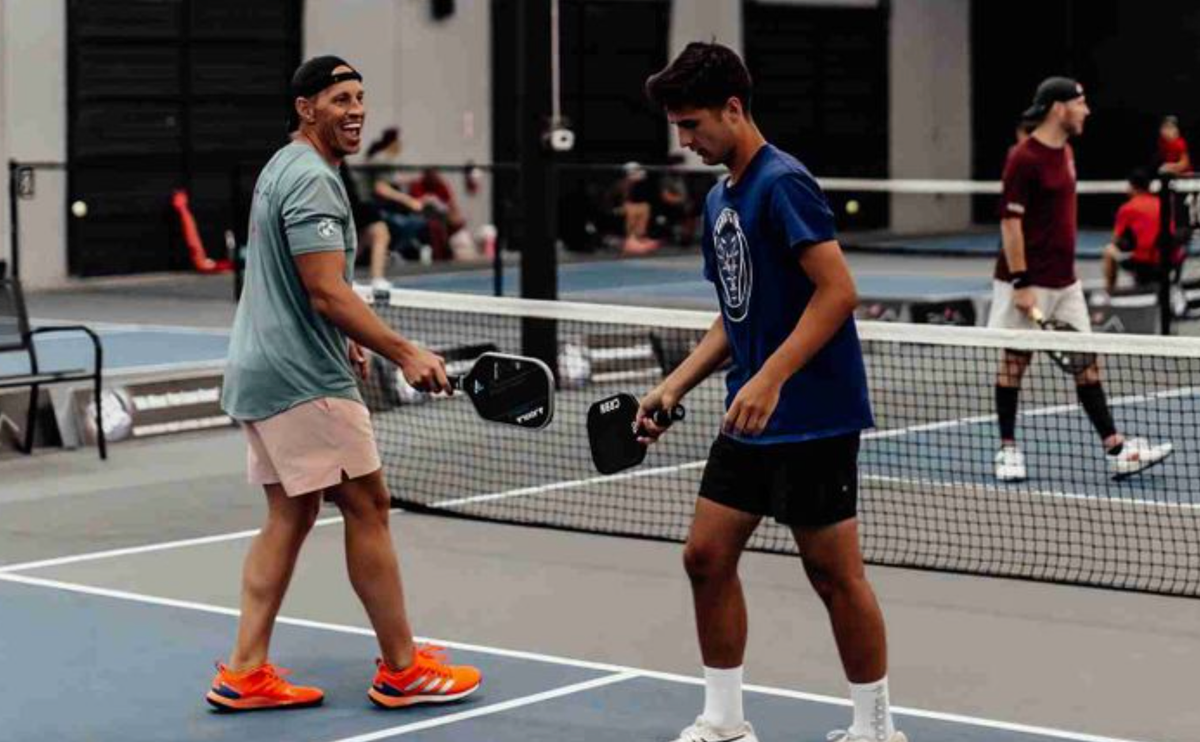
How to Play Doubles With a Beginner Partner
Learning how to play doubles with a beginner partner comes down to three things: who talks, who covers the court, and who takes the harder shot. This guide breaks each one down so the skill gap stops showing up on the scoreboard.
 The Dink PickleballThe Dink Media Team
Step 3: Use Height to Create a Harder Bounce
This is the detail most players completely miss.
If you swing straight up, you get spin but no pace and the ball floats. If you swing straight forward, you get pace but no spin and the ball goes flat.
The 45-degree angle between those two extremes is where both live together.
There is one more refinement on top of that. Instead of coming directly up through the ball, you want to approach slightly from the side of the ball and swing across it.
That diagonal path through contact is what creates heavy topspin.The ball comes over the net with arc and then drops aggressively into the court.
This is the same concept behind hitting a roll shot with fast topspin. The swing path across the ball, not just through it, is what generates that biting spin.
Pickleball Shot Selection: Ball Height & Court Positioning
Advanced pickleball means constantly analyzing the height of the ball and the court positioning off all four players in real time – and keeping this one rule sacred: just because you can hit a more aggressive shot doesn’t mean you should
 The Dink PickleballEric Roddy
Step 4: Do Speed Training With Your Serve
Most players never push past their comfortable speed. They just repeat the same effort level every time they practice and wonder why they plateau.
The approach here was inspired by how golfer Bryson DeChambeau trains for distance. You start by coordinating your mechanics at a controlled pace.
Then, after 20 to 30 balls, you try to swing faster than you have ever swung before.
You push into uncomfortable territory on purpose.
Do 10 balls at maximum effort. Rest. Repeat as many times as your energy allows.
Your coordination will break down at first. That is fine. The goal is to teach your nervous system what full speed actually feels like.
Over time, your control at high speed will improve because you have trained at high speed.
This is also how you find out which part of your mechanics falls apart under pressure.
If your hip rotation stops when you swing hard, that is your limiting factor. If your arm angle collapses, you know what to isolate next session.
The same principle applies to drive technique across the whole game.
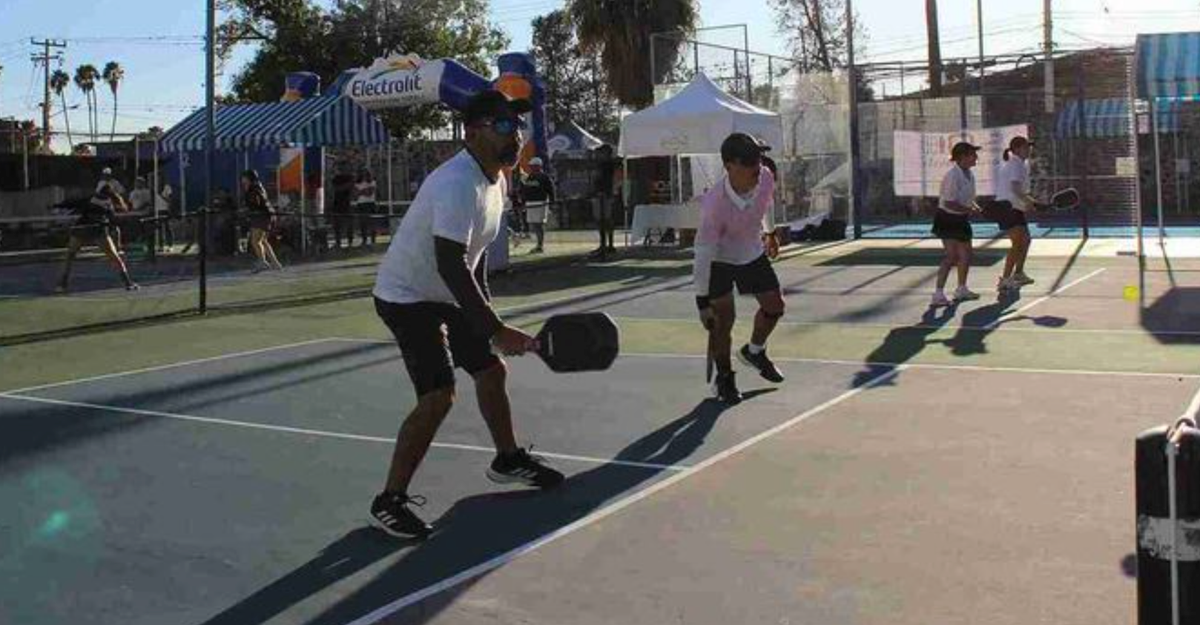
How to Improve Footwork Off Court for Pickleball
If you want to improve footwork off court for pickleball, the gym and your living room are more useful than you think. Off-court agility and speed training builds the lateral quickness and explosive first-step that wins rallies before you even swing.
 The Dink PickleballThe Dink Media Team
Where Should You Actually Put the Serve?
Spin and speed mean nothing if you are serving into the middle of the court every time. Placement is what turns a good serve into a point-winner.
There are three targets worth owning:
- Wide to the forehand or backhand corner to stretch the returner and force a reach. A stretched returner cannot drive the ball back with authority. Their return will float.
- Down the T (the center line) to eliminate angle and limit where the return can go. Fast and flat works well here because the net is lower in the middle.
- Into the body at the hip or shoulder. This is the most underused serve target in recreational pickleball. When the ball jams a player at the hip, they cannot generate a clean swing. The return will be short, weak, or both.
There is also a fourth option for players willing to take a risk.
A short serve down the T that lands near the service line forces the returner to sprint forward instead of setting up in their return position.
They cannot generate pace from there.
The return will be defensive at best.Learning how to find your opponent's weak spot matters just as much as the mechanics of the serve itself.
Watch where their returns break down in the first few points and then go back to that spot repeatedly.
Pickleball Shot Selection: Ball Height & Court Positioning
Advanced pickleball means constantly analyzing the height of the ball and the court positioning off all four players in real time – and keeping this one rule sacred: just because you can hit a more aggressive shot doesn’t mean you should
 The Dink PickleballEric Roddy
Step 5: Put It All Together and Isolate Each Piece
The biggest mistake players make when trying to improve their serve is working on everything at once. You will never know what is actually helping.
The right approach is to isolate each component in the same session. Start with just the arm angle using drop serves.
Then stand at the line and serve using only hip rotation, no leg drive.
Then add the legs back in. Then aim high over the net for the bouncing serve. Then push into speed training.
That sequence gives you feedback on each piece separately. When something is not working, you know exactly where to look.
When something clicks, you know exactly why.
This kind of deliberate practice is what separates players who improve quickly from players who stay stuck.
Advanced players do this differently across every part of their game, not just the serve.
How to Hit a Body Shot in Pickleball: Complete Bodybag Guide
Learning how to hit a body shot in pickleball starts with understanding the rule, not just the aim. This guide breaks down the mechanics, the timing, and the line between smart targeting and a foot fault waiting to happen.
 The Dink PickleballThe Dink Media Team
If you can commit to 10 focused practice sessions with this framework, the results will show up in matches faster than you expect.
The serve is one of the only shots in pickleball you have complete control over. There is no excuse not to make it a weapon.
For more on the serve approach that works best going forward, that resource breaks down what is working at every level of the game right now.
And if your serve is creating short returns that you are not converting, the next thing to fix is your third shot.
Check out how to hit a forehand third shot drop so you can actually capitalize on the pressure your serve creates.
For players working on overall serve consistency during match play, managing nerves during competitive games is often just as important as the mechanics.
Want to build the complete offensive game around this serve?
Start with the return of serve technique that creates offense, so you understand what you are trying to prevent when you serve.
And if you keep spraying balls long when you go for pace, these fixes for shots going long address the exact arm and angle issues that show up in the serve too.
💡
Heads up: hundreds of thousands of pickleballers read our free newsletter.
Subscribe herefor cutting edge strategy, insider news, pro analysis, the latest product innovations and more.
Frequently Asked Questions
What is the most important part of a pickleball serve technique for generating spin?
The arm angle is the most important factor. Swinging across the ball at roughly 45 degrees, approaching slightly from the side rather than straight up, is what creates heavy topspin on a pickleball serve. A straight upward swing produces spin but no pace, while a straight forward swing produces pace but no spin.
Why does the drop serve help improve your regular serve?
The drop serve forces you to get low and swing upward, which are the two mechanical foundations of a strong serve. Most players who skip drop serves develop a flat, forward swing that produces weak, returnable serves. Spending time with drop serves trains the correct motion before you add power.
Where is the best place to serve in pickleball to force a weak return?
The body serve, aimed at the returner's hip or shoulder, is the most underused and most effective placement. It jams the returner and prevents them from generating a clean, powerful swing. Wide serves and serves down the T are also effective, but the body serve creates the most mechanical difficulty for the opponent.
How do you generate more power on a pickleball serve?
Power comes from a sequence: leg drive to initiate, hip rotation as the primary source, and arm swing as the final accelerator. Hip rotation alone can produce significant pace, which surprises most players who focus entirely on arm speed. Training each component separately before combining them is the fastest way to add real power.
Can a slower serve really be harder to return than a fast one?
Yes, when it has heavy topspin and a high arc. A high topspin serve builds energy through the bounce and can jump up into the returner's body or away from them at an unexpected angle. A fast, flat serve is often easier to handle because it travels predictably and the returner just needs to put their paddle in the way.
Anuncie Aqui / Advertise Here
Sua marca para o mundo Pickleball! / Your brand for the Pickleball world!




 English (US) ·
  Portuguese (BR) ·