
 English
  Spanish
  Portuguese
  German
  Italian
  Japanese
  French
  Polish
  Russian
  Netherlands
  Hungarian
  Turkish
  Videos
  Thedink Pickleball

Pickleball often feels chaotic in the middle of a rally. Do you attack? Reset? Drive the ball? Throw up a lob?
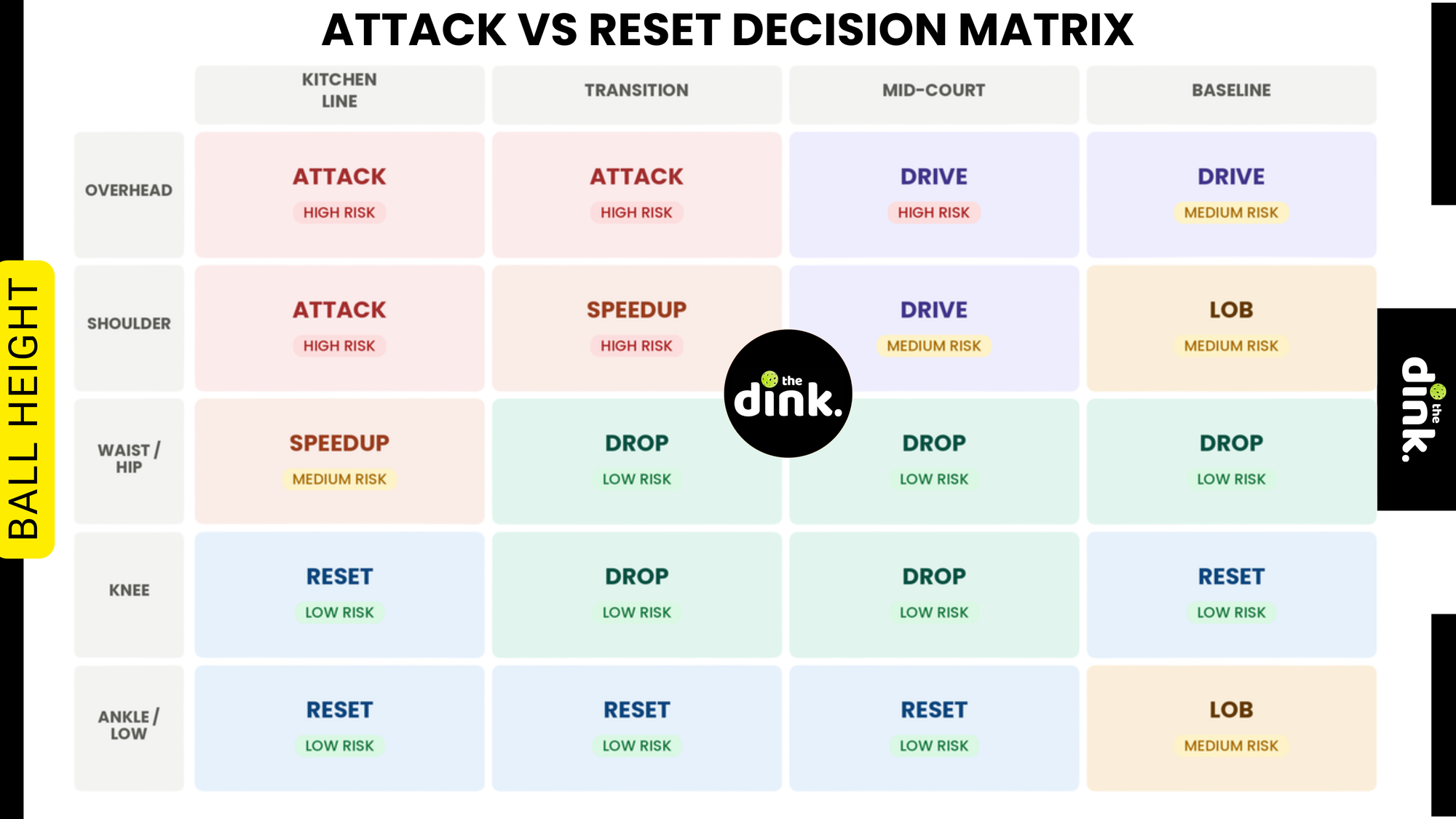
This Attack vs. Reset Decision Matrix simplifies that decision by organizing shot selection around two variables that determine almost every pickleball point: where you are on the court and how high the ball is when you contact it.
Once you understand those two factors, the right play becomes far more obvious.
How to Read the Matrix
The chart is built like a grid with two axes:
Horizontal (left → right): Court position
- Kitchen line
- Transition zone
- Mid-court
- Baseline
Vertical (top → bottom): Ball height at contact
- Overhead
- Shoulder height
- Waist/hip height
- Knee height
- Ankle/low
To use it, simply find the intersection of your court position and the height of the ball. The box tells you the recommended shot and the relative risk level.
Ball Height & Court Positioning: Your 1-2 Checklist for Pro-Level Shot Selection
Advanced pickleball means constantly analyzing the height of the ball and the court positioning off all four players in real time – and keeping this one rule sacred: just because you can hit a more aggressive shot doesn’t mean you should
 The Dink PickleballEric Roddy
For example:
- Kitchen line + shoulder-height ball → Attack (high risk)
- Transition zone + waist-high ball → Drop (low risk)
- Baseline + ankle-low ball → Lob (medium risk)
It’s essentially a quick mental model for deciding when to be aggressive and when to play safe.
Key Lesson #1: Ball Height Determines Aggression
The higher the ball, the more offensive your options become.
High balls (overhead or shoulder height) invite aggressive shots:
- Overheads
- Attacks
- Speedups
- Drives
But even here, the matrix shows that attacking near the kitchen can still be high risk because opponents are positioned to counter.
Conversely, low balls dramatically limit offensive options.
When the ball drops to:
- Knee height or lower
…the matrix consistently recommends resets or drops, which are labeled low-risk plays across nearly every court position.
The takeaway:
Low balls are rarely attackable balls.
11 Concrete Tips to Go From 3.5 to 4.5 in Pickleball
The difference between 3.5 and 4.5 players comes down to consistency, court awareness, and smarter shot selection
 The Dink PickleballThe Dink Media Team
Key Lesson #2: The Transition Zone Is Changing
One of the most interesting takeaways in the matrix appears in the transition area (between the baseline and the kitchen).
Historically, conventional wisdom would tell you to drop your way through the trickiest zone on the court.
Not anymore.
If a ball is waist height or below, your best bet is to play the soft game. But now, even from the midcourt, it can pay to be more aggressive on higher balls.
- The element of surprise works in your favor
- It gives you valuable extra time to move up
- You might even win an easy point or two
How to Attack (and Dodge Attacks) from the Pickleball Transition Zone
Due to technological advancements and pickleball athletes getting better and better, certain shots that were once rare or even considered taboo are now at the forefront of the game.
 The Dink PickleballEric Roddy
Key Lesson #3: The Kitchen Is Where Offense Happens
When you’re at the kitchen line, the chart shifts.
Higher balls here trigger:
- Attacks
- Speedups
These are the moments when players try to win the point.
However, the matrix also emphasizes discipline:
When the ball drops to knee height or lower at the kitchen, the recommendation flips back to:
Reset (low risk)
Even at the most aggressive position on the court, patience beats reckless offense.
Love pickleball fashion? Then subscribe to our free pickleball newsletter for the latest in pickleball news, trends, and style: https://subscribe.thedinkpickleball.com
Key Lesson #4: Drives and Lobs Have Specific Use Cases
Two other shots appear situationally:
Drives
- Common from mid-court or baseline
- Used on higher balls
- Carry medium to high risk
Drives are essentially pressure shots, used when a drop isn’t ideal.
Lobs
- Appear primarily from the baseline
- Work best on shoulder-height balls
From deeper court positions, the lob becomes a way to buy time or push opponents off the kitchen line.
Topspin in Pickleball: The Complete 3-Step Progression Guide
It’s one of those shots that looks effortless when done right, but feels impossible when you’re the one holding the paddle
 The Dink PickleballThe Dink Media Team
The Big Takeaway: Height First, Position Second
If there’s one concept the matrix reinforces, it’s this:
Ball height determines your shot more than anything else.
In simple terms:
- High ball → Attack
- Waist ball → Neutral shot (drop or speedup)
- Low ball → Reset
Court position then helps refine the safest option.
Players who internalize this decision framework tend to:
- force fewer attacks
- hit smarter drops
- extend rallies
- win more points through patience
And in pickleball, patience is often the difference between a highlight shot—and a lost rally.
Anuncie Aqui / Advertise Here
Sua marca para o mundo Pickleball! / Your brand for the Pickleball world!


 English (US) ·
  Portuguese (BR) ·