
 English
  Spanish
  Portuguese
  German
  Italian
  Japanese
  French
  Polish
  Russian
  Netherlands
  Hungarian
  Turkish
  Videos
  Thedink Pickleball

The chicken wing in pickleball is not a reaction speed problem, it is a paddle position problem. These five fixes stop you getting jammed at the body for good.
The chicken wing in pickleball is that ugly, jammed shot where a ball comes hard at your body and your elbow flies up like a wing.
You know the feeling. The ball is on you before you can move, and you either shove it into the net or spray it off the court.
Here is the good news. Getting chicken winged is not a reaction speed problem. It is a paddle position problem, and that means it is completely fixable.
Below are five fixes that stop the chicken wing for good, starting with the single mistake behind almost every one of them.
Love pickleball? Then you'll love our free newsletter. We send the latest news, tips, and highlights for free each week.
What is a Chicken Wing in Pickleball?
A chicken wing in pickleball is what happens when a ball is driven at your body and you are forced to hit it with your elbow raised and your paddle face turned sideways.
Your contact point ends up behind you, near your ribs or your hip, so you have no control and no power.
It shows up most at the kitchen line, where a hard driven ball at your body gives you almost no time.
But the reason you get jammed starts a full second before contact, and that is where the first fix lives.
Fix 1: Point your paddle tip at the ball
The number one cause of the chicken wing is bad paddle tracking.
Watch your paddle in the instant right before your opponent strikes the ball. If the tip is pointing sideways, you are already late.The fix is simple to say and worth drilling until it is automatic: keep your paddle tip pointed wherever the ball is.
When your tip tracks the ball, your paddle face is already square to it, so a shot at your body meets a ready blade instead of a folded elbow.
As the video puts it, "have your paddle tip pointed wherever that ball is." Do that and you catch the ball out in front, unjammed, every time.Drill it this way. Have a partner feed balls at your body from mid court while you focus on one thing only: keeping the tip up and tracking the ball.
Do not swing, just meet and block.
Ten minutes of that rewires the habit faster than any amount of live play, because it trains the paddle to be ready before your brain even registers the shot.
💡
Need some new pickleball gear? Get 20% off select paddles, shoes, and more with code THEDINK at
Midwest Racquet SportsFix 2: Move Your Contact Point in Front of Your Body
Even with good tracking, you get chicken winged when the ball beats you to your chest.
The answer is to win the race to contact by taking the ball earlier.
Reach out and meet the ball in front of your lead hip, not beside your body.
A contact point out front gives your arm room to work and keeps the paddle face pointed at your target.
This is the same principle behind a clean forehand counter.
Great counterpunchers do not swing harder, they simply take the ball sooner and let the opponent's pace do the work.
Why do so many players make contact late? Usually because they wait for the ball to come to them rather than stepping to meet it.
The instant you drift into a passive, wait-and-see stance, the ball wins the race and your elbow shoots up.
Staying on the balls of your feet with a slight forward lean keeps you in attack position instead of survival mode.
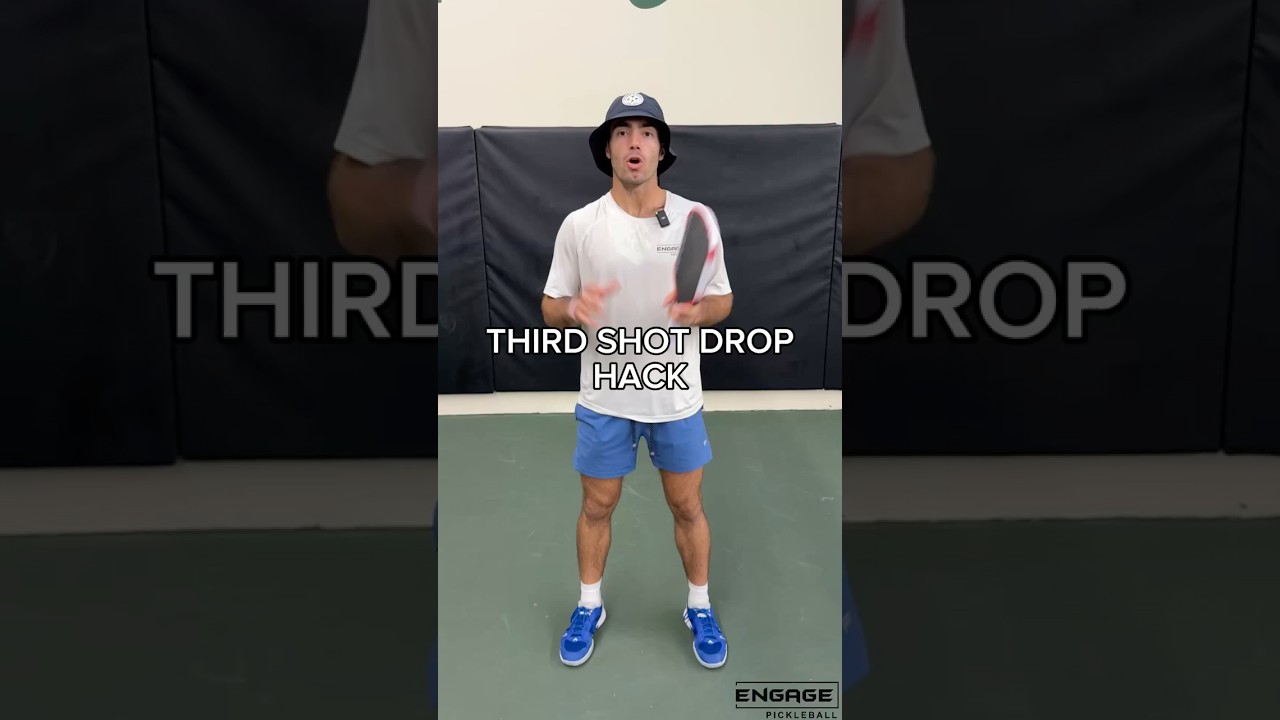
Master the Third Shot Drop in Pickleball
The third shot drop is one of pickleball’s most critical shots, and most players are making a fundamental mistake. Richard from Engage Pickleball reveals the contact point hack that will transform your consistency and get you to the kitchen line every time.
 The Dink PickleballThe Dink Media Team
Fix 3: Reset the Body Shot Instead of Fighting It
Not every ball at your body should be counter-attacked. When you or your partner float one up, the smart play is to reset the ball rather than try to win the exchange.
Soften your grip and think of catching the ball, not hitting it.
Meet it out in front with a relaxed paddle and drop it back into the opponent's kitchen so they cannot attack again.
Coach Mary Barsaleau makes the same point in her breakdown of how to deal with body shots: set up with your paddle up, take the pace off, and let your opponent provide the power while you simply block it low.That mindset turns a scary body shot into a routine hands battle you control.
Knowing when to reset and when to fire back is its own skill.
The strongest players read the height and pace of the incoming ball in a blink, and the best hands battle habits come down to defaulting to a reset when the ball is on you and only speeding up when you get a clean look out in front.
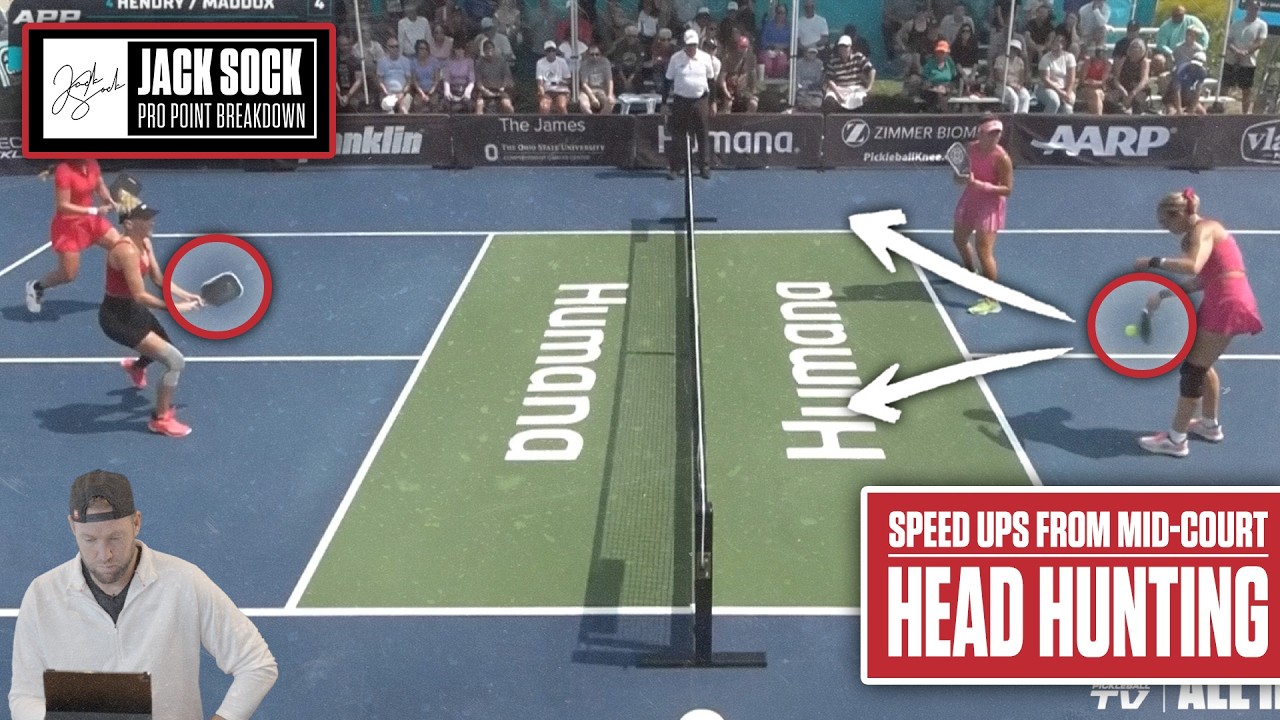
How to Defend Against a Body Bag in Pickleball
The key is to let the ball do some of the work for you. Rather than generating your own power, you’re redirecting the incoming pace back toward your opponent.
 The Dink PickleballThe Dink Media Team
Fix 4: How Do You Protect Your Body at the Kitchen Line?
You protect your body by hiding your target and keeping the paddle in front of your hitting shoulder. Picture a bullseye on your chest and make it hard to hit.
Turn your core slightly and keep your non-hitting hand up and in front of you.
That small rotation shrinks the target and gives your paddle a head start toward the ball.
Footwork matters just as much. Shuffle to a balanced spot with both hands in front rather than reaching across your body, which is exactly how players who stop getting attacked at the kitchen stay square and ready.
Here is a quick pre-shot checklist to run before every ball at the net:
- Paddle up and out in front, tip tracking the ball
- Grip relaxed, ready to counter or reset
- Non-hitting hand up to protect your chest and balance you
- Feet moving to keep contact in front of your lead hip
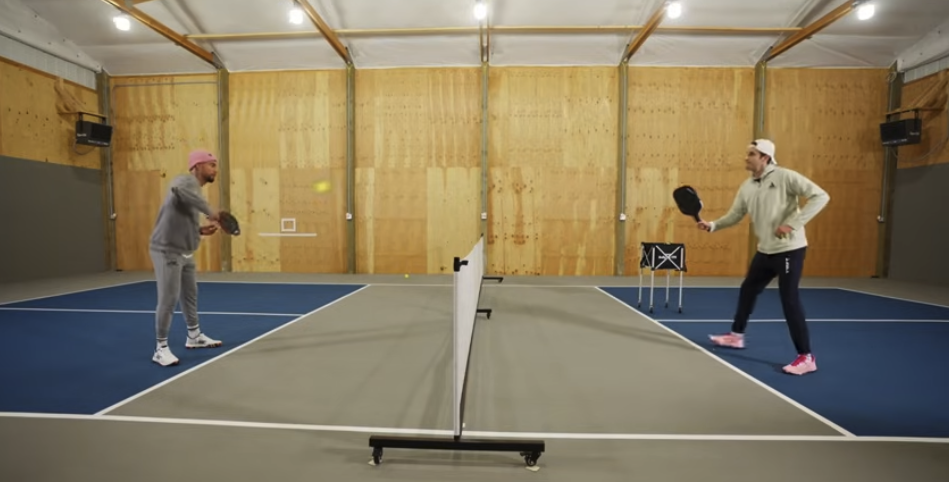
Push & Block: How to Play Smart Defense at the Kitchen Line
Rather than fight fire with fire when you’re outmatched at the kitchen line, the sounder approach is to calm things down and get back to neutral footing.
 The Dink PickleballAlex E. Weaver
Fix 5: Build the Hand Speed that Buys You Time
Better paddle position removes most chicken wings, but faster hands remove the rest.
The quicker your hands, the more margin you have when a ball is drilled at your midsection.
The best part is you can train this alone. To build faster hands, all you need is a wall.
In her tip on wall drills for faster hands, Coach Mary shares a simple progression: alternate forehand and backhand, keep your elbow down, and reset your paddle after every hit.Speed up into the wall, then block or counter the rebound.
Run that for ten minutes a day and pair it with a structured hand speed drill, and the jammed reaction disappears.
It also helps to choke up on your grip slightly, which makes the paddle feel lighter and quicker in tight exchanges.Watch Anna Leigh Waters at the kitchen line and you will see all five fixes at once: her paddle tip stays on the ball, her contact is always in front, and her hands are set before the ball ever arrives.That is why she almost never gets chicken winged, even against the hardest speedups.
💡
Heads up: hundreds of thousands of pickleballers read our free newsletter.
Subscribe herefor cutting edge strategy, insider news, pro analysis, the latest product innovations and more.
Frequently Asked Questions
What does chicken wing mean in pickleball?
The chicken wing is the awkward, jammed shot you make when a ball is hit at your body and you are forced to raise your elbow and turn your paddle sideways to reach it. The name comes from the raised elbow, which looks like a wing.
Why do I keep getting chicken winged in pickleball?
Almost always because your paddle is late. If your paddle tip is pointing sideways when your opponent strikes, you cannot get the face square in time, so the ball jams you at the body.
How do I stop getting jammed at the kitchen line?
Keep your paddle up and out in front with the tip tracking the ball, and take contact in front of your lead hip. Add a relaxed grip so you can reset soft body shots instead of fighting them.
Is the chicken wing a backhand or a forehand problem?
It usually shows up on balls hit at your dominant shoulder and hip, where your instinct is to lift the elbow. Building a reliable backhand counter gives you a cleaner option than winging the elbow up on those balls.
What drill fixes the chicken wing fastest?
Wall drills. Alternating forehand and backhand blocks against a wall trains your paddle to stay in front and square, which is the exact position that prevents the chicken wing.
Anuncie Aqui / Advertise Here
Sua marca para o mundo Pickleball! / Your brand for the Pickleball world!




 English (US) ·
  Portuguese (BR) ·