
 English
  Spanish
  Portuguese
  German
  Italian
  Japanese
  French
  Polish
  Russian
  Netherlands
  Hungarian
  Turkish
  Videos
  Thedink Pickleball

How one Kansas City company used decades of baseball product experience to solve one of pickleball's most enduring problems: translating paddle jargon into measurable performance data
Buying a pickleball paddle used to be simple. Then the sport exploded.
Now? It’s overwhelming.
Hundreds of brands. Thousands of models. Endless shapes. Performance buzzwords claiming superiority in every conceivable metric. It feels like everyone claims to have the perfect paddle.
Most players, especially recreational ones, are left guessing.
That’s the problem JustPaddles is trying to solve. For the everyday pickleball consumer, yes. But also for the sport as a whole.
With so many new paddles hitting the market every day – manufactured by everyone from global behemoths to one-person brands based in a garage – how can we tell the difference between promise and performance, imitation and innovation, inaccuracy and authenticity?
Their solution isn’t yet another paddle or more senseless marketing jargon.
It’s data.
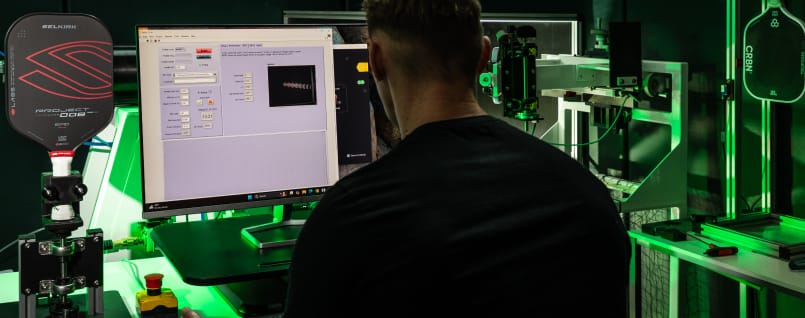
At the center of JustPaddles’ approach is the Paddle Lab — a proprietary, in-house testing system designed to bring objective, measurable performance data into a space long dominated by opinion and conjecture.
“The barrier to entry with paddles is so low,” said Andrew Dowis, CEO of Pro Athlete, the parent company behind JustPaddles.
“People can spin up a paddle in their garage and have a brand within a week.”That explosion of brands has created what Dowis calls “volatility” — a market where hype can often outpace performance.
“So we just thought, what needs to come in and neutralize this and clean it up?” he said. “Instead of opinions driving this, what about data?”
From that, the Paddle Lab was born.
Based in Kansas City, JustPaddles didn’t start in pickleball. Its DNA comes from decades of specialization in other sports.
The company’s parent business, Pro Athlete Inc., built its reputation through focused baseball and softball verticals (named, you guessed it: JustBats and JustGloves) — platforms designed to be product experts, not generalists.
“One advantage is we laser focus on one product,” Dowis explained. “Instead of going to a store where you’re talking to a generalist, you’re going to call us and we’re going to know everything about it.”
That philosophy carried over to pickleball. But expertise in a fast-moving, innovation-heavy sport isn’t built on experience alone.
And unlike some sports, the vast majority of paddle purchases are done online, sight unseen.
To do pickleball right, JustPaddles needed a digital infrastructure.
“The Paddle Lab is the catalyst to being the experts,” Dowis said.
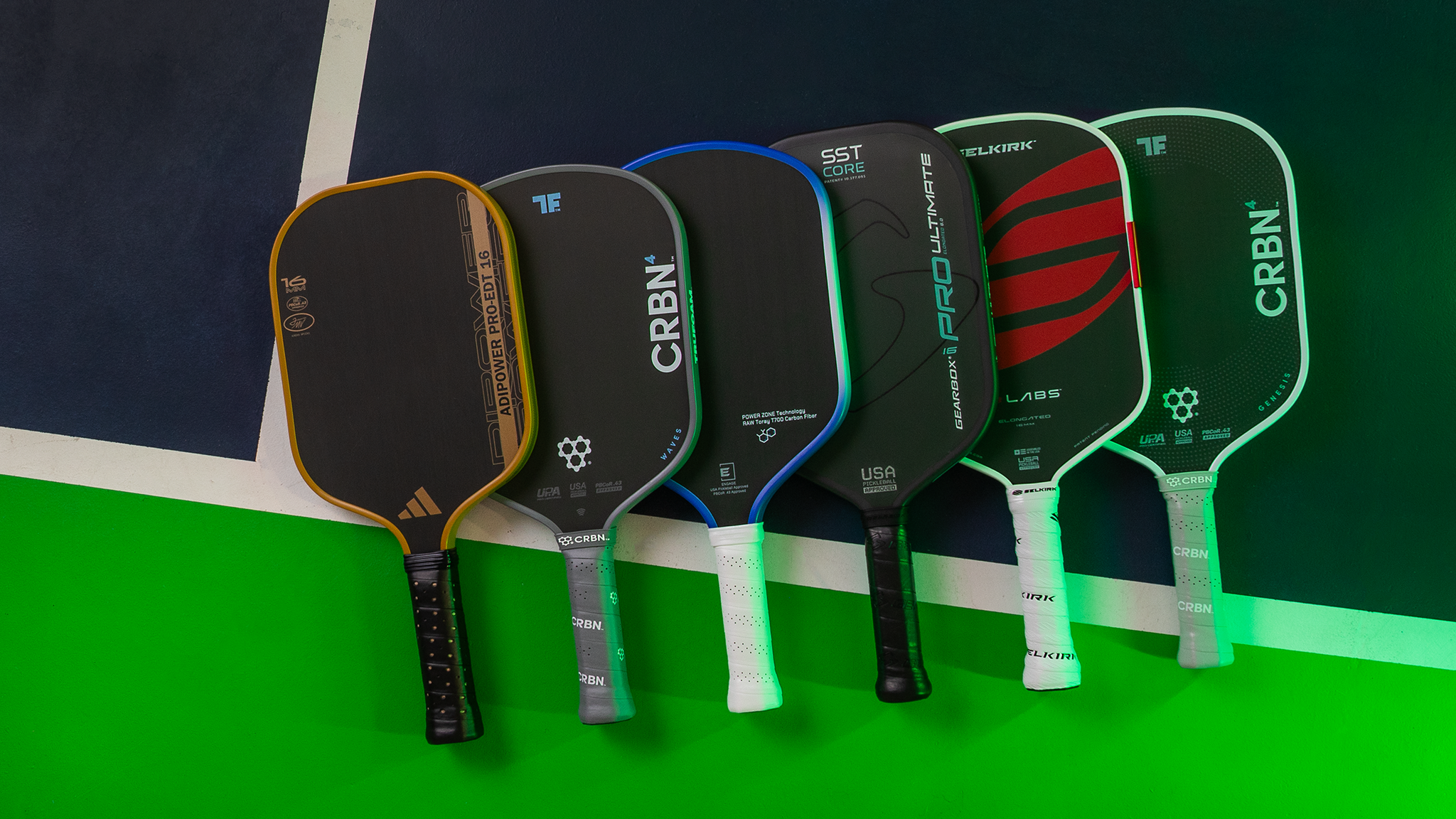
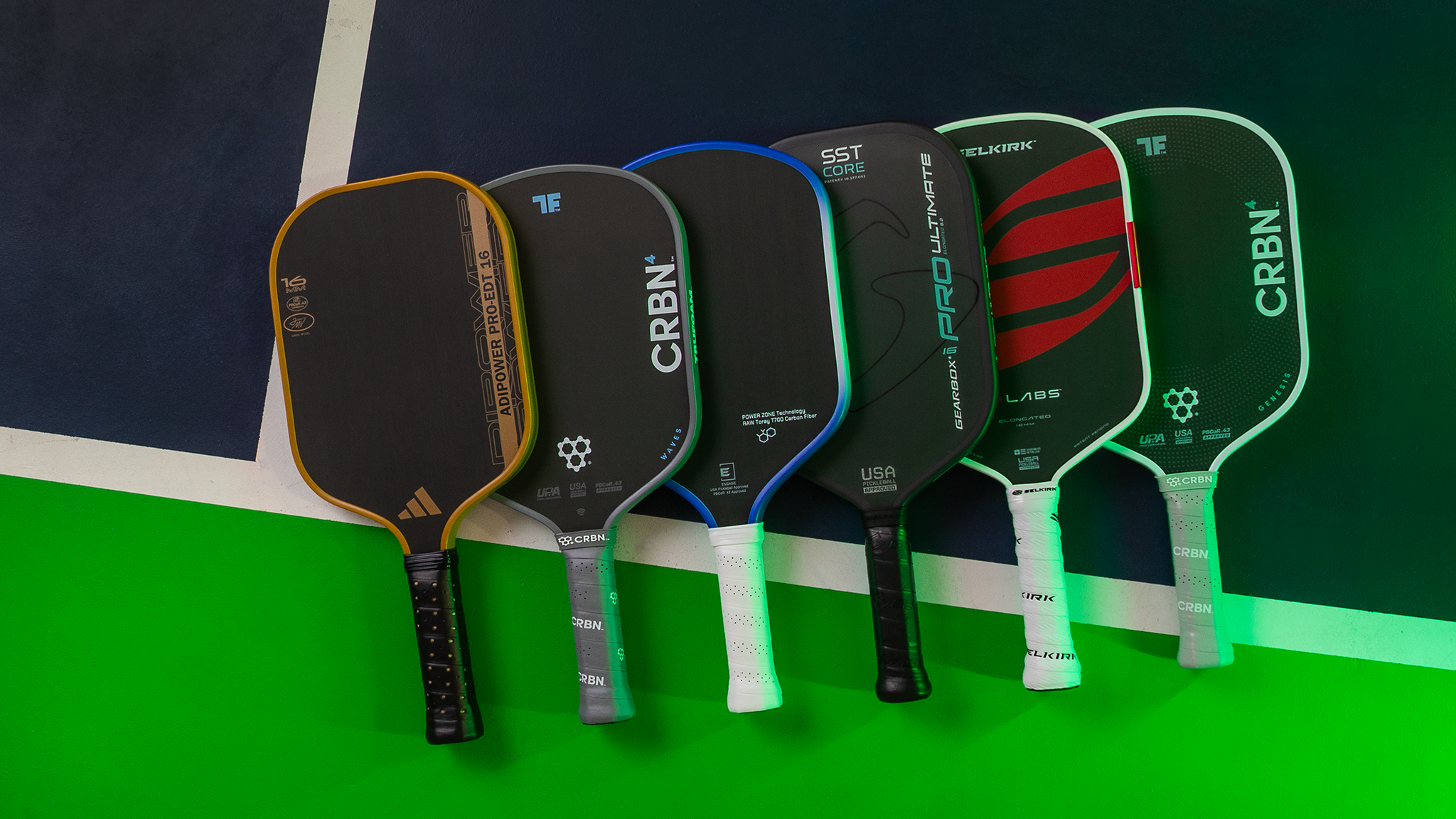
In the market for a new paddle but don't know where to start? Try the Paddle Lab — independent, unbiased performance data on more than 500 paddles.
This isn’t a marketing gimmick. It’s a full-scale testing operation.
Every paddle that enters JustPaddles’ inventory is put through a standardized testing process, ensuring the data reflects the performance output that customers actually feel on the other end.
From there, each paddle undergoes six core tests:
- Exit velocity (power): Exit velocity is the speed at which the ball leaves your paddle after contact.
- Swing weight: How heavy a paddle feels during play, which can differ from its actual static weight.
- Spin rate: Measured in rotations per minute (RPMs), demonstrating how much spin a paddle generates on the ball.
- Twist weight: Measures the stability of your paddle when you strike the ball off-center.
- Balance point: How weight is distributed in your paddle.
- Consistency: How evenly a paddle performs along its vertical axis—from the handle to the head.
Each test is designed to simulate real gameplay, not lab-induced extremes.
“The results that you’ll get from our exit velocity is more of an in-game performance,” said lead buyer Jason Schulz.
“It’s not just trying to maximize the power… but to give you more of what an in-game experience would be.”The process is intensive. Each paddle takes roughly 90 minutes to two hours to test.
Since launching Paddle Lab about six months ago, the JustPaddles team hasn't stopped testing paddles, building its database to more than 500 paddles and counting.
Pickleball players don’t lack information. They lack clarity.
Scroll through paddle reviews and you’ll find endless subjective ratings:
- “9/10 power”
- “Great control”
- “Perfect blend of feel and pop”
- "Superior dwell time and feedback"
But what how is any of that useful to your own game, your own experience?
“There is a lot of marketing jargon out there,” Schulz said. “You might see somebody says the paddle’s nine out of 10 in power. What does that mean?”
The Paddle Lab replaces that ambiguity with measurable benchmarks.
- Want power? Look at exit velocity.
- Want spin? Check RPM output.
- Want forgiveness? Study consistency metrics across the paddle face.
“If you’re looking for a superpower paddle, look for something with high exit velocity,” Schulz explained. “That’s going to be your best bet.”
It’s not telling you what to buy.
It’s giving you the tools to decide.
Power and spin get the headlines. But one of the most revealing metrics in the Paddle Lab might be consistency.
This test measures how much performance varies across the paddle face vertically from the tip, through the sweet spot, and down to the throat.
- Higher consistency allows you to trust your paddle to respond predictably, even if your contact isn’t perfect.
- Lower consistency means performance may vary based on where you strike the ball.
Paddles that score at the top of the consistency list include the Six Zero Coral, Gearbox GX2 Power, and CRBN TruFoam Barrage.
And while it's natural to want to align a metric like consistency with softer shots like dinks and resets, don't be so quick to judge.
This measurement is also critical for players seeking reliable performance during fast-paced exchanges or when stretched out of position.
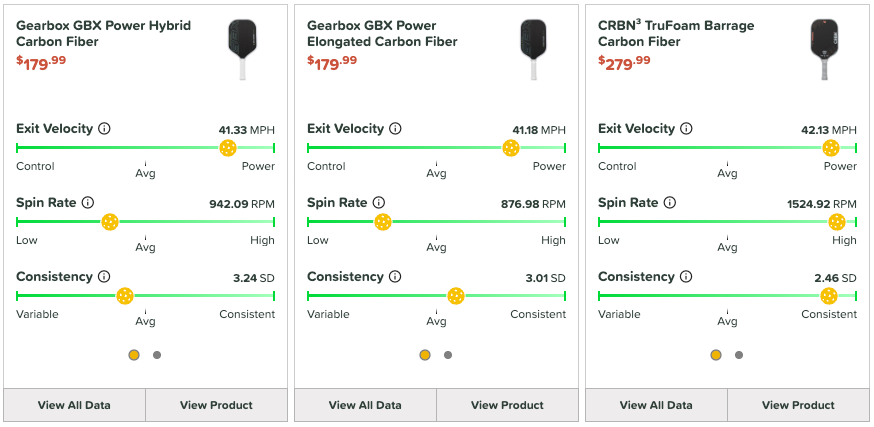
One of the smartest and most actionable elements of the Paddle Lab is how it’s presented.
The data isn’t buried behind dense, technical dashboards. It’s integrated directly into the shopping experience.
“I think the lab could serve two different demographics,” Dowis said. “The average person… it’s right there to just give them that boost to either buy that one or buy this one.”
But for those who want to go deeper?
“If you want to geek out on it, you can geek out on it,” he added.
That dual-layer approach is critical. It meets players where they are—whether they’re buying their second paddle or their tenth.
Perhaps the most important—and underrated—aspect of the Paddle Lab is independence.
JustPaddles doesn’t manufacture paddles. It sells them.
That distinction matters.
“We don’t really care what paddle you buy,” Dowis said.
“We just want you to buy the right paddle for you.”That neutrality allows the Paddle Lab to function as something rare in pickleball: An unbiased source of performance data.
It also opens the door to deeper collaboration with brands.
“We’ve definitely tested some prototypes for brands… to provide feedback and kind of where it stacks up,” Schulz said.
In other words, the Paddle Lab isn’t just helping consumers.
It’s quietly influencing product development on a deeper, more analytical level.
It’s important to understand what the Paddle Lab is not.
It’s not a governing body. It’s not a certification system.
“This has nothing to do with certification,” Dowis said. “These are performance-based metrics to help you get the best paddle for your game.”
That distinction is key.
Certifications tell you whether a paddle is legal. The Paddle Lab tells you how it plays.
And in a sport where governing bodies don’t publish detailed performance data, that gap can be massive.
In the market for a new paddle but don't know where to start? Try the Paddle Lab — independent, unbiased performance data on more than 500 paddles.
Zoom out, and the Paddle Lab represents something bigger than a better shopping experience.
It’s an attempt to raise the standard across the entire industry.
“The idea was this will hopefully elevate all the brands,” Dowis said. “I’ve got to produce really good paddles, or it’s going to be obvious because of this data.”
That’s the real unlock.
When performance is measurable and transparent, marketing claims become testable. And when claims become testable, products get better.
Dowis put it more simply: “This is our gift to the game.”
Pickleball isn’t slowing down. Neither is innovation in paddles.
New materials. New cores. New surface technologies. More noise.
For players, the challenge isn’t finding options. It’s choosing the right one.
The Paddle Lab doesn’t eliminate that decision. But it does something far more valuable: It replaces guesswork with clarity.
“We want customers to feel confident in the paddles that they’re using,” Schulz said.
In a market built on opinions, that might be the most disruptive idea of all.
Anuncie Aqui / Advertise Here
Sua marca para o mundo Pickleball! / Your brand for the Pickleball world!




 English (US) ·
  Portuguese (BR) ·