
 English
  Spanish
  Portuguese
  German
  Italian
  Japanese
  French
  Polish
  Russian
  Netherlands
  Hungarian
  Turkish
  Videos
  Thedink Pickleball

We analyzed more than 4,000 USAP-approved paddles over a five-year span. Here are five trends that point toward a maturing, more consumer-friendly market.
Nobody is denying that the pickleball paddle market is booming, but it's probably already peaked.
And that's not a bad thing.
USA Pickleball's Approved Paddle List, spanning some 4,101 paddles certified over the past five years, reads like the story of a gold rush that's already starting to dry up.
We pulled every entry from the USA Pickleball Approved Paddle List from May 2021 through May 2026 and analyzed the lot: certification dates, number of brands, core materials, one-hit wonders, all of it.
Five trends stood out. Together they paint a picture that goes beyond just a boom and a possible bust.
Sure, far fewer brands are pushing paddles through USAP certification these days. But there are lots of different reasons for that. And many point toward a healthier longterm paddle landscape rather than just a contracting one.
Before the What, Let's Look at the Why
We talked to a few prominent paddle brands to get a sense of what factors contribute to the ebb and flow of paddle certifications.
On its face, it's easy to understand why hundreds of paddles were flooding through USAP's doors just a few short years ago – the nation was emerging from COVID, pickleball as a serious hobby had exploded, and the equipment market was ripe for the taking.
A couple years on, we've learned a few things. Here are a few to keep in mind before we take a closer look at the numbers.
- Certification is somewhat seasonal: the fall season tends to have more submissions, as brands often prep to launch major releases in spring.
- Foam core paddles only broke into the market in January 2025, but now they're ubiquitous. Their manufacturing opens up a world of possibilities for different core constructions, but also extends the time to market considerably.
- Mercurial oil prices and other political and economic factors continue to impact the way brands are making decisions.
- Larger brands are starting to more strictly enforce their patents. This places more emphasis (and time) on R&D before brands can jump to market with the new hot technology.
- USA Pickleball is reportedly in the comment period for a new spin testing protocol they've been developing for years; once this is formalized, it's possible we see another uptick in submissions.
Again, these are just a few factors influencing the current evolution in USAP paddle certification trends.
1. Is the Pickleball Paddle Market Boom Already Over?
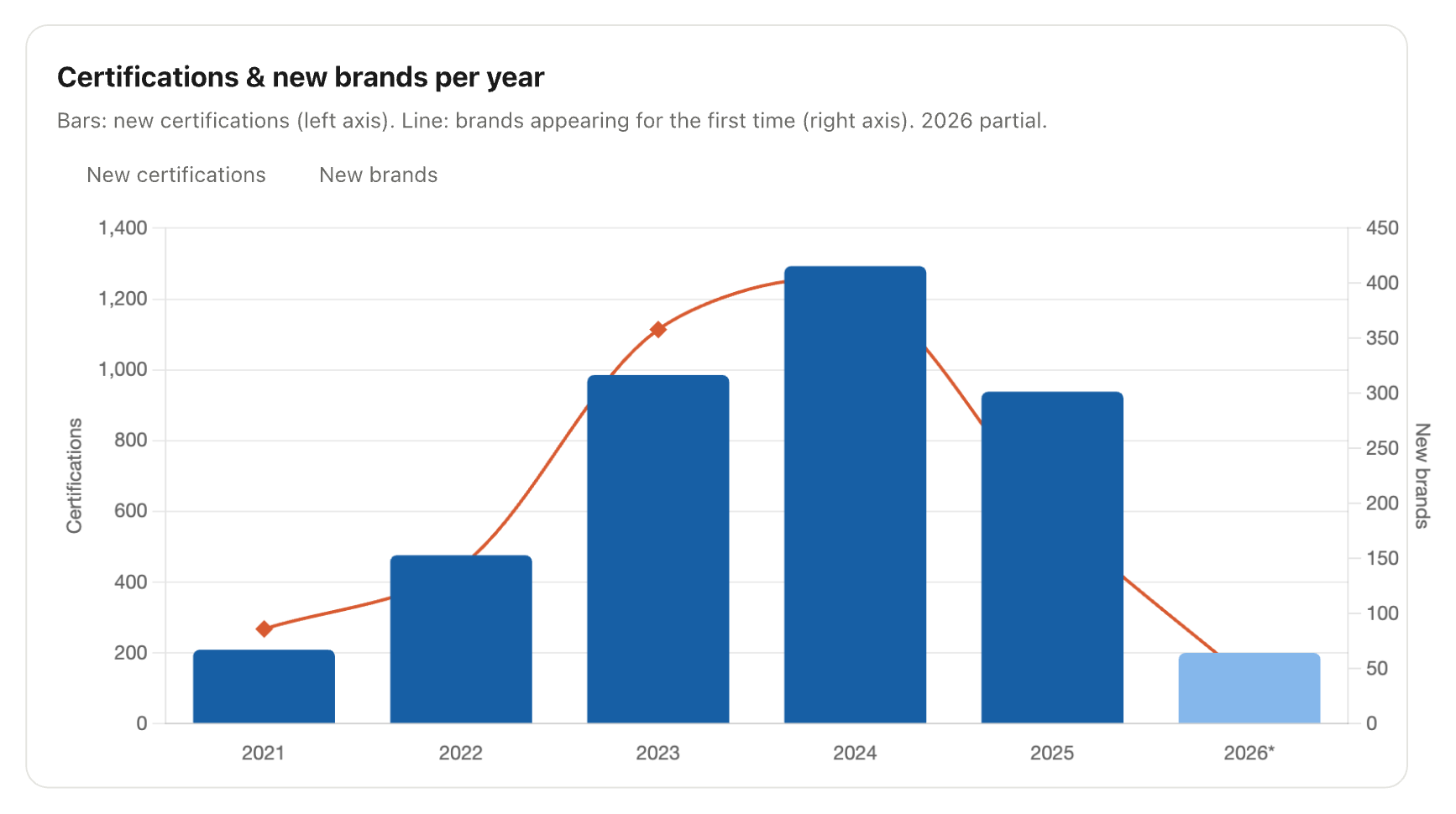
New paddle certifications peaked at 1,293 in 2024, fell 27% in 2025, and are on pace for roughly 518 in 2026, about 60% below peak in just two years.
That's a fairly stark decline. But it's not entirely surprising. Pickleball is growing at such an explosive pace, it's natural to feel like it's maturing just as quickly.
There are millions of people playing the world over, to be sure. But no sport can realistically support hundreds of suppliers of the same piece of equipment. Look at soccer, hockey, golf, lacrosse, tennis... the list goes on and on.
At some point, the cream rises to the top. The best brands separate from the pack and the masses start to gravitate toward the brands who have successfully built a reputation around performance, quality, and price.
Is This the Craziest USAP-Approved Pickleball Paddle Yet?
Crazy long handle. Edgeless design. Massive throat holes. Alien-like head construction. Intense color scheme. $400 price tag.
 The Dink PickleballAlex E. Weaver
For pickleball, the climb was steep: 209 new certifications in 2021, hen a near vertical run to the 2024 peak as America's fastest growing sport pulled every garage entrepreneur and overseas factory into the paddle business.
The descent has been just as steep. Here is the certification timeline in plain terms:
- 2021: 209 new paddles approved. The early days.
- 2024: 1,293 approved. Peak gold rush, more than 3 new paddles every single day.
- 2025: Down 27% from the peak.
- 2026: On pace for ~518, roughly 60% below the 2024 high.
Now the market is maturing. Evolving. Identifying those brands with lasting power and those that were just a flash in the pan. Regulations are tighter. Patent protection is stricter. Players are starting to pick and choose the handful of brands they like and stick to them.
From the consumers' perspective, paddles are just better these days. And cheaper.
A small collection of brands have separated themselves as industry leaders. The options are endless, sure, but as quality goes up and prices comes down, perhaps there's less and less incentive to jump ship to the "next best thing"?
2. Half of All Paddle Brands Are One Hit Wonders
Of the 1,214 distinct brands on the approved list as of May 2026, 611 certified exactly one paddle and never came back. That is half the pickleball paddle market: one paddle, one approval, gone.
Even the giants do not dominate the list. The top 10 brands hold just 13% of all approvals. This is still a wildly fragmented market, which is exactly why paddle databases have become essential shopping tools.
The volume leaders will mostly look familiar:
- Franklin Sports tops the list with 108 approved paddles, aided in no small part by the signing of star Anna Leigh Waters
- JOOLA is close behind with 99
- Engage (91)
- Paddletek (78)
- Selkirk Sport (67)
- ProXR (52)
The long tail is where it gets weird. Hundreds of brands you have never heard of, including some responsible for the wackiest USAP approved paddle we have covered, got one paddle through the process and vanished.
That churn matters for your wallet. A brand that disappears cannot honor a warranty, and orphaned paddle molds are exactly the kind of inventory that helps feed the fake paddle scam at big box stores.
💡
100s of thousands of pickleballers read The Dink Newsletter, including pros, business owners, beginners & (probably) your grandma. Click here to subscribe, it's free.
3. Why Did Paddles Get So Thick?
Average core thickness across new approvals rose from 12.6mm in 2021 to 15.4mm in 2026, and paddles 16mm or thicker went from 15% of approvals to 74%.
Thin paddles are nearly extinct: sub 14mm models fell from 64% of the list to just 7%.
Quick definition for newer players: core thickness is the depth of the honeycomb or foam layer between a paddle's two faces.
- Thicker cores absorb more pace and enlarge the sweet spot, giving you control and forgiveness.
- Thinner cores rebound faster, giving you pop at the cost of stability.
It's true that some 14mm paddles provide more throat flex and thus give the perception of playing softer. But largely, the market has come to equate thicker cores with increased control.
By and large, the market is evolving and the meta is moving back to control. As rec players got better and the soft game spread, manufacturers seemingly followed demand straight to 16mm. And they seem pretty intent to stay there.
JOOLA Files Patent Infringement Case Against 11 Paddle Brands
The legal action names major brands including Franklin, RPM and Paddletek as defendants, claiming “unauthorized use of its proprietary propulsion core technology.”
 The Dink PickleballAlex E. Weaver
4. The Spin Era Took Over the Pickleball Paddle Market
Raw carbon fiber and textured spin faces grew from 27% of new approvals to 62%, overtaking printed and spray-on faces around 2023.
If you have demoed a paddle lately, you felt this shift before you read it. Modern faces grip the ball longer, and the right topspin technique turns that grit into heavy, diving drives.
Spin is also the first thing to disappear on a knockoff. When we went testing counterfeit pickleball paddles, the fake faces lost their texture almost immediately or never had it to begin with.
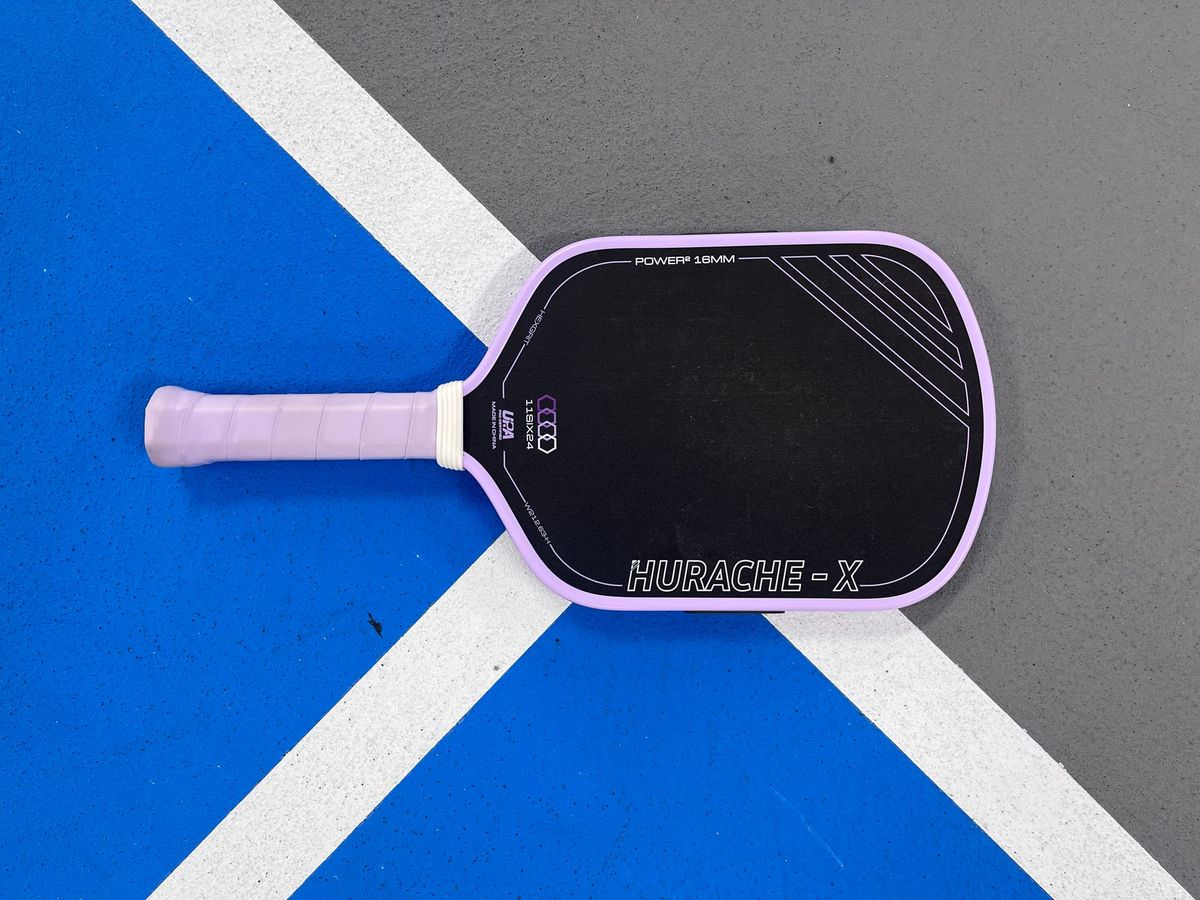
Now, the newest trend is longer-lasting surface grit as found on the 11Six24 Power 2 Series, Six Zero Coral, Selkirk Boomstik and Omni, and others.
Whereas the question used to be, "How hard does it hit?", now it's, "How long does the spin last?"
11Six24 Launches Power 2 Paddle With HexGrit Spin Tech
The brand’s new Power 2 paddle line features a proprietary silicon-carbide surface material designed to solve one of the industry’s most persistent problems.
 The Dink PickleballAlex E. Weaver
5. Foam Cores Have Effectively Replaced Polypropylene
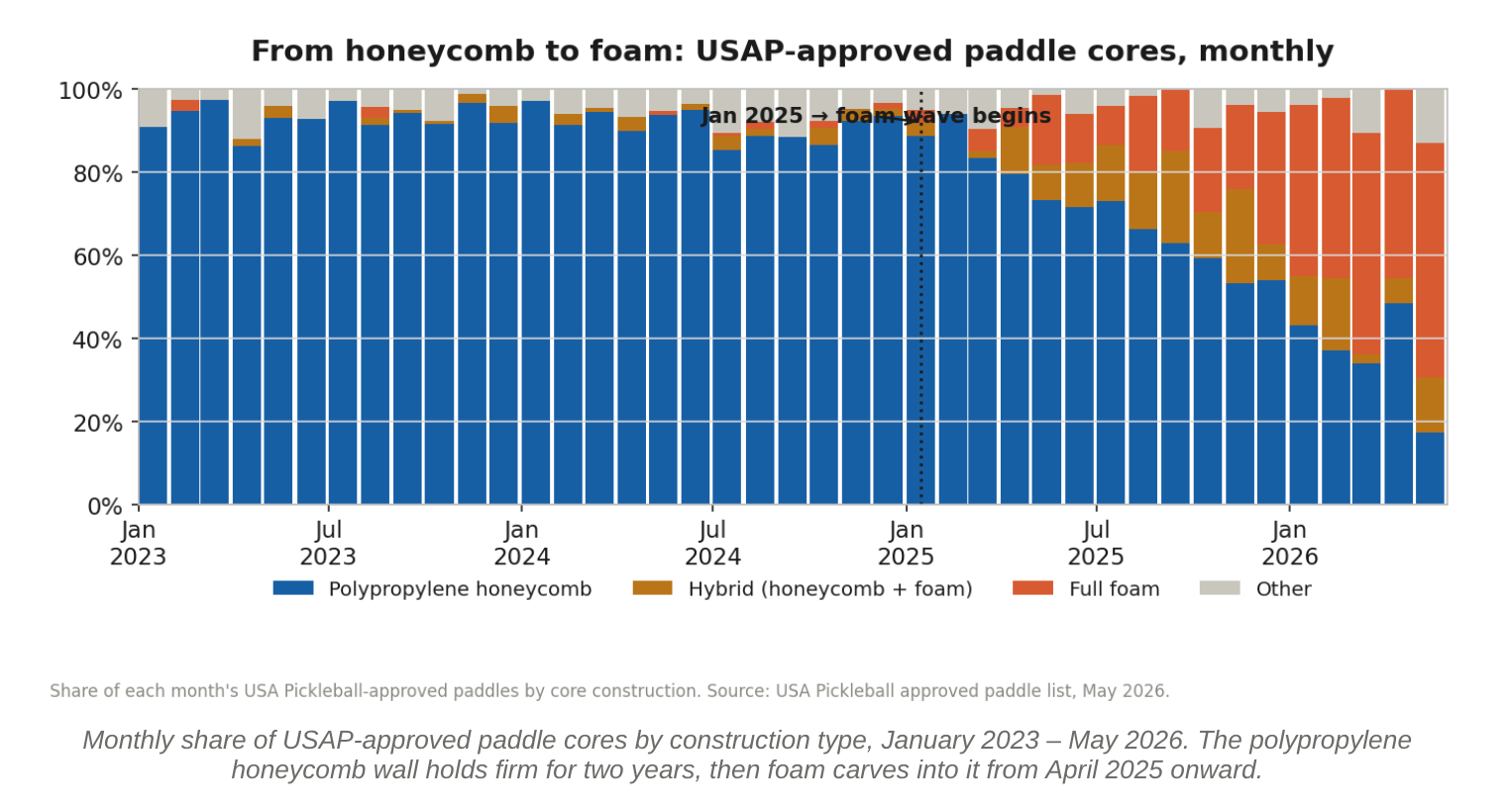
Before January 2025, 91.5% of every paddle USA Pickleball approved used a polypropylene honeycomb core, and foam was under 2%.
Since then, foam constructions account for 28% of new approvals, and in May 2026 fully 70% of newly approved paddles had foam in them.
The crossover came in March 2026: full foam paddles alone outnumbered polypropylene honeycomb in new approvals for the first time, 53% to 34%. The core that defined the modern paddle for half a decade is being replaced in real time.
The brands chose sides fast.
- Ronbus went all in (12 of 12 approvals since January 2025 are foam)
- CRBN matched it (9 of 9)
- Enhance is at 10 of 11
The incumbents flipped at scale too: Selkirk built foam into 82% of its post-2025 approvals, a number that's only likely to increase.
Holbrook followed suit at 77%, Wilson at 64%, and Vatic Pro and Gearbox both at 56%.
The contrarian is the biggest one.
JOOLA, the volume leader that helped define the state of amateur and pro pickleball, has 45 new approvals since January 2025 and not one uses foam.
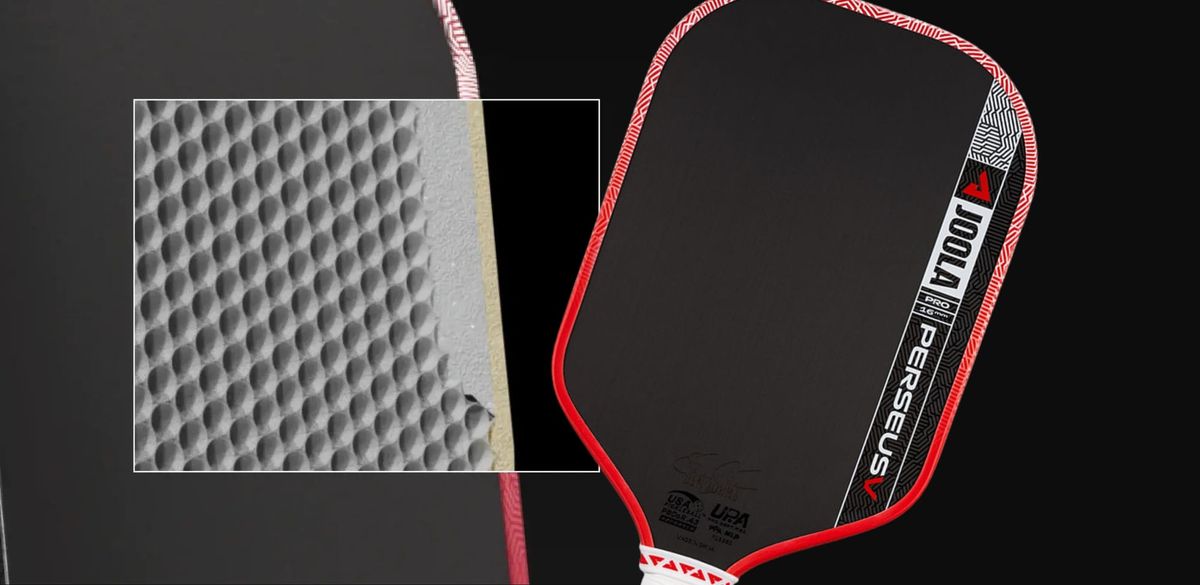
The honeycomb construction inside Ben Johns' Perseus Pro V line is still the company's whole bet, and Franklin Sports is right there with 28 approvals, all polypropylene. Two of the highest volume mainstream brands are making opposite bets on what a paddle should be built from – for now.
At this point, it's safe to say foam isn't a matter of if for these brands, but when.
The honeycomb era did not end with a press release. It ended quietly, one approval at a time, starting in spring 2025. Not the future is foam.
This Might Actually Be the Wackiest USAP-Approved Paddle Yet
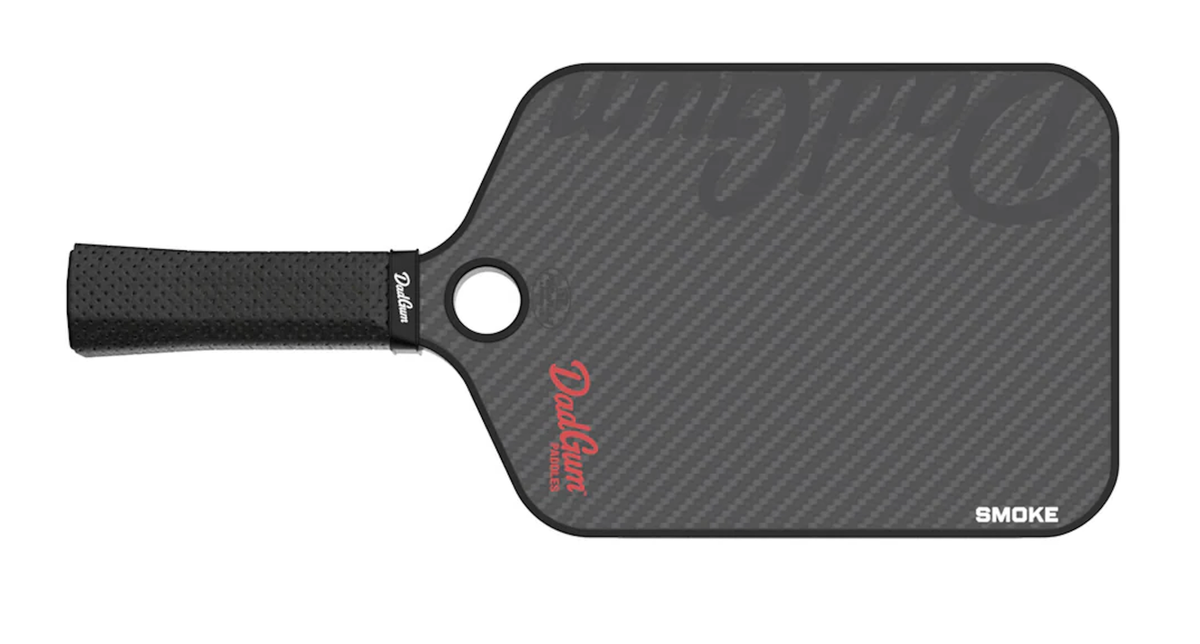
Square top. Round throat hole. No regrets.
 The Dink PickleballAlex E. Weaver
What This Means for You
A maturing pickleball paddle market is good news for you, the player.
When try-hards and wannabes are filtered out, only serious brands will remain. From there, the spotlight will shine even brighter on what matters most: performance, quality, durability, price, and customer service.
New brands will rise. Established brands will wither on the vine or go the way of mergers and acquisitions (like we just saw with Bread & Butter and Selkirk).
Behind it all, innovation will continue to win out. Brands that care about player experience rather than making a quick buck will be rewarded. Those that copy and paste from others and throw their hands up
💡
Heads up: hundreds of thousands of pickleballers read our free newsletter. Subscribe here for cutting edge strategy, insider news, pro analysis, the latest product innovations and more.
A few caveats on the data:
- This is the currently approved list, so decertified paddles are absent and earlier years undercount their original volume.
- Certification dates also are not retail launch dates.
- The core material field on each listing is free text, so treat the monthly foam percentages as accurate to within a few points.
Anuncie Aqui / Advertise Here
Sua marca para o mundo Pickleball! / Your brand for the Pickleball world!



 English (US) ·
  Portuguese (BR) ·