
 English
  Spanish
  Portuguese
  German
  Italian
  Japanese
  French
  Polish
  Russian
  Netherlands
  Hungarian
  Turkish
  Videos
  Thedink Pickleball

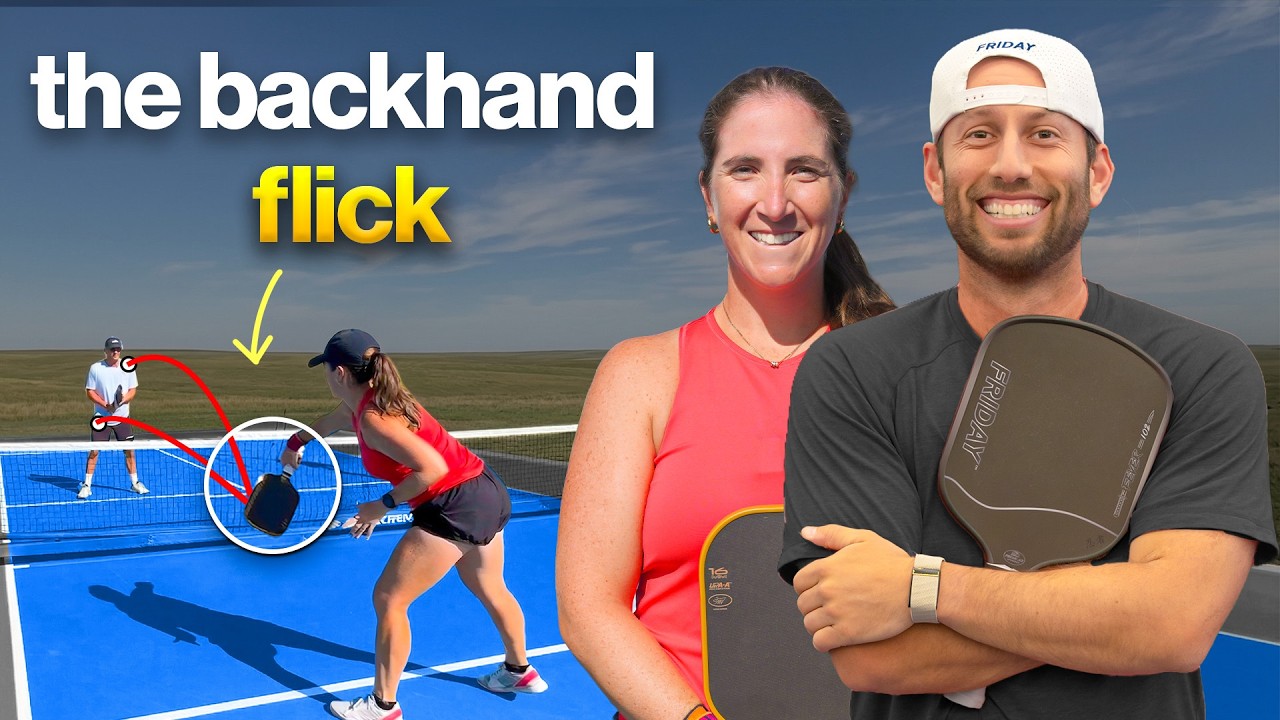
Stop blending your backhand shots into one confused motion. Discover how to execute a clean backhand flick pickleball shot, adjust your body mechanics, and confidently choose the right attack to win more points.
The backhand flick and backhand roll are two of the most misunderstood shots in pickleball.
Most players either combine them into one confused motion or struggle to know which one to hit in any given situation.
But here's the thing: these shots have completely different purposes, mechanics, and moments when they shine.
Once you understand the distinction, your backhand attacks become cleaner, more controlled, and far more effective.
Love pickleball? Then you'll love our free newsletter. We send the latest news, tips, and highlights for free each week.
What's the Real Difference Between the Backhand Flick Pickleball Shot and the Roll?
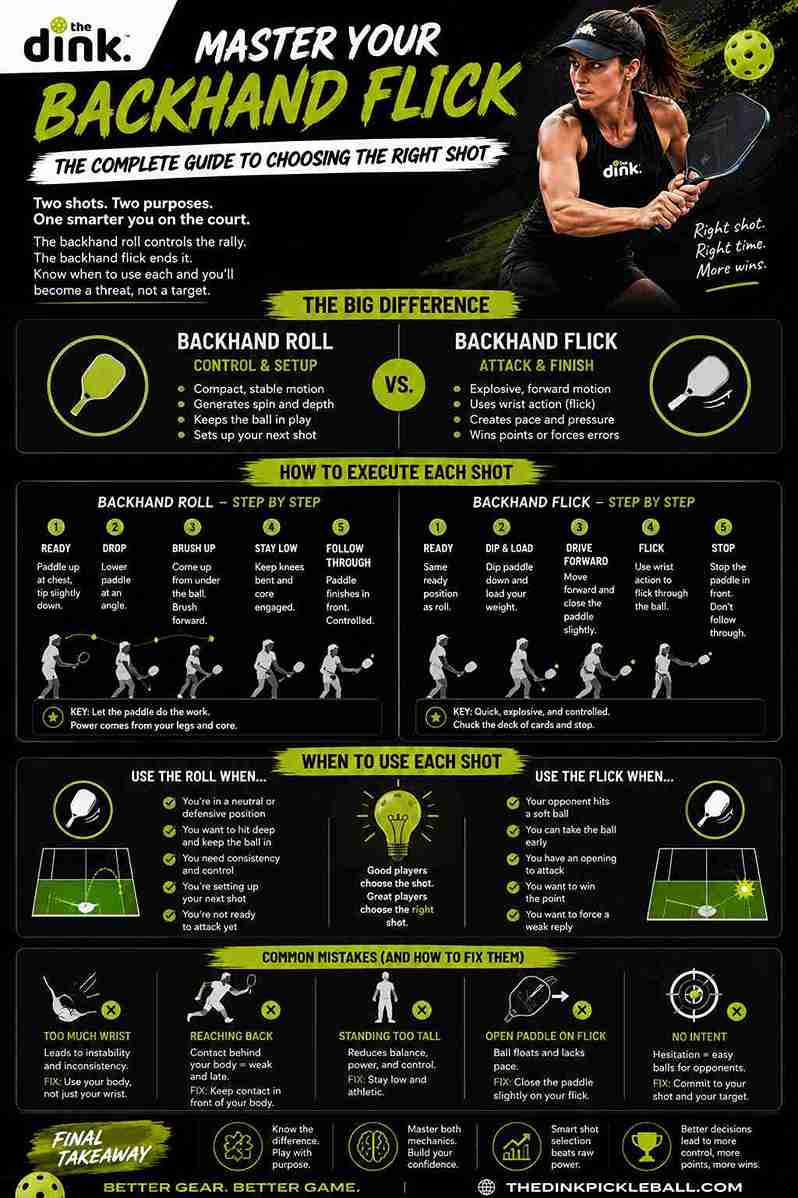
The backhand roll is the stable, controlled option. It's a compact motion where the paddle does most of the work, not your arm or wrist.
You're brushing under the ball, creating spin and depth without explosive power.
Think of it as the setup shot. The one that keeps the ball in play and sets you up for the next opportunity.
The backhand flick pickleball shot, by contrast, is your attacking weapon. It's got velocity, acceleration, and intent.
You're using a bit of wrist action (like flicking a frisbee) to generate pace and control.
The flick is designed to win the point or at least force your opponent into a defensive position.Cori Elliott, a renowned pickleball coach, breaks this down perfectly in her coaching series.
She explains that the confusion happens because players try to do both things at once, which results in inconsistent, uncontrollable shots.
"You're kind of like combining both of them," she tells her student Yanni.
"So the problem with that is like obviously you're probably not controlling where the ball goes."Why Your Backhand Roll Feels So Inconsistent
Most players struggle with the backhand roll for the same reasons.
- First, they're not bending their knees enough.
- Second, their paddle tip is out of position before contact.
- Third, they're using too much wrist, which creates instability.
The fix starts with your ready position. Your paddle should be held up at chest height, with the tip slightly down.
When the ball comes to you, drop your paddle down at an angle and come up from underneath the ball. You're not coming over it; you're brushing under it.
This is the same compact body mechanics that separates controlled pickleball shot technique from wild, inconsistent swings.
The more you allow the ball to drop into your strike zone, the more you can come under it without breaking your wrist.
This creates the topspin and control you need.
Your body matters too. Stay lower through the contact point. Use your core and shoulders to generate power, not your arm.
Your left hand (if you're right-handed) can extend slightly to help you reach through the court and add depth.
The paddle stays in front of your body the entire time. Understanding proper body rotation is the key to generating that kind of effortless power on the roll.
Master the Backhand Roll: A 5.0 Player’s Guide
The backhand roll is one of the most underrated shots in pickleball, and most players never develop it properly. A 5.0 instructor breaks down exactly how to master this shot with the right grip, body mechanics, and consistency drills.
 The Dink PickleballThe Dink Media Team
How to Execute a Backhand Flick Pickleball Shot That Actually Wins Points
The backhand flick requires a different mindset. You're not trying to be safe; you're trying to be aggressive.
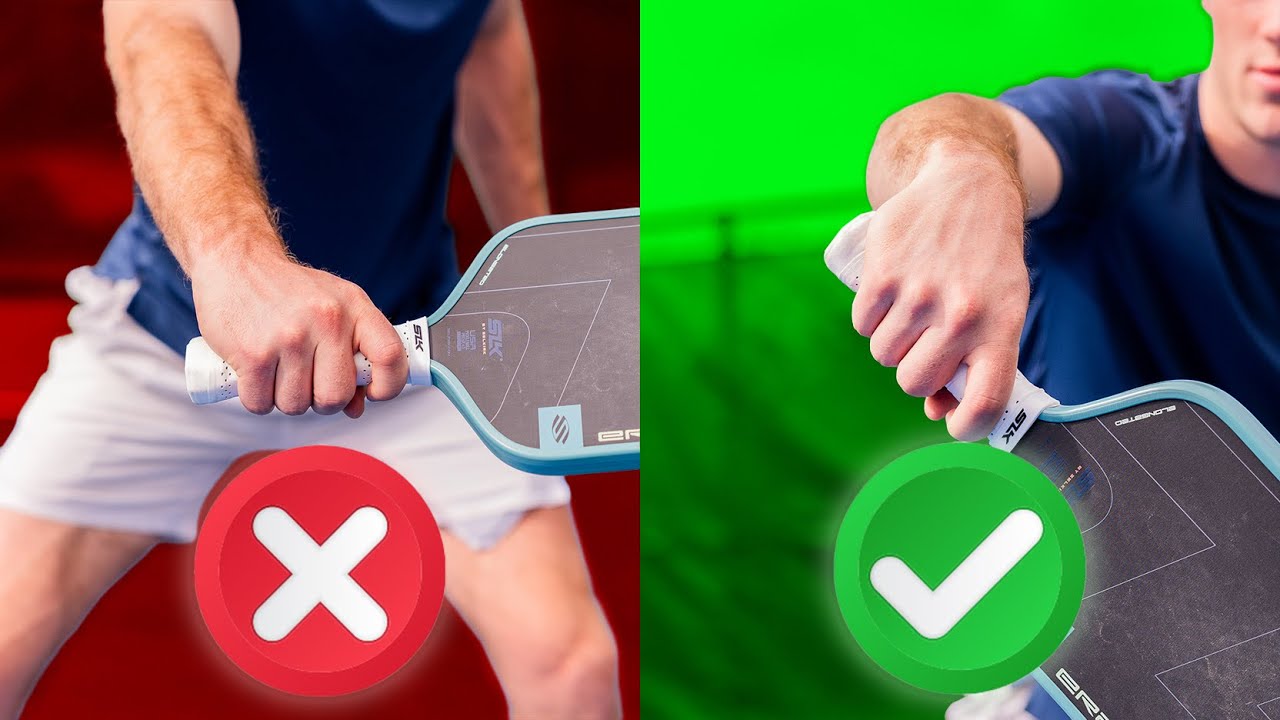
Start in the same ready position, but this time you're going to dip the paddle down and hold it there momentarily.
Then you're going to move forward, and as you do, your paddle closes slightly.
This attacking mindset is exactly what separates players who understand the dos and don'ts of attacking in pickleball from those who pop up easy balls.
The key is stopping your paddle in front of you with velocity. You're not following through wildly; you're controlling the finish.
Elliott describes it like this:
"Chuck the deck of cards. Chuck and stop."That's the motion.
- Quick
- Explosive
- Controlled
The wrist action on the flick is intentional. You're using it to create spin and pace, similar to how you'd flick a frisbee. But it's not a wild, uncontrolled motion.
It's purposeful and compact. The paddle stays in front of your body, and you're aiming for a specific target.
Players who have already dialed in their forehand flick mechanics will recognize this same "set and stop" principle on the backhand side.
One critical detail:
Keep your feet grounded. Don't come up on one leg.Stay on your toes, use your core and shoulders, and let your body do the work. Your paddle is the tool; your body is the engine.
Those who've studied how to develop faster hands in pickleball know that compact, grounded footwork is non-negotiable for shot control.
Mari Humberg’s Complete Guide to the Backhand Flick
Mari Humberg finally breaks down her signature backhand flick in a comprehensive video guide. Learn the grip, movement, positioning, and four key shot placements to master this finesse attack.
The Dink PickleballThe Dink Media Team
When Should You Actually Use Each Backhand Pickleball Shot?
This is where the real game sense comes in. The backhand roll is your go-to when you're in a neutral or defensive position.
You're trying to keep the ball deep, create spin, and set up your next shot. It's the shot you hit when you're not ready to attack yet.
Knowing when to stay patient versus when to pull the trigger is exactly what smart shot decisions in advanced pickleball are built on.
The backhand flick pickleball shot is for when you see an opportunity. Your opponent has hit a soft ball, and you can take it early and aggressively.
You're trying to win the point or at least force them into a weak response.
This is the attacking option, and it lines up perfectly with how top players attack the right spots on their opponents.
Elliott makes this distinction clear:
"The roll is a little more stagnant in terms of the motion. The flick, you're going to actually kind of use a little bit of the wrist."The roll is about consistency and control. The flick is about aggression and pace.
The Backhand Decision Tree: One Pro’s Real-Time Strategy for Cooking at the Kitchen
Zane Navratil has boiled the key steps for a successful backhand dink down to five critical questions he cycles through in real-time. Learn his framework and watch your shot selection – and winning percentage – improve dramatically.
The Dink PickleballAlex E. Weaver
What Is the Backhand Flick Pickleball Shot and Why Does It Work?
The backhand flick works because it converts a neutral ball into an offensive weapon.
It's the same mechanics behind the set and snap technique that pros use to destroy speed-ups and initiate attacks at the kitchen line.
When you can read an opponent's soft return and respond with a quick, controlled flick, you compress their reaction time.
That's the point.
It's also why players who've mastered the backhand decision tree at the kitchen rarely second-guess themselves.
They know their shot options before the ball even crosses the net.
How to Hit a Backhand Flick in Pickleball
The backhand flick is one of pickleball’s most dangerous offensive weapons, but most players never master it. Mari Humberg breaks down exactly how to hit a backhand flick with proper technique, grip selection, and court positioning.
The Dink PickleballThe Dink Media Team
The Common Mistakes That Sabotage Your Backhand
Most players make the same errors repeatedly.
- They don't bend their knees enough, which limits their ability to get under the ball.
- They position their paddle tip too high before contact, which forces them to come over the ball instead of under it.
- They use too much wrist on the roll, which creates inconsistency.
These are the same stubborn habits that cost players matches at every level.
On the flick, the mistake is often the opposite: not using enough wrist action or not stopping the paddle with velocity.
Players either follow through too much or don't commit to the aggressive motion.
The solution is deliberate practice. Hit rolls until the motion becomes automatic.
Your paddle does the work; your wrist stays relaxed. Then practice flicks with intention.
If you're not sure where to start, simple wall drills are one of the fastest ways to groove these mechanics without needing a partner.
7 Pickleball Mistakes Beginners Make Without Realizing
Most beginners struggle not because they lack power, but because they repeat the same pickleball mistakes over and over without realizing it. Pro player Michael Loyd reveals the seven habits quietly holding players back and exactly how to fix them.
The Dink PickleballThe Dink Media Team

How to Know if Your Backhand Flick Pickleball Mechanics Are Right
When your backhand roll is working, it feels rhythmic and compact. The ball goes deep with topspin.
You're not thinking about your wrist or your arm; you're just letting the paddle do the work.
Elliott describes it perfectly:
"Looks real rhythmic. Looks real compact."When your backhand flick is dialed in, you're hitting your targets. The ball has pace and control. You're not surprised by where it goes; you meant to hit it there.
You're finishing with velocity, and the motion feels explosive but controlled.
Players who've studied wrist lag in pickleball will recognize this feeling as the snap point where power and precision meet.
The biggest sign you've got it right? Your shots feel consistent.
You're not wondering if the ball will go in or where it will land. You know what you're doing, and your body executes it the same way every time.
That kind of shot-making consistency doesn't happen by accident.
How to Develop a Backhand Flick in Pickleball
Anna Bright went from zero one-handed ability to developing one of the best backhand flicks in women’s pickleball. Here’s exactly how she did it and how you can too.
The Dink PickleballThe Dink Media Team

Building Consistency Into Your Backhand Flick Pickleball Game
The path to mastery is straightforward: understand the difference, practice each shot separately, and then learn when to deploy each one.
Don't try to combine them.
Don't try to do both things at once. Master the roll first, then add the backhand flick pickleball shot to your arsenal.
Elliott's coaching approach is instructive here. She isolates each shot, breaks down the mechanics, and then has her student practice with intention.
Only after the fundamentals are solid does she move on to game situations and shot selection.
Pairing this kind of focused drilling with the 12 drills you need to play your best pickleball in 2026 will accelerate your progress on both shots.
Your backhand doesn't have to be a weakness. With the right mechanics and the right mindset, it becomes one of your most reliable weapons.
The backhand flick and roll are two distinct tools. Learn to use them both, and your game transforms.
💡
Need some new pickleball gear? Get 20% off select paddles, shoes, and more with code THEDINK at
Midwest Racquet SportsFrequently Asked Questions
What Is the Difference Between a Backhand Flick Pickleball Shot and a Backhand Roll?
The backhand flick pickleball shot is an attacking motion that uses intentional wrist action to generate velocity and pace. The backhand roll is a compact, controlled shot used for consistency and setup, relying on paddle brushwork and minimal wrist movement rather than explosive acceleration.
When Should I Use a Backhand Flick Instead of a Roll?
Use the backhand flick when your opponent hits a soft ball and you have a clear opportunity to attack. Use the backhand roll when you're in a neutral or defensive position and your priority is keeping the ball deep and setting up your next shot.
Why Does My Backhand Roll Feel So Inconsistent?
Most players struggle with the backhand roll because they don't bend their knees enough, position their paddle tip incorrectly, or use too much wrist. Focus on dropping your paddle, coming under the ball, and letting your core and shoulders generate power instead of your wrist.
How Do I Know If My Backhand Flick Pickleball Mechanics Are Correct?
Your backhand flick should feel explosive but controlled, finishing with your paddle stopped in front of your body. You're aiming for a specific target, the motion is compact, and the wrist action is intentional, similar to flicking a frisbee, not a wild swing.
Can I Use the Backhand Flick in Every Situation?
No. The backhand flick is an attacking shot best reserved for moments when you have a genuine opportunity to be aggressive. In neutral or defensive situations, the backhand roll is the smarter choice because it prioritizes control and consistency over pace.
Anuncie Aqui / Advertise Here
Sua marca para o mundo Pickleball! / Your brand for the Pickleball world!



 English (US) ·
  Portuguese (BR) ·